


Joseph R. Shaw: Residual FXa Inhibitor Levels Influence the Hemostatic Effect of 4F-PCC
Joseph R. Shaw, Director of Research Plus Program at Ottawa Department of Medicine, EHJ-CVP Associate Editor at European Heart Journal, shared a post on LinkedIn about a recent article he and his colleagues co-authored, published in Blood Advances, adding:
“I am happy to see the results of GAUGE published in Blood Advances.
It has been a long road—I began developing this study as a thrombosis fellow in 2020.
GAUGE prospectively evaluated the in vivo effects of four-factor prothrombin complex concentrate (4F-PCC; Octaplex) in 101 episodes of factor Xa inhibitor (FXaI)–associated major bleeding or urgent surgery.
4F-PCC did not reduce FXaI levels.
After accounting for the baseline FXaI level and the time elapsed between samples, the observed decline was explained by expected drug clearance rather than an effect of 4F-PCC.
This supports viewing 4F-PCC as a nonspecific prohemostatic agent—not a direct reversal agent that removes or neutralizes the anticoagulant.
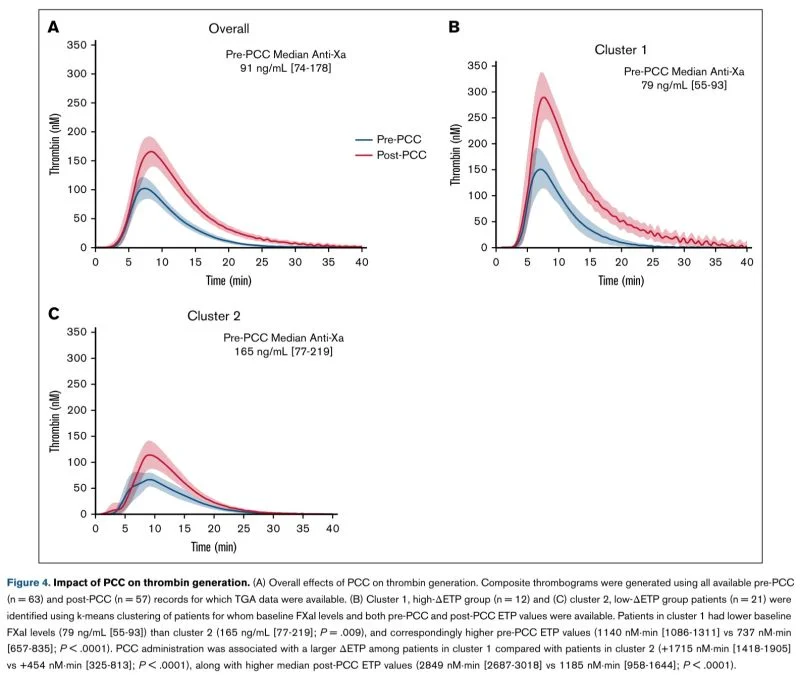
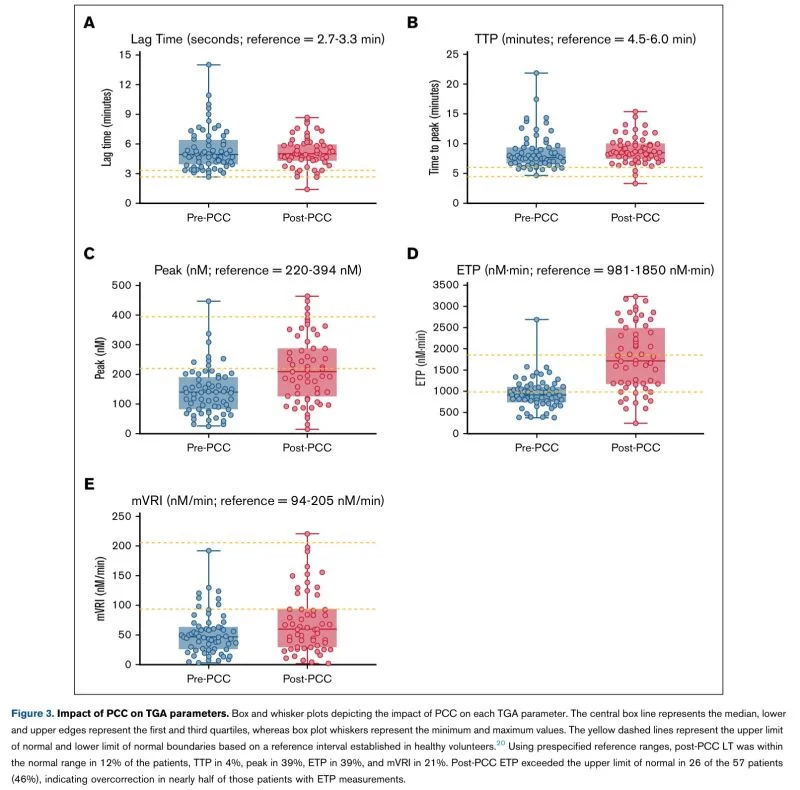
4F-PCC increased quantitative thrombin generation, including endogenous thrombin potential (ETP), peak thrombin, and mean velocity rate index.
However, it did not shorten lag time or time to peak.
In other words, 4F-PCC increased thrombin generation, while delayed coagulation initiation caused by residual FXa inhibition persisted.
Our exploratory k-means cluster analysis was not intended to define a treatment threshold, and a single hard FXaI cut-off applicable to every patient is unlikely to exist.
However, patients with lower baseline FXaI levels had a substantially greater increase in ETP after 4F-PCC than those with higher levels: plus 1715 versus plus 454 nM·min, with median baseline FXaI levels of 79 versus 165 ng/mL, respectively.
These in vivo findings build on prior in vitro results and support that the biological effects of 4F-PCC diminish as residual FXaI levels increase.
Overall, GAUGE provides important in vivo evidence that 4F-PCC can augment thrombin generation in FXaI-treated patients, but that its effect is incomplete and attenuated at higher residual drug levels.
The findings support a mechanistic, potentially more individualized approach to 4F-PCC use, while highlighting the need to determine which thrombin generation parameters best reflect net clinical hemostatic benefit.
Grateful to the entire GAUGE team: Hannah Gray, Yan Xu, Grégoire LE GAL, Tzu-Fei Wang, Roy Khalife, Deborah Siegal, Lana Castellucci, Aurelien Delluc, Matthieu Grusse, Patrick Van Dreden, Dr. Dar Dowlatshahi, Katryna Petersen, Hakan Buyukdere, Timothy Ramsay, and Marc Carrier—as well as our research staff, collaborators, and participating patients.
We are also grateful to the PSI Foundation for funding this project through a clinical research grant.”
Title: Effect of PCC on thrombin generation in patients on FXaI with bleeding or needing urgent surgery (GAUGE)
Authors: Joseph R. Shaw, Hannah Gray, Yan Xu, Grégoire Le Gal, Tzu-Fei Wang, Roy Khalife, Deborah M. Siegal, Lana A. Castellucci, Aurélien Delluc, Matthieu Grussé, Patrick Van Dreden, Dar Dowlatshahi, Katryna Petersen, Hakan Buyukdere, Timothy Ramsay, Marc Carrier
Stay updated on all scientific advances with Hemostasis Today.
-
Sep 21, 2026, 04:06Allison Lewin: How Gender Shapes the Way We Receive Medical Care
-
Sep 21, 2026, 03:49Jessica Lee: Walking Together for a Stronger Bleeding Disorders Community
-
Sep 21, 2026, 03:36Syed Asif Ali Shah: From Pakistan to Australia – A Clinical Haematology Milestone
-
Sep 21, 2026, 03:22Katie Baca-Motes: Estradiol Fluctuations May Help Explain Menstrual Migraine
-
Sep 21, 2026, 03:00Family History Can Reveal Hidden Risk of Aortic Dissection – The Marfan Foundation
-
Sep 21, 2026, 02:47Transitioning from Paediatric to Adult Haemophilia Care – Haemophilia Foundation Australia
-
Sep 21, 2026, 02:29Diana Castro Paupério: A New Era for Patient Blood Management
-
Sep 21, 2026, 00:29Iheanyichukwu Ike: Childhood Anaemia in Nigeria Through an Analysis of the 2018 NDHS
-
Sep 21, 2026, 00:27Nicole De Vita: The Global Burden of Iron Deficiency and Anemia in Women at SABM