

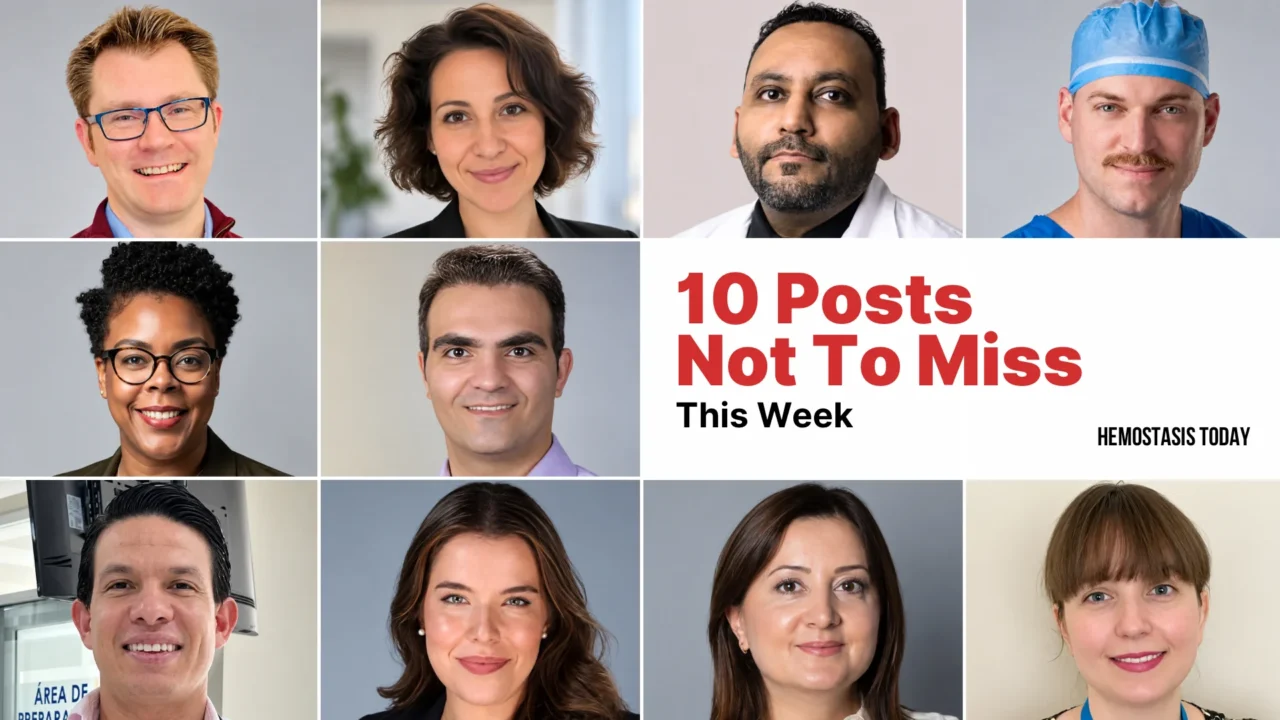
10 Posts Not to Miss This Week
This week’s hematology and hemostasis community highlights important developments across thrombosis, coagulation, platelet biology, iron deficiency, hemophilia and transfusion medicine.
From new evidence in pulmonary embolism and updated guidance on iron deficiency to advances in the diagnosis and management of HLH, several posts focus on evolving approaches that are shaping clinical practice and research.
At the same time, discussions on thromboinflammation, von Willebrand disease and platelet biology highlight the growing connections between coagulation, inflammation and vascular disease.
Beyond clinical advances, this week also brings attention to early-career development, scientific collaboration, blood donation and the importance of peer support within the hematology community.
Here are 10 posts worth catching up on this week – covering new evidence, clinical perspectives, educational opportunities and community developments across hematology and hemostasis.
Paul Armstrong, Lecturer in Pharmacology at Queen Mary University of London, Chair – Executive Committee of The Platelet Society։
”I’m honoured to share that I’ve taken on the role of Chair of the The Platelet Society.
I want to pay tribute to Amanda Unsworth, who has led the Society brilliantly over the past three years.
Her dedication and tireless work have strengthened our community, advanced platelet research, and left the Society in a fantastic position for what comes next.
Looking ahead, I want to highlight two of our priorities that are important to me.
First, supporting the development and training of our ‘early-career’ scientists, so they have the encouragement, opportunities and mentorship they deserve.
Second, raising awareness of the role platelets play in health and disease in order to help the wider public understand a field that touches so many lives.
What makes this Society particularly special is that nothing we do happens without the support of our generous, curious and incredibly collaborative community.
It is the work of our scientists, clinicians, trainees and patient advocates who work together to push the field forward.
I’m looking forward to the challenge ahead and to working with our community to grow the Society’s impact even further.”
Grace M Thomas, Tenured Researcher (CR) at INSERM U1263 – C2VN:
”We are delighted to invite you to the 3rd edition of the Neutrophil Club of the SFI French Society of Immunology Webinar Series, dedicated to the fascinating and rapidly evolving field of thromboinflammation.
Join us for two outstanding presentations by Prof. Dr. med. Steffen Massberg and Prof. Dr. Julie Rayes, who will explore the emerging roles of neutrophils in thrombosis and inflammation, and their complex interactions with platelets in disease.
Save the date and join us!
Free to attend but registration required.”
Shehab Mohamed, Hematologist at Hamad Medical Corporation:
”Here we go!
We share our newly published GCC consensus recommendations for the diagnosis and management of hemophagocytic lymphohistiocytosis (HLH) in Frontiers in Immunology.
This work represents the first GCC-specific consensus framework for HLH, developed to address the unique diagnostic and therapeutic challenges encountered across our region in both adult and pediatric patients.
A multidisciplinary panel of 15 experts representing all GCC countries evaluated 40 clinical statements using a modified Delphi approach. All 40 recommendations achieved consensus in the first round, with 80–100% agreement.
The recommendations emphasize early recognition of suspected HLH, appropriate use of HLH-2004 criteria and HScore alongside clinical judgment, parallel investigation for underlying triggers, early genetic assessment when indicated, individualized risk-adapted treatment, and timely referral to centers with ICU and transplant capabilities.
Importantly, the consensus provides a practical regional framework to help harmonize HLH recognition, treatment, referral, transplant planning, and coordination across GCC countries, while also identifying priorities for future regional research.
Many thanks to Dr. Mohamed A. Yasin and all colleagues across the GCC for their leadership, collaboration, and dedication to this important work.
It is rewarding to see expertise from across the region come together to advance the care of patients with HLH.
This publication represents another step in our ongoing work and interest in HLH.
We look forward to continuing our collaborative research and contributing further evidence to the HLH literature, particularly in regional epidemiology, genetics, treatment strategies, and clinical outcomes, with the ultimate goal of improving the recognition and management of this challenging syndrome.
Consensus recommendations for the diagnosis and management of hemophagocytic lymphohistiocytosis in the Gulf Cooperation Council: a modified Delphi approach”
Sebastian Mafeld, Interventional Radiologist, Radiology Site Director – Toronto Western Hospital at University Health Network, Associate Editor Canadian Association of Radiologists Journal at Canadian Association of Radiologists, Interventional Radiologist at Mount Sinai Hospital (Toronto), Sinai Health:
”I thought I understood where PE treatment was heading. Then 2026 happened.
Two randomized trials of catheter-directed thrombolysis (CDT) vs anticoagulation appeared in NEJM:
HI-PEITHO
PRAGUE-26
Both trials found lower rates of their respective early composite endpoints with CDT plus anticoagulation compared with anticoagulation alone (please see trials for details and make your own interpretation).But these studies have had me thinking: What should this data mean in 2026?
Technology in PE has evolved incredibly quickly.
Perhaps faster than our ability to work out exactly how best to use it.
There are still some fascinating considerations for CDT:
What if CDT could move out of the ICU?
Could treatment become shorter and use even less thrombolytic?
Can we identify patients who need immediate clot removal versus those in whom several hours of thrombolysis is acceptable?
Could advances in AI and PA waveform analysis during CDT offer new benefits?
Is a catheter needed at all? (some answers may come in PEITHO-3)
Two randomized trials have put CDT back into the conversation. I’ve had so many emails and questions about it.
We have more ways to treat PE than ever.
How should we choose between them?
Not medical advice or an endorsement of any treatment.”
Consuela A. Albright, Nurse Practitioner at Cleveland Clinic:
”Here’s a number worth sitting with: blood donors who are Black are almost three times more likely to be a close match for sickle cell patients than donors who aren’t – and that match quality matters enormously for people who need regular transfusions.
The American Red Cross Sickle Cell Initiative, launched in 2021, was built to close that gap.
Since launching, it has inspired more than 140,000 first-time African American blood donors, provided over 300,000 free sickle cell trait screenings to donors who self-identify as Black or multiracial, and invested over $200,000 in scholarships for high schoolers committed to supporting the sickle cell community.
Every September, the initiative expands its reach through partnerships with HBCUs, the National Pan-Hellenic Council, Inc., and organizations like the NAACP and 100 Black Men of America, Inc.
This is advocacy you can act on today, not just something to read about.
If you’re eligible, a single donation appointment is a direct, measurable contribution to someone’s sickle cell care.”
Omid Seidizadeh, Research Leader of the A. Bianchi Bonomi Hemophilia and Thrombosis Center:
”It was a great pleasure to speak on von Willebrand disease at the 59th NordCoag Congress at Karolinska University Hospital in Stockholm.
Many thanks to the organizers for the invitation and to all colleagues for the stimulating discussions.”
Luis Oliverio Ambriz Garcia, Doctor, Specialist in Internal Medicine at HRAEB, Chief Executive Officer of Memodi:
”Latest ASH guidelines (2026) on iron deficiency.
Key points:
Adult: ferritin 30 ng/mL or less, deficiency. Sensitivity 67%, specificity 96%. The threshold applies even without anemia; the diagnosis does not depend on hemoglobin.
With symptoms or persistent risk factor, the cutoff rises to 50 ng/mL or less. The cost is more false positives, so it’s best to use it in those with a real pretest probability.
Inflammation: ferritin plus TSAT, never ferritin alone. Applies in heart failure, CKD, IBD, cancer, and rheumatic disease. Diagnosis is considered with TSAT less than 20% or ferritin less than 100 ng/mL. TSAT should be taken after fasting for 5 to 9 hours and without iron supplements.
The lab’s ‘normal range’ is a problem. The lower limits for ferritin were set with a ‘seemingly healthy’ population that included people with deficiency. A ferritin of 18 marked as ‘normal’ on the report is still deficiency.
I’m going to finish reading them thoroughly to update the apps.”
Irem Karaman Sebin, Internal Medicine Resident at Florida International University – Herbert Wertheim College of Medicine:
”ASH 2026 changes a key concept in iron deficiency: don’t wait for anemia.
Ferritin less than or equal to 30 ng/mL now identifies iron deficiency in many adults, even with normal hemoglobin.
With inflammation: ferritin less than 100 ng/mL OR TSAT less than 20 percent.
Iron deficiency does not equal iron-deficiency anemia.
Earlier recognition may mean earlier intervention.”
Heghine Khachatryan, Co-Founder. Chef-in-Editor, Hemostasis Today at Hemostasis Today:
“Thrombophilia, APS and coagulation testing.
The second part of Professor Jeko Thachil’s lecture offered a focused analysis of thrombophilia, antiphospholipid syndrome and coagulation testing. Its central message was that laboratory investigations have value only when they answer a defined clinical question and are interpreted in context.
The lecture began with the regulation of thrombin. When thrombin binds thrombomodulin, it activates protein C; activated protein C, together with protein S, limits coagulation by inactivating factors Va and VIIIa. Deficiencies of protein C, protein S or antithrombin increase thrombotic susceptibility, but thrombosis usually results from interaction with acquired triggers such as surgery, immobility, pregnancy, inflammation, malignancy or hormonal therapy.
Factor V Leiden, the prothrombin G20210A variant and deficiencies of natural anticoagulants do not carry equal clinical significance. Their identification should not automatically determine indefinite anticoagulation. Management must also consider whether the event was provoked, its location, recurrence risk and bleeding risk.
Particular attention was given to patient selection and timing. Functional measurements of protein C, protein S and antithrombin may be distorted by acute thrombosis or anticoagulant therapy; testing at the wrong time can therefore create false diagnoses. MTHFR testing should not be included in routine thrombophilia panels because it provides no clinically useful information about venous thromboembolic risk.
Thrombosis at unusual sites, including cerebral or splanchnic veins, requires broader assessment for APS, JAK2-associated myeloproliferative neoplasms, paroxysmal nocturnal haemoglobinuria, malignancy and local factors.
The discussion of APS was especially relevant. It should be considered in younger patients with unexplained venous or arterial thrombosis, ischemic stroke, pregnancy morbidity or autoimmune disease. One positive antibody result is insufficient: diagnosis requires an appropriate clinical event and persistent laboratory positivity. Correct recognition may change treatment; in high-risk APS, particularly after arterial thrombosis, vitamin K antagonists remain the established therapy.
Finally, bleeding during anticoagulation should not be attributed only to the drug. Treatment may reveal a silent lesion, including malignancy; the bleeding source must therefore always be investigated.Thank you, Professor Jeko Thachil, for connecting complex haemostatic mechanisms with practical clinical reasoning.”
Emma Copperwaite, Clinical Consultant Scientist Trainee (HSST):
”Yesterday I presented for the first time at the British Blood Transfusion Society conference
I am incredibly grateful to have been given this opportunity.
Thank you Laura Eastwood for inviting me to speak.
It was scary, there were nerves.
However this was dampened by the incredible support, kindness and encouragement from my peers, audience and other incredible speakers.
Special thanks to Dr. Jayne Peters who had to listen to me practice more than once on the run up.
Do the scary thing, it may be more fun than you imagined.”
Stay updated with Hemostasis Today.
-
Sep 20, 2026, 12:11Giacomo Buso: Silent Atherosclerosis Begins Earlier Than Expected
-
Sep 20, 2026, 11:27Edward Lee Carter: Prasugrel Dosing Matters in P2Y12 Inhibitor Comparisons After PCI
-
Sep 20, 2026, 09:51Ceasovschih Alexandr: A Closer Look at Lipid Disorders in CKM Syndrome
-
Sep 20, 2026, 09:05World Stroke Academy: Can Adjunct IAT Improve Tissue Reperfusion?
-
Sep 20, 2026, 06:46Neeraj Songara: From Donated Blood to Engineered Therapeutics
-
Sep 20, 2026, 06:24Louise St. Germain Bannon: Improving Awareness and Care for Women Across the Lifespan
-
Sep 20, 2026, 05:17Maxime Dely: When ABO Compatibility Isn’t Enough for Safe Transfusion
-
Sep 20, 2026, 04:54William Aird: What Does a Complete History and Physical Really Mean?
-
Sep 20, 2026, 04:34Hons Saurabh Kaushik: Why Uncontrolled LDL Can Be Harmful