


Manuel De Jesus: Validating the Future of Point-of-Care Anemia Monitoring
Manuel De Jesus, Trainee in Polymer Sciences and Advanced Materials at the Center for Graduate Studies and Research in Chemistry (CGIQ), shared a post on LinkedIn about a recent article he and his colleagues co-authored, adding:
”Scientific advancement depends not only on developing new technologies, but also on validating and verifying their performance to ensure reliable, accurate, and reproducible results in real-world applications.
I’m pleased to share the publication of our scientific work:
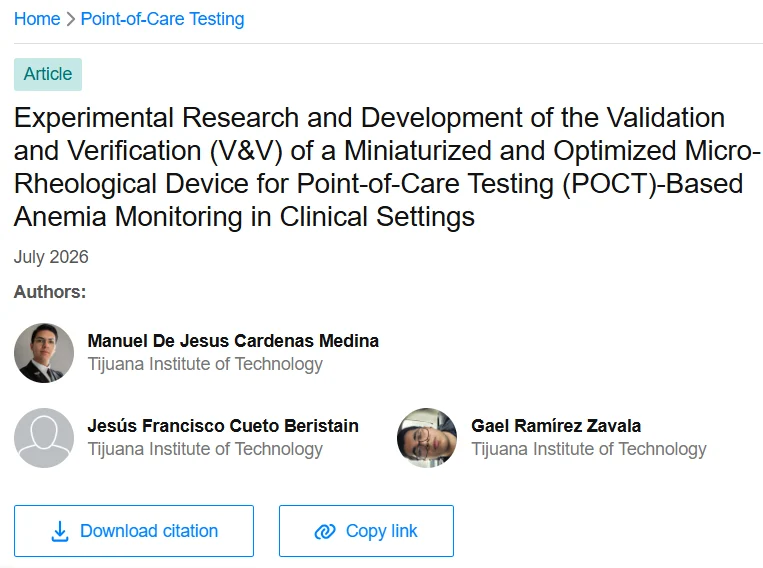
‘Experimental Research and Development of the Validation and Verification (V&V) of a Miniaturized and Optimized Micro-Rheological Device for Point-of-Care Testing (POCT)-Based Anemia Monitoring in Clinical Settings.’ — July 2026
This work presents the experimental validation and verification of a miniaturized micro-rheological device developed for point-of-care hematocrit assessment and anemia monitoring in clinical settings.
The proposed system exploits the relationship between whole-blood viscosity and hematocrit, integrating controlled microfluidic flow with a calibrated visual interpretation method to obtain quantitative results. A structured V&V framework was implemented to evaluate mechanical, thermal, and fluidic stability, as well as analytical performance against the conventional centrifugation-based reference method.
Experimental evaluation demonstrated a strong agreement with the standard method, achieving high precision, repeatability, and operational stability across clinically representative samples. These results support the potential of the proposed technology as a simplified, reliable, and scalable approach for rapid hematocrit estimation and point-of-care applications.
The development and validation of miniaturized diagnostic technologies represents an important step toward making clinical testing more accessible, efficient, and adaptable to decentralized healthcare environments.
From experimental research to technological validation, engineering innovation becomes meaningful when it contributes to better and more accessible healthcare.
Engineering innovation begins with transforming scientific research into reliable solutions for real-world challenges.”
Title: Experimental Research and Development of the Validation and Verification (V&V) of a Miniaturized and Optimized Micro-Rheological Device for Point-of-Care Testing (POCT)-Based Anemia Monitoring in Clinical Settings
Authors: Manuel De Jesus Cardenas Medina, Jesús Francisco Cueto Beristain, Gael Ramírez Zavala
Stay updated on all scientific advances with Hemostasis Today.
-
Sep 29, 2026, 11:21Richard Davis: Rapid Rescue in Massive Pulmonary Embolism
-
Sep 29, 2026, 11:14Nissan Brown: Every Step Counts for the Hemophilia Community
-
Sep 29, 2026, 11:03Zain Khalpey: SINGLE AF Adds New Evidence to the Anticoagulation Debate
-
Sep 29, 2026, 10:54How Does Haemophilia Affect Motor Development in Infants? – EAHAD
-
Sep 29, 2026, 10:49Alison Davey: The Vital Role of Community Support in Bleeding Disorders
-
Sep 29, 2026, 10:36Abdul Muqtadir Abbasi: 5 Questions to Ask When the CBC Is Abnormal
-
Sep 29, 2026, 10:28Manu Morales Sánchez: DOACs in Intermediate Risk Atrial Fibrillation
-
Sep 29, 2026, 09:59William Sauer: Ablation in Patients With LAAO Devices
-
Sep 29, 2026, 03:53Nahrwan Masaoodi: Iron Deficiency Can Exist Without Anemia