


Ney Carter Borges: Intensive LDL-C Lowering and Coronary Plaque Regression
Ney Carter Borges, Member Cardiologist of Global Physician Association at Cleveland Clinic Florida, shared a post on LinkedIn:
“Intensive LDL-C Lowering and Coronary Plaque Regression
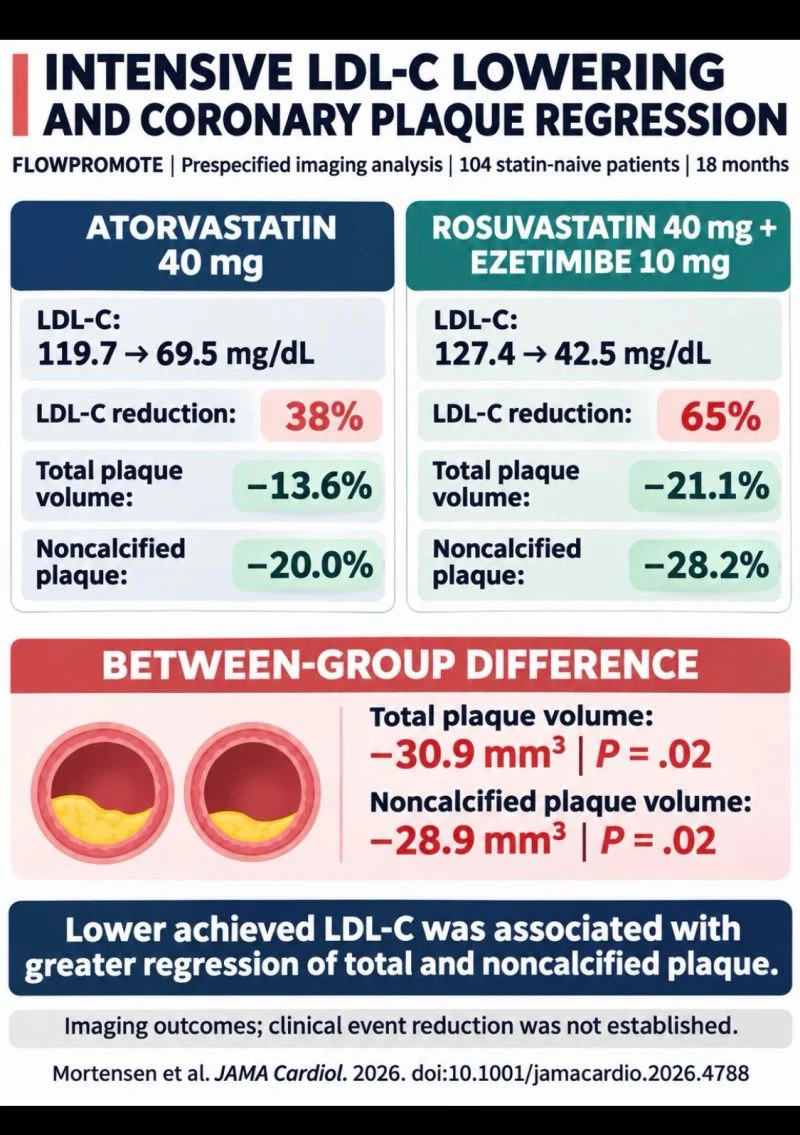
The FLOWPROMOTE trial provides evidence that intensive LDL-cholesterol lowering can promote regression of coronary atherosclerosis in patients with stable coronary artery disease.
This secondary analysis included 104 statin-naive patients with obstructive disease, defined by coronary stenosis greater than 50% and FFR-CT of 0.80 or less.
Participants were randomized to atorvastatin 40 mg daily or rosuvastatin 40 mg plus ezetimibe 10 mg daily, with coronary CT angiography at baseline, 9 months, and 18 months.
At 18 months, LDL-C fell from 119.7 to 69.5 mg/dL with atorvastatin and from 127.4 to 42.5 mg/dL with combination therapy, corresponding to reductions of 38% and 65%, respectively.
Total plaque volume decreased by 13.6% with atorvastatin and 21.1% with rosuvastatin plus ezetimibe; the between-group difference was 30.9 mm³ in favor of combination therapy (95% CI, 4.5–57.2 mm³; P = .02).
Noncalcified plaque volume declined by 20.0% and 28.2%, respectively (between-group difference, 28.9 mm³; 95% CI, 4.6–53.2 mm³; P = .02).
Calcified plaque volume increased similarly in both groups.
Lower achieved LDL-C levels were associated with greater regression of total and noncalcified plaque.
These findings suggest that coronary atherosclerosis is partly modifiable and that achieving lower LDL-C may enhance plaque regression.
However, the study was small, enrolled patients with obstructive disease, and assessed imaging rather than cardiovascular events.
Therefore, it does not establish that the observed plaque changes reduce myocardial infarction or mortality, nor define an LDL-C threshold for regression.
Larger outcome trials are needed to determine the clinical significance and generalizability of these results.”
Stay updated with Hemostasis Today.
-
Nov 6, 2026, 14:57Rahul Thakur: Pretransplant Biomarkers Linked to Post Transplant GVHD and Survival at ASH 2026
-
Nov 6, 2026, 14:46ASH 2026 Outlines Visa Guidance and Flexible Registration for International Attendees
-
Nov 6, 2026, 14:34William Wallace: Visceral Fat Drives the Broadest Inflammatory Protein Signature Among Cardiometabolic Traits
-
Nov 6, 2026, 14:28Akshat Jain: Completing a Milestone Speaker Circuit with Gene Therapy and VWD Presentations at ASH 2026
-
Nov 6, 2026, 14:23Anirban Sen Gupta: Bridging Therapeutics and Diagnostics for the Future of Precision Transfusion
-
Nov 6, 2026, 14:18Ravi K. Gupta: Hematologic Care and Venous Thromboembolism Management for Transgender Patients
-
Nov 6, 2026, 14:12When Platelets Cannot Support Thrombin Generation: The Hidden Dimension of Bleeding Disorders
-
Nov 6, 2026, 14:10Irish Blood Transfusion Service: Exploring Red Blood Cells
-
Nov 6, 2026, 14:02Jeff June: Spaceflight Microgravity Unlocks New Insights Into Rare Pediatric Heart Disorders