


Paris Margaritis: Assays vs Outcomes – Connecting FVIII Expression to Bleeding Phenotype in Hemophilia A
Paris Margaritis, Chief Scientific Officer at GeneVentiv Therapeutics, Inc, shared on LinkedIn about a recent article by Anna R Sternberg et al, published in Blood, adding:
“A recent paper in Blood by Sternberg and colleagues caught my attention.
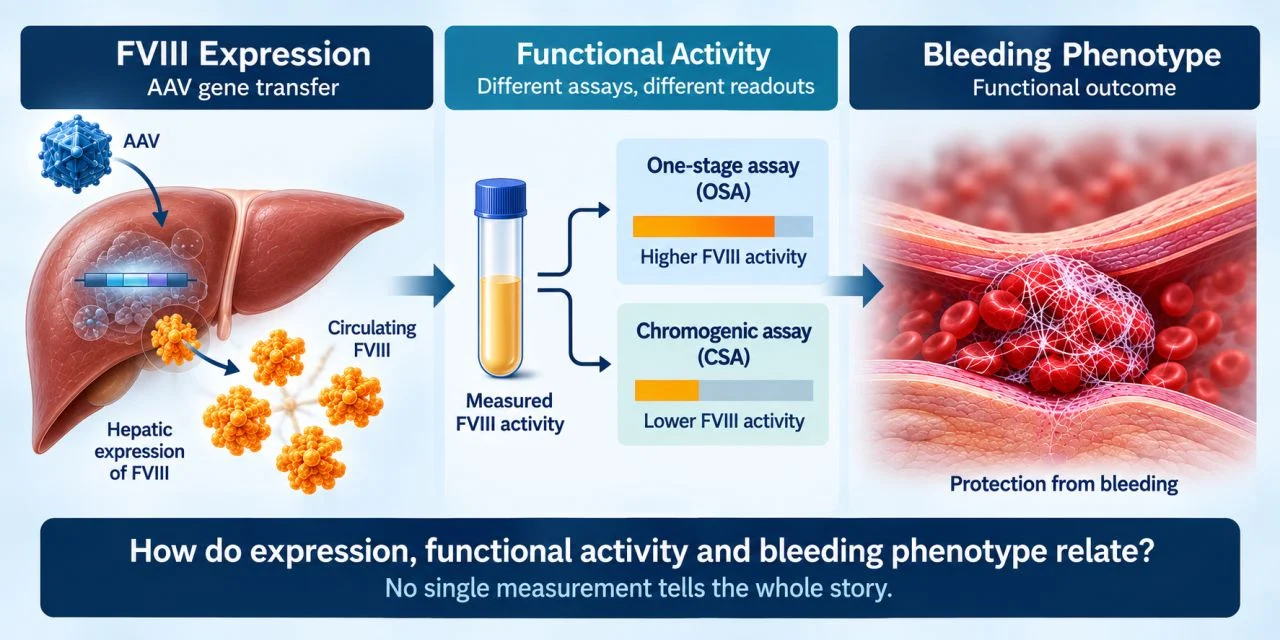
The authors examined the longstanding discrepancy between one-stage and chromogenic FVIII assays following AAV gene transfer and provide evidence that the higher one-stage activity reflects a biological property of AAV-derived FVIII-SQ (enhanced activation by thrombin) rather than simply an assay artifact.
This is significant work that begins to provide a biological explanation for a longstanding observation in clinical FVIII gene therapy.
The question is:
What does measured FVIII activity tell us about actual protection from bleeding?
Years ago, we approached the activity-versus-phenotype question in hemophilia A rats using both AAV-mediated FVIII gene transfer and FVIII protein infusion.
Because these animals develop spontaneous bleeds, we could relate circulating FVIII activity to actual bleeding risk across both approaches.
Increasing FVIII activity was associated with progressively greater protection from bleeding.
Looking back at those experiments now, the new study adds a very interesting dimension: how does the way we measure FVIII activity influence our interpretation of the relationship between factor activity and bleeding phenotype?
But there is also a broader principle here:
For hemostatic gene therapy, no single measurement tells the whole story.
Expression, functional activity and bleeding phenotype need to be understood together.
That principle is very relevant to how we think about GENV-HEM at GeneVentiv Therapeutics, Inc.
With liver-directed expression of activated Factor V, we are interested not only in transgene expression, but in how that expression translates into measurable hemostatic activity and the resulting bleeding phenotype.
Taken together, these different measures give us a more complete picture of what a gene therapy is actually doing.
A very interesting study and another reminder that the biology behind the number matters.
Congratulations to the team, led by my former CHOP/Penn colleague Lindsey George”
Title: One-stage Assay Factor VIII Activity Reflects AAV-Derived Factor VIII–Enhanced Thrombin Activation and Predicts Phenotype
Authors: Anna R Sternberg, Connor T Watson, Robert J Davidson, Marianne Uguen, Anna Kiialainen, Lindsey A George
Stay updated on all scientific advances with Hemostasis Today.
-
Oct 9, 2026, 00:39Rodrigo Arreola Diaz: The Rise of Concizumab for Hemophilia A and B
-
Oct 8, 2026, 23:27Shayan Mohammadmoradi: Happy to Be Back at the Midwest Platelet Conference for Its 20th Meeting
-
Oct 8, 2026, 23:18Lorena Arranz: Honoured to Contribute to the 6th Global MPN Symposium
-
Oct 8, 2026, 23:06Denis Oduor: Serving Citizens and Saving Lives Through Blood Donation During National Customer Service Week 2026
-
Oct 8, 2026, 22:51Jan Hartmann: Speaking on Global Trends in Plasma Collection at the 50th Meeting of the Japanese Society of Blood Services
-
Oct 8, 2026, 22:49Akshat Jain: Proud to Announce the Publication of Advances in Sickle Cell Disease
-
Oct 8, 2026, 22:49Ed Shovelin: Extending the Platelet Aggregation Testing Window to 72 Hours
-
Oct 8, 2026, 22:48Abdulla A. Damluji: Anticancer Drugs and Thrombosis Mechanisms, Risk Factors, and Prevention
-
Oct 8, 2026, 22:46Miguel Escobar: My Research on Oral Health and Hemophilia