


Platelets Journal: Glycocalicin Accumulation Within Thrombi Reveals Species-Specific Mechanisms
Platelets Journal shared a post on LinkedIn about a recent article by Caitlin Debaene et al, adding:
“Recently published in Platelets!
‘Glycocalicin is contained inside the thrombus’ by Caitlin Debaene, et al. (2026).
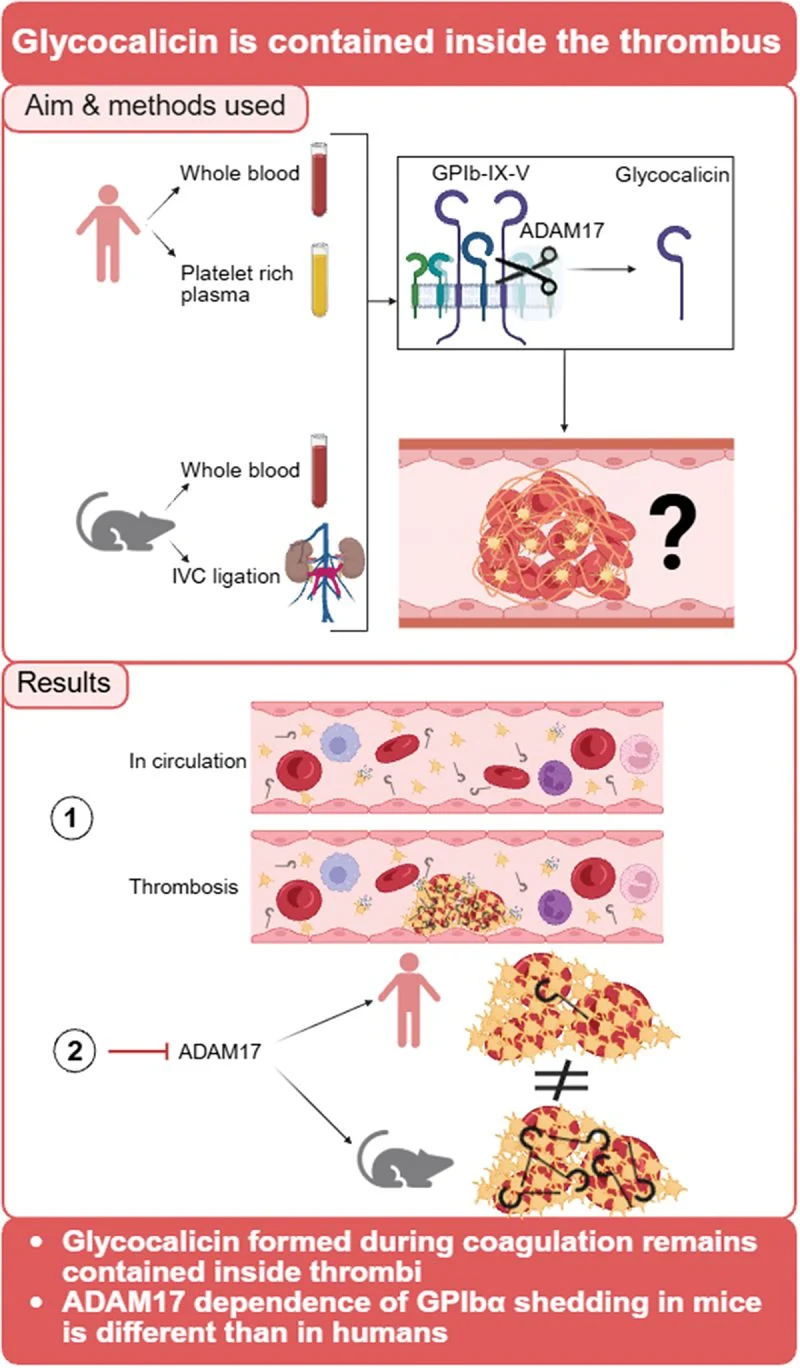
ADAM17 sheds GPIbα to release glycocalicin, but this process takes place over hours, and therefore, it is unknown whether this fragment is retained in a clot.
Debaene and colleagues measured glycocalicin using an in house ELISA in in vitro thrombi and an inferior vena cava (IVC) ligation model, testing ADAM17 dependence with inhibitors and platelet specific Adam17 knockout mice.
Glycocalicin accumulated inside thrombi throughout: 4.0 plus minus 0.8 vs 1.0 plus minus 0.1 µg mL in surrounding serum for human whole blood (p equal .0001), and 135.1 plus 44.3 vs 8.2 plus 1.0 µg mL after IVC ligation, with no rise in the circulation.
Notably, a species specific difference emerged with further testing.
ADAM17 inhibition halved glycocalicin in human thrombi (1.6 plus minus 0.5 to 0.8 plus minus 0.1 µg mL; p low .0001), while in mice neither inhibitors nor knockout reduced intrathrombic levels, despite that knockout dropping steady state plasma glycocalicin five fold (1.3 plus minus 0.5 vs 7.1 plus minus 2.6 µg mL).
The authors cite glycocalicin’s 7.8 nm radius against a thrombus core impermeable above 6.4 nm, and propose enzymatic redundancy in mice, ADAM10 being the candidate their inhibitors cannot exclude.”
Title: Glycocalicin is contained inside the thrombus
Authors: Caitlin Debaene, Katrijn R. Six, Sarah Vertongen, Carine De Buck, Hendrik B. Feys
Stay updated on all scientific advances with Hemostasis Today.
-
Nov 21, 2026, 03:45Aref Ghanaatpisheh: The Role of Systemic Inflammation in Preoperative Deep Vein Thrombosis Risk Assessment
-
Nov 21, 2026, 03:43Dimitrios Hatzichristou: Advancing Standardization and Quality Control in Platelet-Rich Plasma Therapy
-
Nov 21, 2026, 03:15Amirabbas Sheykhalo: Silent Mesenteric Ischemia in Portomesenteric Thrombosis
-
Nov 21, 2026, 02:51Ivone Su: Raising Awareness of Venous Thromboembolism
-
Nov 21, 2026, 02:40Aniqa Gohar: One Heart Conclave – Advancing Integrated Thrombosis Care
-
Nov 20, 2026, 17:27Adam Bryant: Great Science, Valuable Connections and a Wonderful Haematology Community at Blood 2026
-
Nov 20, 2026, 17:25Gurpreet Kaurr: Scientific Discussions, New Perspectives and Inspiration at HAEMATOCON 2026
-
Nov 20, 2026, 17:24Bispecific FVIIIa-Mimetic Antibodies in Haemophilia A – CRH French Reference Center for Hemophilia Lyon
-
Nov 20, 2026, 17:23Khalid Rehman: Psychosocial Burden Among Caregivers of Patients with Beta-Thalassemia Major in Pakistan