


PAI-1 Deficiency and Its Distinct Bleeding Phenotype – RPTH Journal
RPTH Journal shared a post on LinkedIn by Bauke Haisma et al, adding:
”PAI-1 deficiency: what does the bleeding phenotype reveal about this rare disorder?
PAI-1 deficiency is a rare bleeding disorder with a distinct bleeding phenotype, yet pathogenic SERPINE1 variants have only sporadically been reported in affected patients.
A new study in RPTH Journal characterizes the phenotype and fibrinolytic profile of patients with PAI-1 deficiency or isolated hyperfibrinolysis from the RBiN cohort.
Key findings from the RBiN study:
- Patients with PAI-1 deficiency or isolated hyperfibrinolysis showed a distinctly increased plasmin generation profile
- The bleeding phenotype was distinct from other rare bleeding disorders
- Pathogenic SERPINE1 variants were rarely identified, suggesting that non-coding, regulatory, and epigenetic mechanisms may underlie many cases
- Future genotyping of PAI-1 deficiency should therefore extend beyond coding sequences
These findings refine the laboratory and clinical picture of PAI-1 deficiency and point the way toward broader genetic exploration, including regulatory and epigenetic mechanisms, in patients with unexplained hyperfibrinolysis.”
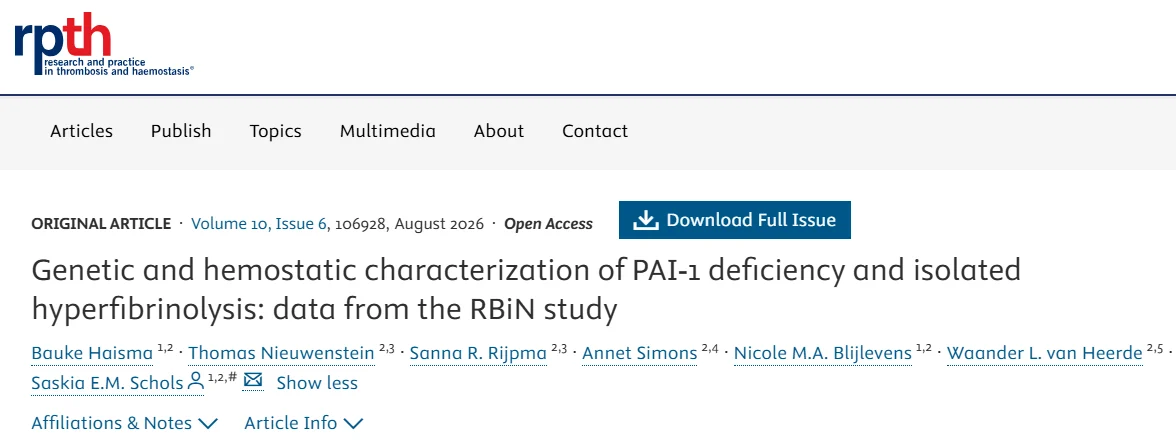
Title: Genetic and hemostatic characterization of PAI-1 deficiency and isolated hyperfibrinolysis: data from the RBiN study
Authors: Bauke Haisma, Thomas Nieuwenstein, Sanna R. Rijpma, Annet Simons, Nicole M.A. Blijlevens, Waander L. van Heerde, Saskia E.M. Schols
More posts featuring RPTH Journal on Hemostasis Today.
-
Nov 29, 2026, 03:19Explore the Evolving Role of Anti-TFPI Agents in Achieving Hemostatic Balance – ISTH
-
Nov 29, 2026, 03:14Zeinab Bidel: Blood Pressure Lowering Reduces Cardiovascular Risk Across All Baseline Risk Levels
-
Nov 28, 2026, 17:22Ahmed Fawzy: First Paediatric Right Atrial Thrombosis Case Treated Using AlphaVac at KFSH-JED
-
Nov 28, 2026, 17:21Antiplatelet vs Anticoagulation after Ischemic Stroke in Active Cancer Patients – International Journal of Stroke
-
Nov 28, 2026, 17:19Kemal Karaagac: Hemorrhagic Transformation Predicts Poor Outcomes After Breakthrough Ischemic Stroke
-
Nov 28, 2026, 17:19Aniqa Gohar: Ferozsons Laboratories and Pakistan Cardiac Society Join Hands for Thrombosis Mastery
-
Nov 28, 2026, 17:18Faruk Danış: Appointed to the Editorial Review Board of Clinical and Applied Thrombosis/Hemostasis
-
Nov 28, 2026, 17:18Salih Ehsan: Solving the Complex Puzzle of Hemoglobinopathies
-
Nov 28, 2026, 17:17Tushar Chauhan: Karyotyping vs FISH – Which One Wins the Diagnostic Race?