

Tushar Chauhan: Karyotyping vs FISH – Which One Wins the Diagnostic Race?
Tushar Chauhan, Founder and Scientist at Genetic Education Academy, shared a post on LinkedIn:
“Karyotyping vs FISH: Which one wins the diagnostic race?
You might expect FISH to win because it is faster, targeted and can detect abnormalities even in non-dividing cells.
But trust me, the results are more interesting than that!
I spent some time reading a research paper comparing conventional karyotyping and FISH in 201 patients with different hematological malignancies.
Here is what the researchers found:
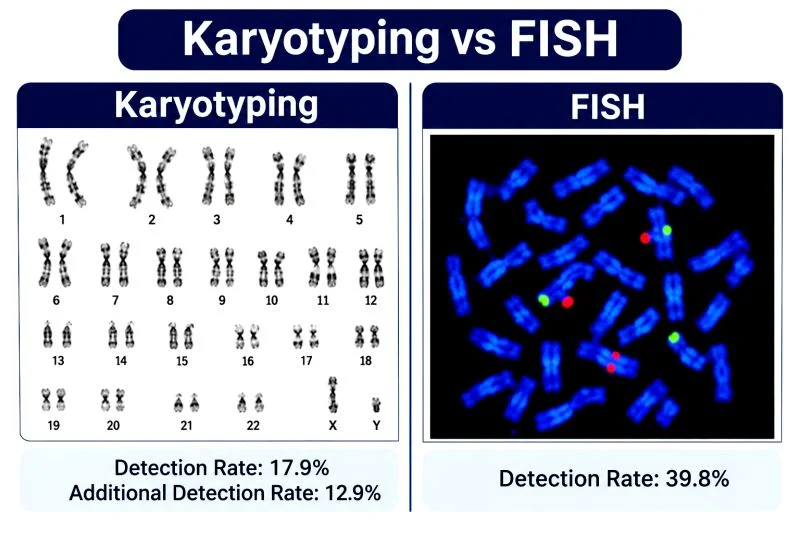
- FISH detected chromosomal abnormalities in 39.8% of cases.
- Conventional karyotyping detected abnormalities in 17.9% of cases.
At first glance, FISH clearly appears to be the winner.
But there is another finding worth looking at.
Karyotyping identified additional chromosomal abnormalities in 12.9% of patients that were not detected by the targeted FISH panel.
Now, why does this happen?
FISH is a targeted technique. It looks for specific chromosomal abnormalities using selected probes. It is very useful when we already know which genetic changes we are looking for.
Karyotyping, on the other hand, provides a broader view of the entire chromosome complement. It can identify numerical and structural abnormalities beyond the specific targets included in a FISH panel.
Meaning,
A higher detection rate does not necessarily mean that one technique can replace the other.
FISH may detect more abnormalities in certain hematological malignancies, while karyotyping can reveal additional findings that targeted FISH panels may miss.
So, the key takeaway is that these techniques should be considered complementary to each other rather than replacements for one another.”
Stay updated with Hemostasis Today.
-
Nov 28, 2026, 17:15Asma Anjum: When to Start Anticoagulation After Ischemic Stroke in Atrial Fibrillation
-
Nov 28, 2026, 17:14Daniel Jenniches: Anticoagulation Reversal in Traumatic Isolated Parafalcine Subdural Hematoma
-
Nov 28, 2026, 17:12Matthew Hazell: Challenging Unnecessary Transfusion Requests – Empowering Laboratory Professionals
-
Nov 28, 2026, 17:11Sharjeel Haider: Ischemic and Bleeding Outcomes With Prolonged DAPT After PCI
-
Nov 28, 2026, 16:59Mohamed Hemida: Coronary Stent Thrombosis in Cancer Patients Undergoing PCI
-
Nov 28, 2026, 16:45Aravind Palraj։ Low Platelets In Lupus Do Not Always Mean ITP
-
Nov 28, 2026, 16:36Chokri Ben Lamine: Understanding HIT and DITP Through Clinical Features, Diagnosis and Management
-
Nov 28, 2026, 15:24Seyed Mohammad Sadegh Pezeshki: Characterizing Platelet Adhesive Dysfunction in Chronic ITP
-
Nov 28, 2026, 14:52Peter A. Everts: PRP Variability and the Path Toward Precision Orthobiologics