

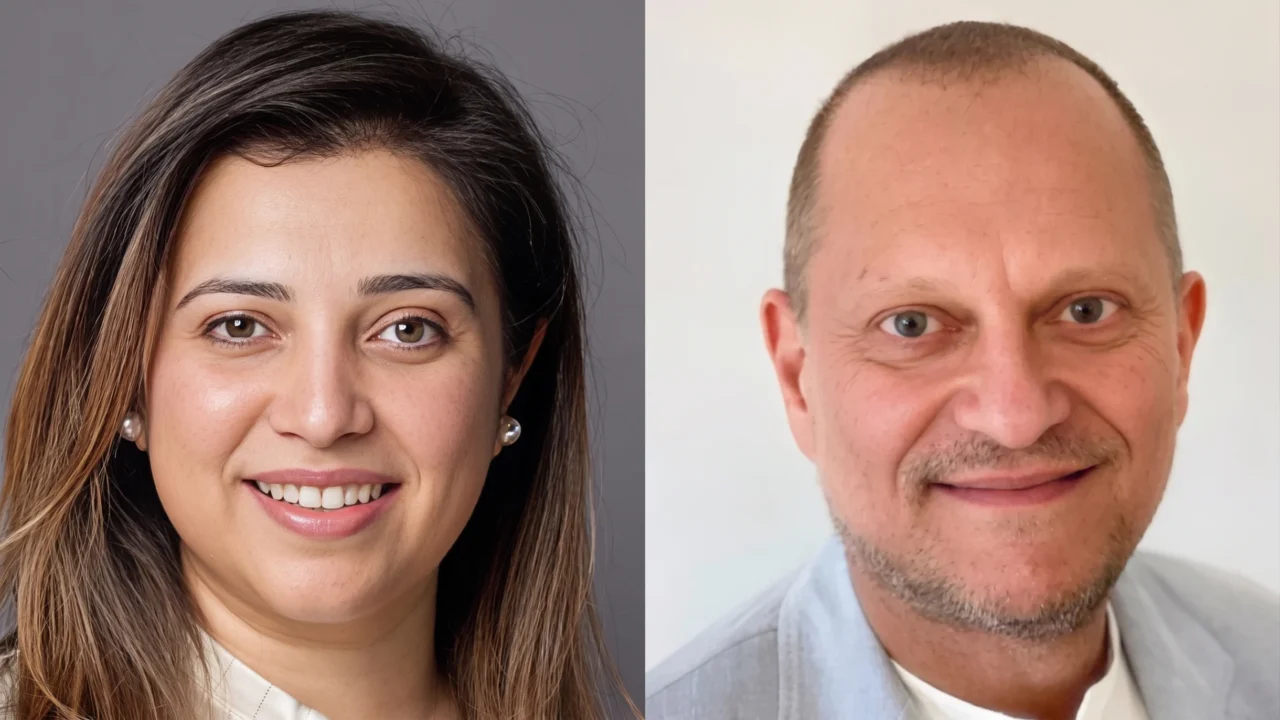
Satarupa Choudhuri: Personalizing Anticoagulation Duration After VTE
Satarupa Choudhuri, Deputy Clinical Director of Haematology, Rheumatology, Acite Oncology and Immunology at Northern Care Alliance NHS Foundation Trust, shared Miroslaw Bober‘s post on LinkedIn about a recent article she and her colleagues co-authored, published in JTH, adding:
“How long should you treat venous thromboembolism (VTE)?
Not simply 3–6 months or indefinitely. The real challenge is balancing the risks of recurrent clots and bleeding.
Our two new JTH papers provide complementary dynamic risk prediction tools for recurrences and bleeding to support personalised treatment decisions throughout the VTE journey.”
Miroslaw Bober, Professor of Video Processing and Machine Learning at University of Surrey, shared a post on LinkedIn about a recent article, he and his colleagues co-authored published in JTH, adding:
“I am delighted that our two complementary studies on recurrent venous thromboembolism (rVTE) and clinically significant bleeding (CSB) have now been published in the Journal of Thrombosis and Haemostasis.
A central challenge in thrombosis care is determining how long anticoagulation treatment should continue after a VTE event.
The decision requires balancing the risk of recurrent thrombosis against the risk of bleeding, both of which can change substantially over time.
In these studies, we developed two dynamic and clinically interpretable risk prediction models that quantify these competing risks and support more personalised assessment of anticoagulation benefit and risk.
The analyses drew on more than 20 years of CPRD data covering approximately 16 million patient records, from which a cohort of over 50,000 VTE patients was identified and followed longitudinally.
What struck me most was the durability of the models.
While we expected dynamic risk assessment to improve prediction by updating patient risk profiles over time, it was still remarkable to observe reliable prediction of both recurrence and bleeding risk extending up to 10 years after the index VTE event.
The findings reinforce how heterogeneous VTE patients are and highlight the need to move beyond simple ‘low-risk’ and ‘high-risk’ classifications towards truly individualised risk assessment.
Many thanks to all co-authors and collaborators from the NHS, academia, industry, and ForecomAI who made this work possible.”
Title: A novel dynamic risk score to predict clinically significant bleeding after 3 months of anticoagulation in patients with incident venous thromboembolism and without active cancer
Authors: Satarupa Choudhuri, Alexander T. Cohen, Imran Khan, Kevin G. Pollock, Mikel Bober-Irizar, Zbigniew Galias, Amaia Irizar, Miroslaw Bober
Title: A novel dynamic risk score to predict venous thromboembolism recurrences after 3 months of anticoagulation in patients with incident venous thromboembolism and without active cancer
Authors: Alexander T. Cohen, Satarupa Choudhuri, Imran Khan, Kevin G. Pollock, Mikel Bober-Irizar, Zbigniew Galias, Amaia Irizar, Miroslaw Bober
Stay updated on all scientific advances with Hemostasis Today.
-
Oct 5, 2026, 22:34Hasan Abbas Zaheer: Honoured to Have Co-Authored One of the Four Reviews in The Lancet Thalassemia Series
-
Oct 5, 2026, 22:34Kamyar Shameli: Understanding the Coagulation Cascade – How Anticoagulants Prevent Blood Clots
-
Oct 5, 2026, 22:31Risika Samanta: Pediatric ITP in a 12-year-old – An Atypical Presentation without a Viral Prodrome
-
Oct 5, 2026, 22:25Allie Boutin: Raising Awareness and Supporting the Community During ITP Awareness Month
-
Oct 5, 2026, 15:31Irma Bagdoniene: Multidisciplinary Management of High-Risk Familial Hypercholesterolaemia and CAD
-
Oct 5, 2026, 15:00Serena Williams and Pulmonary Embolism: From Personal Crisis to Lessons in Venous Thromboembolism
-
Oct 5, 2026, 14:55Marco Moscarelli: 3D Reconstruction Enhances Volumetric Assessment of Post-TAVI Thrombosis
-
Oct 5, 2026, 13:24Abdul Muqtadir Abbasi: Diagnostic Pearls for Evaluating Isolated Thrombocytopenia in Residents
-
Oct 5, 2026, 13:16Katerina Pavenski: Rethinking What ‘Normal’ Means for Iron Deficiency