


Seyed Mehrab Safdari: Factor VII Padua and the Limits of FVII Activity
Seyed Mehrab Safdari, Molecular Laboratory Technician at Tehran University of Medical Sciences, shared a post on LinkedIn about a recent article he and his colleagues co-authored, published in Annals of Hematology, adding:
“In my previous post, I shared findings from our cohort on Factor VII Padua, particularly the marked differences in FVII activity depending on the thromboplastin reagent used.
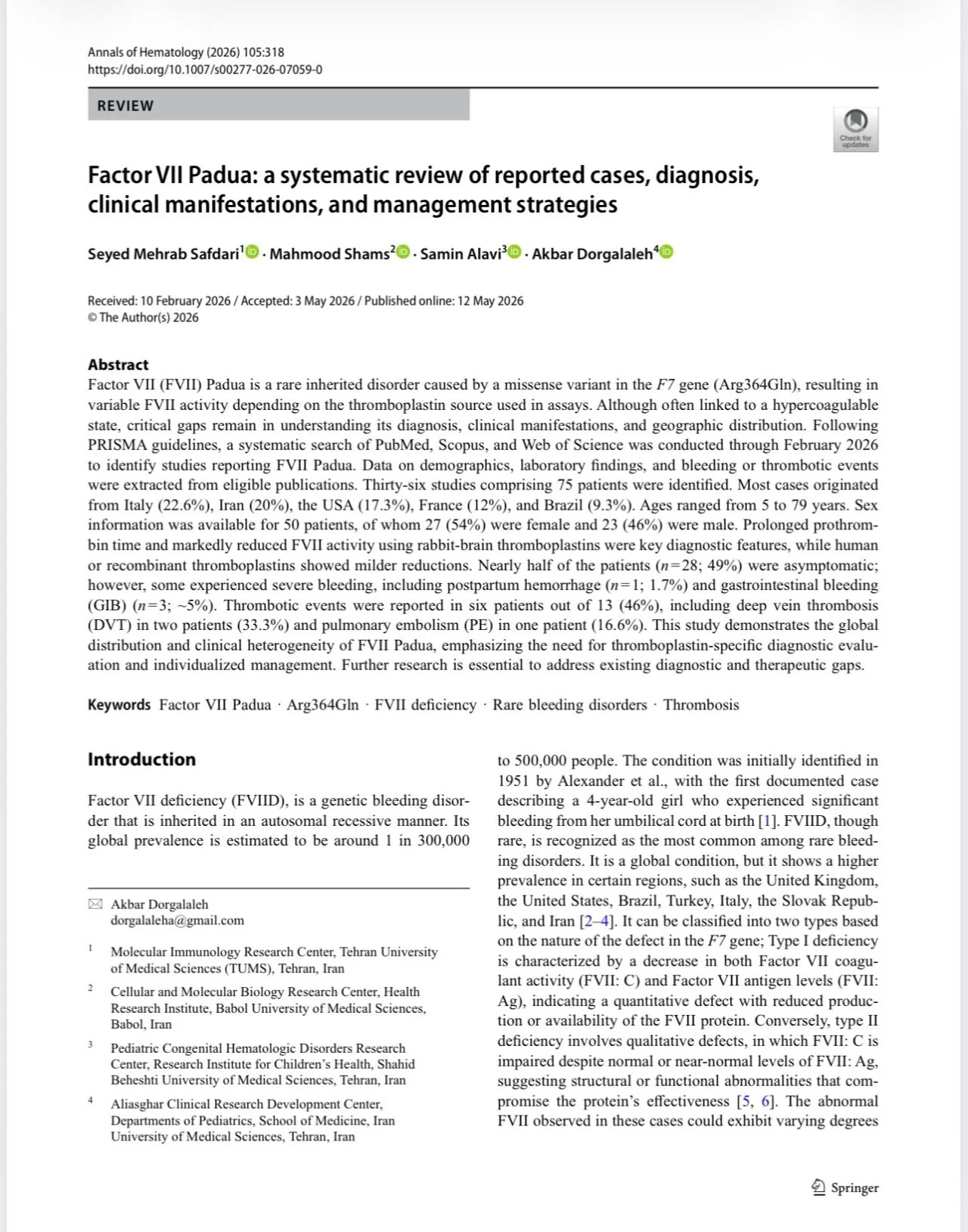
To put those findings into a wider context, we reviewed the published literature on Factor VII Padua. Our systematic review included 75 patients from 36 publications.
The clinical picture was highly variable. Nearly half of patients with available bleeding data were asymptomatic, and very low FVII activity, especially with rabbit brain thromboplastin, did not reliably reflect bleeding severity.
Thrombotic events, including DVT and PE, were also reported, particularly in homozygous and compound heterozygous patients.
The mechanism behind this paradox is still unclear, and understanding why thrombosis occurs in Factor VII Padua could be an important next step for future research.
What I take from these findings is that FVII activity should not be interpreted on its own.
The thromboplastin reagent, the patient’s bleeding history, previous hemostatic challenges, and genotype, when available, all need to be considered together.
This review supports the same message we saw in our previous study: A very low FVII activity does not always tell the whole story.”
Title: Factor VII Padua: a systematic review of reported cases, diagnosis, clinical manifestations, and management strategies
Authors: Seyed Mehrab Safdari, Mahmood Shams, Samin Alavi, Akbar Dorgalaleh
Stay updated on all scientific advances with Hemostasis Today.
-
Sep 15, 2026, 12:16Cedric Hermans: New Chinese Data Expand the Evidence for Hemophilia B Gene Therapy
-
Sep 15, 2026, 12:13Brianna Nobles: The Human Side of Rare, Voices From BDC2026
-
Sep 15, 2026, 12:04Ifeanyichukwu Ifechidere: When Coagulation Becomes Critical in Obstetrics
-
Sep 15, 2026, 11:55Yadira Torres MAS: Predicting Chronic Immune Thrombocytopenia in Children
-
Sep 15, 2026, 11:44Chokri Ben Lamine: Matching Anemia Treatment to the Myelofibrosis Patient
-
Sep 15, 2026, 11:17Adam Urato: How SSRIs May Affect Maternal and Fetal Serotonin
-
Sep 15, 2026, 11:05Sudhir Kumar: Maternal Anemia May Shape a Child’s Brain Development
-
Sep 15, 2026, 10:48Ashok Singhal: A Life-Changing Transplant Brings New Hope for Beta Thalassemia
-
Sep 15, 2026, 10:33Vera Ghali: Mitapivat Opens a New Chapter in Thalassemia Treatment