


Seyed Mohammad Sadegh Pezeshki: Characterizing Platelet Adhesive Dysfunction in Chronic ITP
Seyed Mohammad Sadegh Pezeshki, PhD Candidate at IBTO at High Institute for Research and Education in Transfusion Medicine, shared a post on LinkedIn about a recent article he and his colleagues co-authored, published in Thrombosis and Hemostasis, adding:
“It is my great pleasure and honor to present to you our latest original research, conducted by my professors and me.
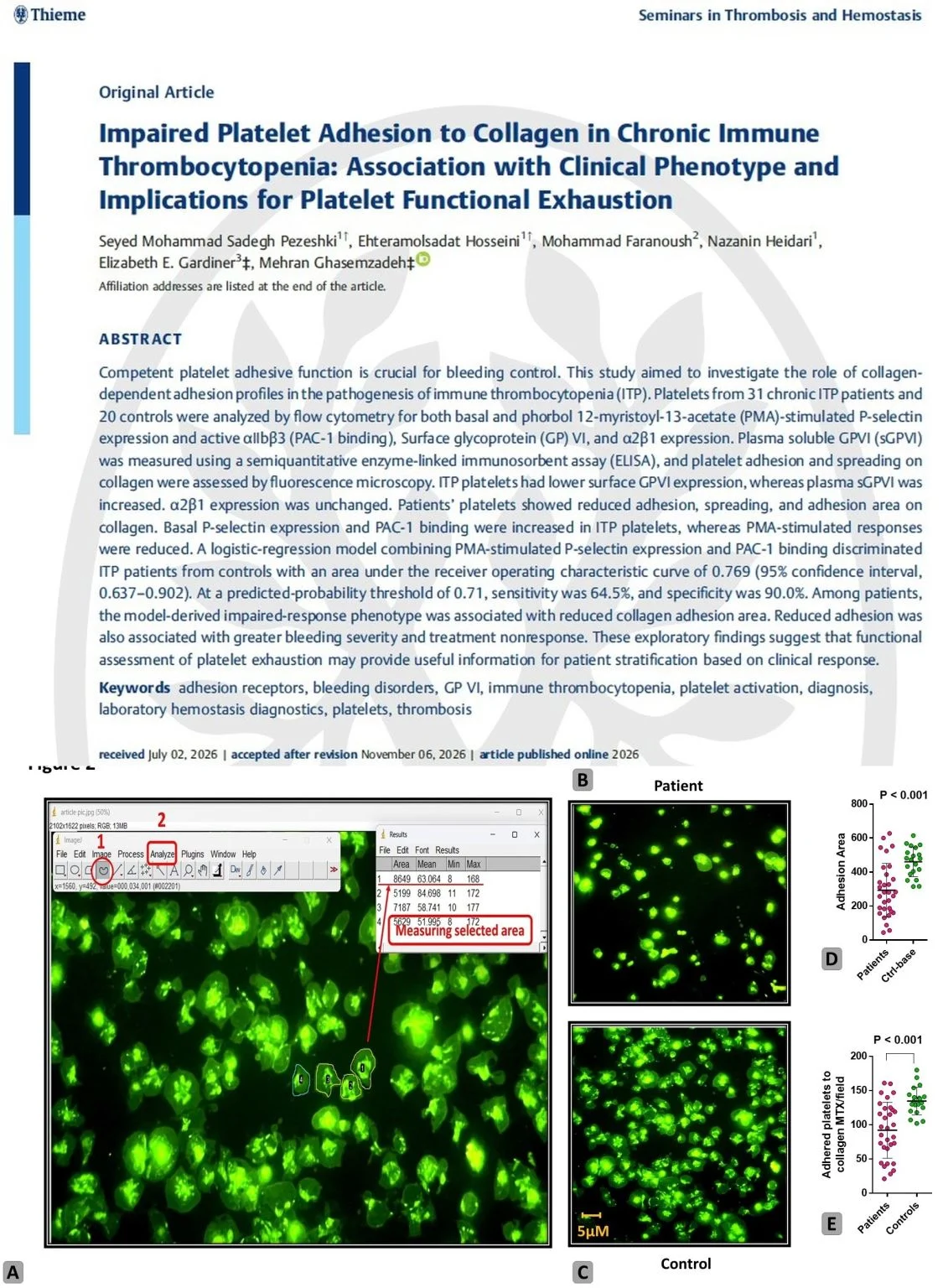
Building upon our team’s studies over the past four years, led by Professor Ghasemzadeh and Professor Hosseini, which have focused on qualitative platelet alterations in patients with chronic ITP, the present study aimed to characterize the platelet adhesive profile in these patients.
To this end, we first investigated the expression and shedding patterns of platelet adhesion receptors.
Subsequently, we evaluated platelet adhesive function based on the functional activity of these receptors.
In line with our previous studies, we also assessed platelet activation status, further confirming our earlier findings.
Finally, we explored the relationships between our findings regarding receptor expression and platelet adhesive function and the patients’ clinical characteristics.
The key findings of our study can be summarized as follows:
The present study demonstrated the presence of platelet adhesive dysfunction in patients with ITP and further established its association with the patients’ clinical status.
Furthermore, building upon our two previous studies, we emphasized the existence of a distinct platelet functional exhaustion phenotype in ITP, characterized by platelet pre activation and impaired responsiveness, and highlighted its potential role in the pathogenesis of the disease.
Taken together, these findings underscore the importance of qualitative platelet alterations in ITP.
They suggest that qualitative platelet assessment, alongside routine clinical evaluations and platelet count measurements, is essential for monitoring patients’ treatment responses.
Such an approach may, firstly, help resolve the discrepancy between persistent clinical bleeding and an improved platelet count and, secondly, provide physicians with a more comprehensive picture of the patients’ response to treatment.
Acknowledgments
At this point, I would like to express my sincere gratitude to my supervisor, Professor Hosseini, for her invaluable guidance, continuous support, and meticulous attention throughout this project.
I am also deeply grateful to my advisor, Professor Ghasemzadeh, for his outstanding ideas, novel perspectives, and invaluable teachings, which greatly contributed to the advancement of this project.
My sincere thanks also go to Professor Faranoush for introducing us to a well-characterized and relatively homogeneous patient cohort and for his valuable clinical guidance.
Finally, I would like to extend my heartfelt appreciation to Professor Elizabeth E. Gardiner for her collaboration to this project.”
Title: Impaired Platelet Adhesion to Collagen in Chronic Immune Thrombocytopenia: Association with Clinical Phenotype and Implications for Platelet Functional Exhaustion
Authors: Seyed Mohammad Sadegh Pezeshki, Ehteramolsadat Hosseini, Mohammad Faranoush, Nazanin Heidari, Elizabeth E. Gardiner, Mehran Ghasemzade
Stay updated on all scientific advances with Hemostasis Today.
-
Nov 28, 2026, 14:52Peter A. Everts: PRP Variability and the Path Toward Precision Orthobiologics
-
Nov 28, 2026, 14:12Ahmed Kamal: RBC Morphological Abnormalities – Key Diagnostic Clues in Hematological Disorders
-
Nov 28, 2026, 14:07Hanie Salah: Can Administering 100% Pure Oxygen at 2.5 Times Atmospheric Pressure Actually Reduce Oxidative Damage?
-
Nov 28, 2026, 14:01Intissar Haddiya: Antihypertensive Treatment Lowers Major Cardiovascular Events Even in Low-Risk Patients
-
Nov 28, 2026, 13:55Emily Bury: SVUH Thrombosis Team Raising Awareness for World Thrombosis Day!
-
Nov 28, 2026, 13:55Sanjeev Bagai: SARSCoV2 Infection and Long‐Term Risk of First‐Time PE and DVT
-
Nov 28, 2026, 13:48Does the Location of the Deletion of F8 Gene Matter for ITI outcome? – RPTH Journal
-
Nov 28, 2026, 12:10Yannig Querel: Recognising Undiagnosed Bleeding Disorders in Women and Girls
-
Nov 28, 2026, 12:09Diane J.: Understanding the Impact of Sickle Cell Disease on Children’s Lives