

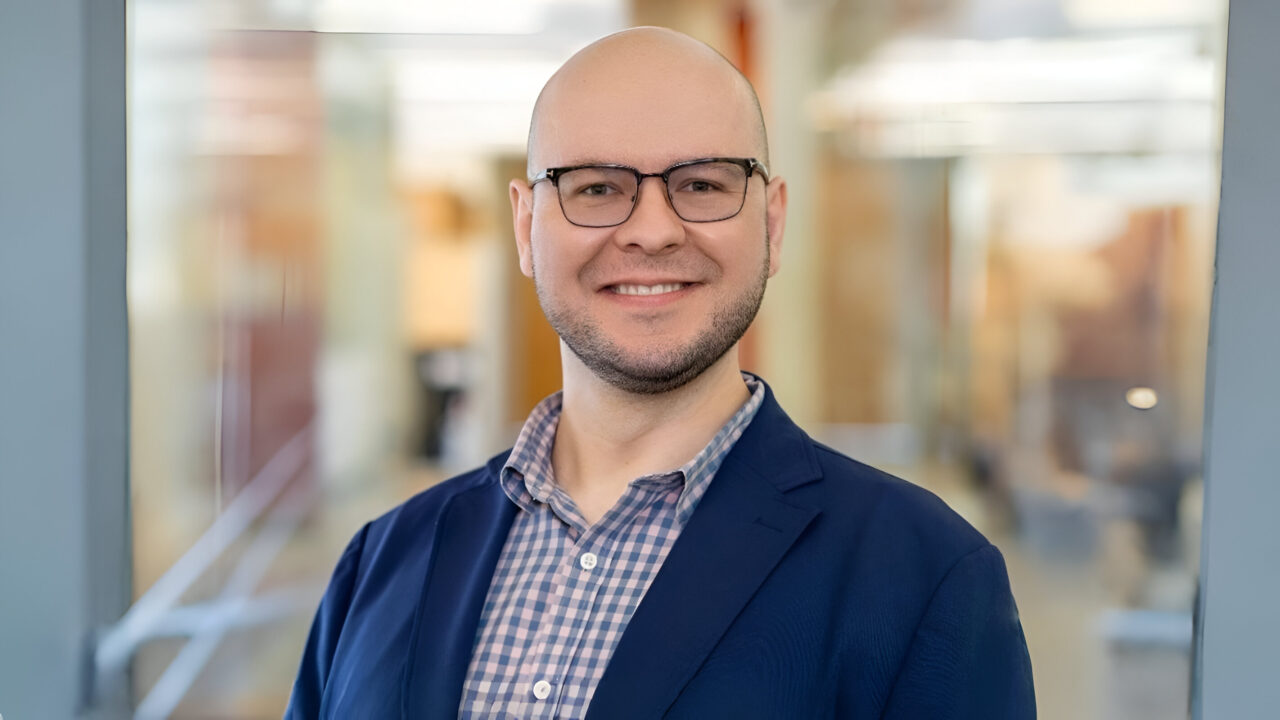
Tomasz Brzoska on How Personalized Medicine Benefits SCD Patients
Tomasz Brzoska, Assistant Professor of Medicine in University of Pittsburgh, School of Medicine, shared on LinkedIn:
”Our newest study has just been published.
See how personalized medicine can potentially benefit sickle cell disease patients!
Big thanks to all collaborators and contributors, especially Prithu Sundd, PhD , PhD and Tomasz Kaminski.
Most of the studies were performed at University of Pittsburgh School of Medicine and Vascular Medicine Institute.”
Read the full article here.
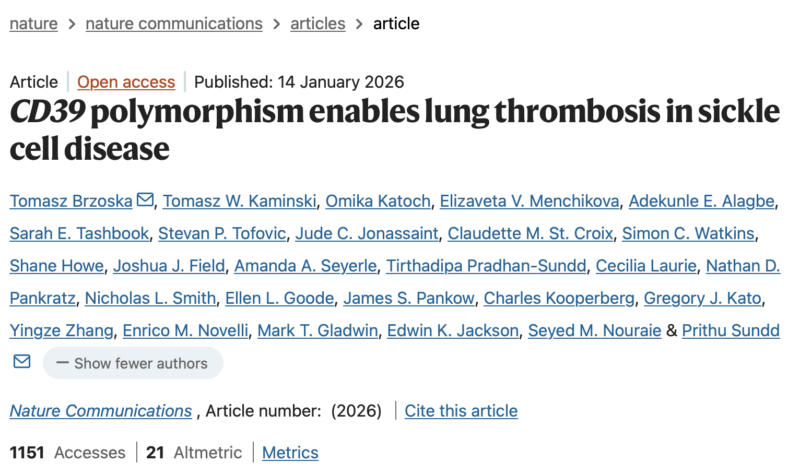
Article: CD39 polymorphism enables lung thrombosis in sickle cell disease
Authors: Tomasz Brzoska, Tomasz W. Kaminski, Omika Katoch, Elizaveta V. Menchikova, Adekunle E. Alagbe, Sarah E. Tashbook, Stevan P. Tofovic, Jude C. Jonassaint, Claudette M. St. Croix, Simon C. Watkins, Shane Howe, Joshua J. Field, Amanda A. Seyerle, Tirthadipa Pradhan-Sundd, Cecilia Laurie, Nathan D. Pankratz, Nicholas L. Smith, Ellen L. Goode, James S. Pankow, Charles Kooperberg, Gregory J. Kato, Yingze Zhang, Enrico M. Novelli, Mark T. Gladwin, Edwin K. Jackson, Seyed M. Nouraie, Prithu Sundd
Stay updated on all scientific advances with Hemostasis Today.
-
Jul 26, 2026, 08:51Dayita Banerjee: Presenting New Insights in Fibrinolysis Research at ISTH 2026
-
Jul 26, 2026, 08:39Roshni Kulkarni: The Human Face of Postpartum Hemorrhage
-
Jul 26, 2026, 08:14Atahar imam Hasan: Universal Artificial Blood and the Future of Trauma Care
-
Jul 26, 2026, 07:40Maha Othman: Leading Scientific Collaboration Across Hemostasis at ISTH 2026
-
Jul 26, 2026, 07:20Pablo Corral: Why Should Dyslipidemia Be Any Different?
-
Jul 26, 2026, 06:46Marios Georgakis: Largest GWAS of Transient Ischemic Attacks Reveals New Genetic Insights into Stroke Risk
-
Jul 26, 2026, 06:40Aaron Iding: From Virtual Meetings to Meaningful Connections at ISTH 2026
-
Jul 26, 2026, 06:36How Stroke Services Have Evolved Over the Past 8 Years in Kazakhstan – International Journal of Stroke
-
Jul 26, 2026, 06:31Leonardo Roever: Non-LDL Biomarkers and The Potential Future Applications for 2ry Stroke Prevention