


Ahmed Alotaibi: Monoclonal Antibodies Challenge Routine Pretransfusion Testing
Ahmed Alotaibi, Senior Specialist (Blood bank and blood transfusion) at Afif General Hospital – Riyadh Third Health Cluster (Ministry of Health), shared a post on LinkedIn about a recent article by Philipp Trummer, published in Frontiers in Immunology, adding:
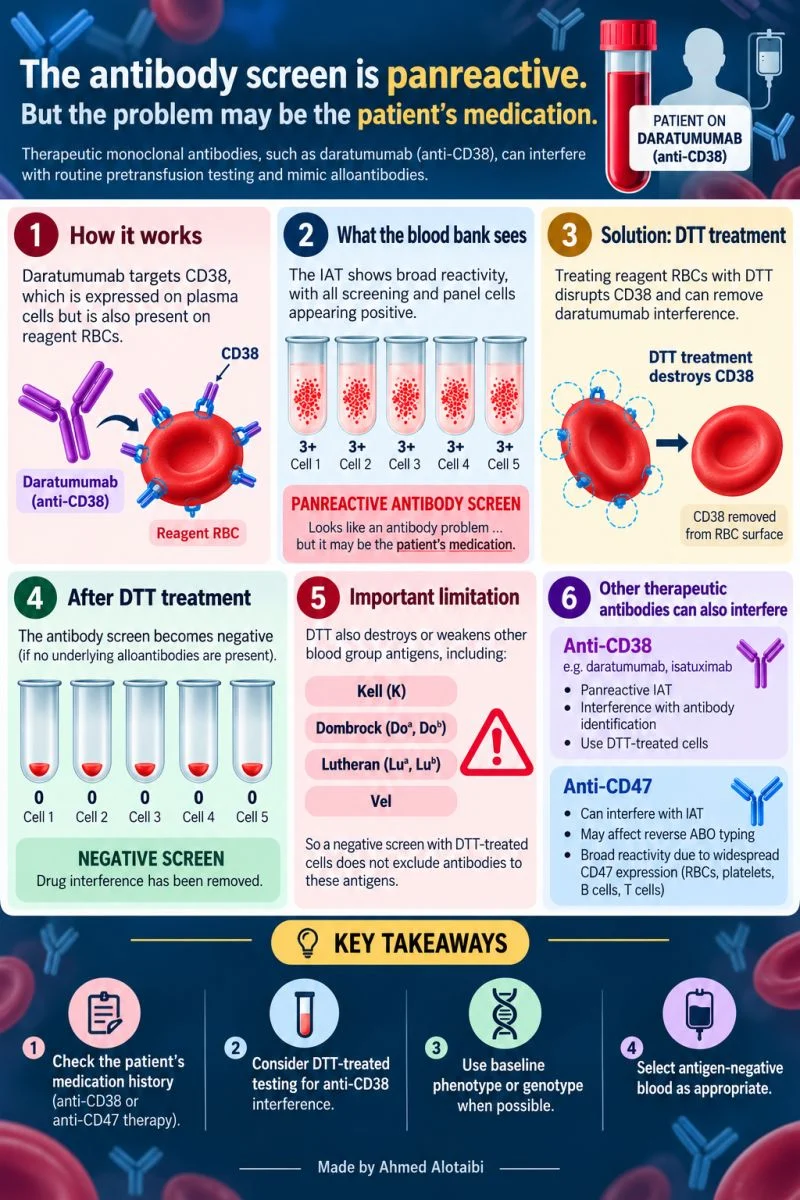
“The antibody screen is panreactive.
But the problem may be the patient’s medication.
Modern biologic therapies are creating a new challenge for blood banks.
A 2026 Frontiers in Immunology review highlights how therapeutic monoclonal antibodies can interfere with routine pretransfusion testing.
One of the best-known examples is daratumumab, an anti-CD38 therapy.
CD38 is not only found on plasma cells.
It is also present on reagent RBCs.
So when a patient receiving daratumumab undergoes antibody screening, the drug can react with the screening cells and produce:
Panreactivity in the IAT
That creates an important question:
Is this a true alloantibody, or just drug interference?
One commonly used solution is to treat reagent RBCs with DTT.
DTT disrupts CD38 and can remove the interference.
But there is a catch.
DTT also destroys or weakens several blood group antigens, including the clinically important Kell system.
So after DTT treatment, a negative screen does not mean every clinically significant antibody has been excluded.
That is why patients receiving anti-CD38 therapy often require careful planning, including:
Medication history
- Baseline phenotype or genotype when possible
- DTT-treated testing when needed
- Appropriate antigen-negative blood selection
The review also highlights newer challenges from anti-CD47 therapies, which can interfere not only with antibody testing but also with other RBC-based serologic methods.
The blood-bank lesson?
Not every panreactive antibody screen is caused by a patient alloantibody.
Sometimes the medication is the reason every cell is reacting.
And knowing that before transfusion testing begins can save a lot of time and confusion.”
Title: Therapeutic biologics interference in serological and pre-transfusion testing
Authors: Philipp Trummer, Cora P. Habicht, Erwin A. Scharberg, Clemens Schneeweiß

More posts featuring Ahmed Alotaibi on Hemostasis Today.
-
Oct 28, 2026, 03:32Wolfgang Miesbach: Should Prophylaxis in Type 3 VWD Follow the Bleeding Phenotype?
-
Oct 28, 2026, 03:25Owen McCarty: Exploring Platelet Polyphosphates in Coagulation Under Flow
-
Oct 28, 2026, 03:19Arwa Z. Al-Riyami: Key Takeaways from the Blood Conference in Auckland
-
Oct 28, 2026, 03:14Kristopher Jonas: The Ethical Case for Compensated Plasma Donation
-
Oct 28, 2026, 03:09Amber Paratore Sanchez: Therapeutic Plasma Exchange in PTE Patients with Cold Agglutinins
-
Oct 28, 2026, 03:04Fonkou Steve: Overcoming Fear to Build a Lifelong Blood Donor
-
Oct 28, 2026, 03:00Joanne Marlor: NHS Blood and Transplant Opens Country’s Largest Donor Centre in Reading
-
Oct 27, 2026, 23:04Stefano Navarro: Hypertension Reprogrammes Megakaryocytes and Increases Platelet Responsiveness to Thrombin
-
Oct 27, 2026, 23:03Enrique M. San Norberto García: What Is the Best Treatment for Femoropopliteal in-Stent Restenosis