

Yaozhi Wang: AI Increased Incidental Pulmonary Embolism Detection
Yaozhi Wang, Founder at RadAISlice, shared a post on LinkedIn about a recent article by Fergus O’Herlihy et al., published in British Journal of Radiology, adding:
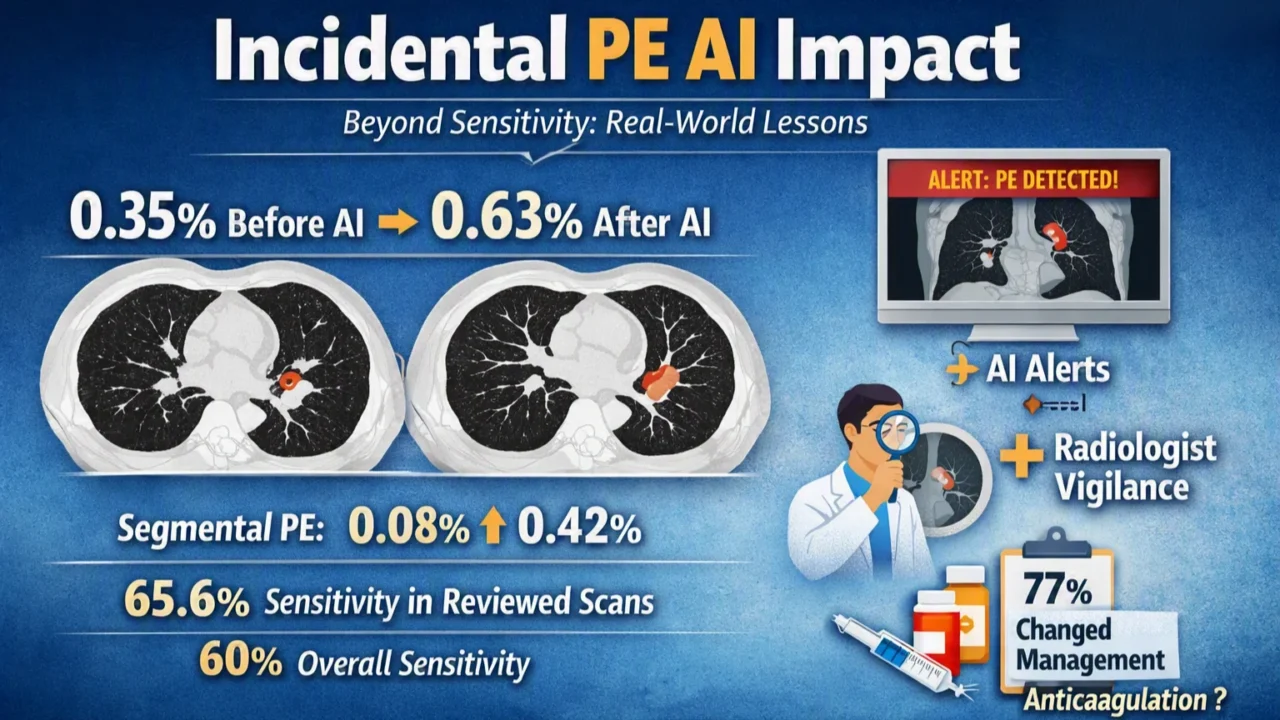
”A commercial PE AI had only 65.6 percent sensitivity for incidental pulmonary embolism in the scans it analyzed, yet after deployment, the reported incidental PE rate increased from 0.35 percent to 0.63 percent.
That contrast is what makes this study interesting.
Researchers reviewed 11,690 contrast-enhanced CT examinations before and after implementation of an AI system for pulmonary embolism detection.
Among non-CTPA studies, incidental PE was reported in:
- 0.35 percent before AI deployment
- 0.63 percent after AI deployment
The increase was especially striking for segmental PE, which rose from 0.08 percent to 0.42 percent.
But the real-world limitations are just as interesting.
The AI processed only 78.7 percent of eligible non-CTPA examinations. Among the scans it analyzed, sensitivity for incidental PE was 65.6 percent.
When unprocessed eligible examinations were included, real-world sensitivity fell to 60 percent.
Performance also varied substantially by contrast phase.
So why did reported detection still increase?
The authors point out that they cannot separate the direct effect of AI alerts from another possible effect: having AI in the workflow may have made radiologists more vigilant when reviewing the pulmonary arteries on routine CT.
That may be one of the more interesting lessons here.
The clinical impact of imaging AI is not always captured by benchmark sensitivity alone.
Coverage, protocol compatibility, workflow integration, and changes in reader behavior can all affect what happens after deployment.
There is also an important downstream question. In this study, 77 percent of patients with an incidental PE had an immediate change in management, most commonly initiation or intensification of anticoagulation.
At the same time, the authors note that the clinical significance of some of these additional, predominantly peripheral emboli remains uncertain.
This is why real-world post-deployment studies matter.
A model can look quite different once it leaves a curated dataset and enters everyday clinical workflow.
Fergus Herlihy, Dora Gorman, Lara Toerien, Fionnuala Ní Áinle, Brian Gibney, Peter MacMahon. Incidental Pulmonary Embolism Detection on Routine Contrast-Enhanced CT before and after Deployment of a Commercial AI Tool: A Real-World Evaluation. British Journal of Radiology.
I share more radiology AI research, papers, and updates each week in RadAISlice.”
Title: Incidental Pulmonary Embolism Detection on Routine Contrast-Enhanced CT before and after Deployment of a Commercial AI Tool: A Real-World Evaluation
Authors: Fergus O’Herlihy, Dora Gorman, Lara Toerien, Fionnuala Ni Ainle, Brian Gibney, Peter MacMahon
Stay updated on all scientific advances with Hemostasis Today.
-
Sep 15, 2026, 15:17Shehab Mohamed: A New Regional Consensus on HLH Diagnosis and Management
-
Sep 15, 2026, 15:17Sheharyar Raza: Managing Randomness in Artificial Intelligence for Transfusion Medicine
-
Sep 15, 2026, 15:00Sarah Wachtman: Modeling AAV-Based Gene Therapy for Hemophilia A Using Pediatric Liver Organoids
-
Sep 15, 2026, 15:00Ashenafi Tazebew Amare: From Blood Donation to Innovation and Patient Access
-
Sep 15, 2026, 14:56Glanzmann Thrombasthenia Beyond Platelet Transfusion
-
Sep 15, 2026, 14:55Christina Pohlman: The Hidden Complexity of Warfarin Therapy in APS
-
Sep 15, 2026, 14:44Consuela A. Albright: Building a More Connected Sickle Cell Care System
-
Sep 15, 2026, 14:43Andrew Jackson: Cyanosis as a Clue to Central Venous Obstruction
-
Sep 15, 2026, 14:43Andy Darlington: Randomized Evidence for Catheter-Based Treatment of Intermediate-High-Risk PE