

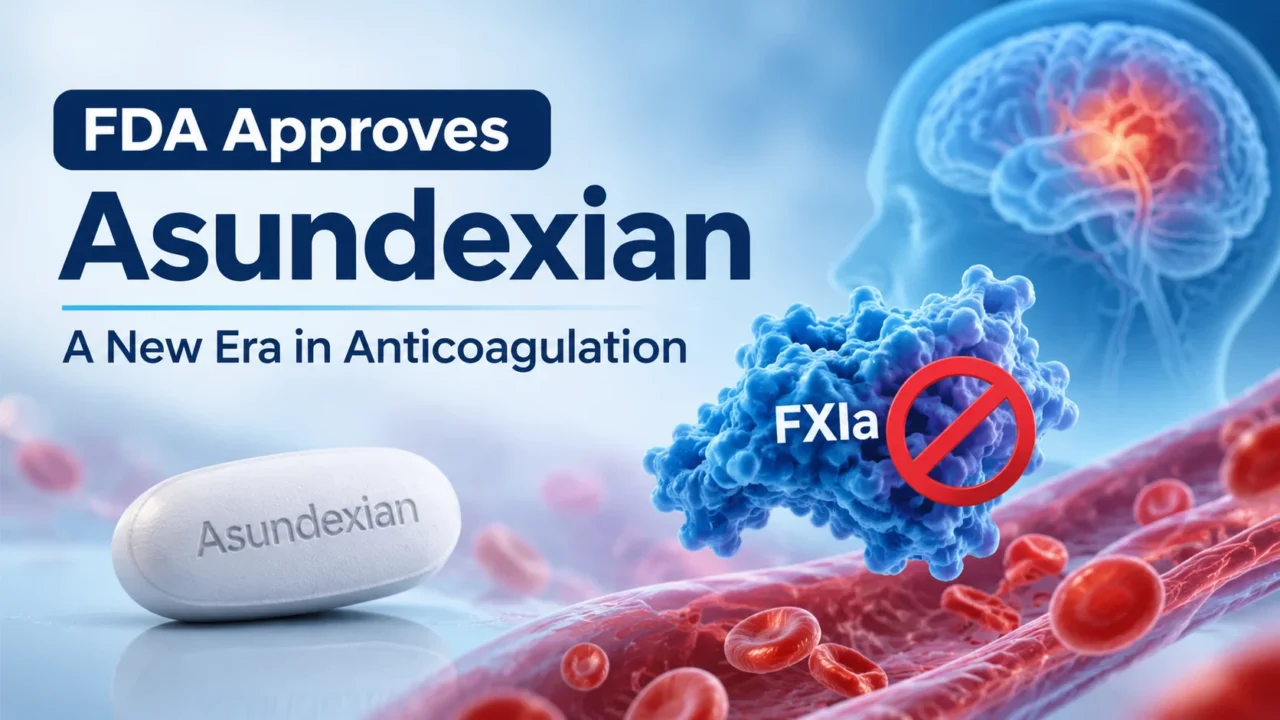
Kalyan Roy: Asundexian Approval Marks a Milestone in Targeted Anticoagulation
Kalyan Roy, Specialist Transfusion Medicine Center at Square Hospitals LTD, shared a post on LinkedIn:
“A new era in anticoagulation? Can we prevent blood clots without increasing bleeding risk?
A significant milestone in cardiovascular medicine!
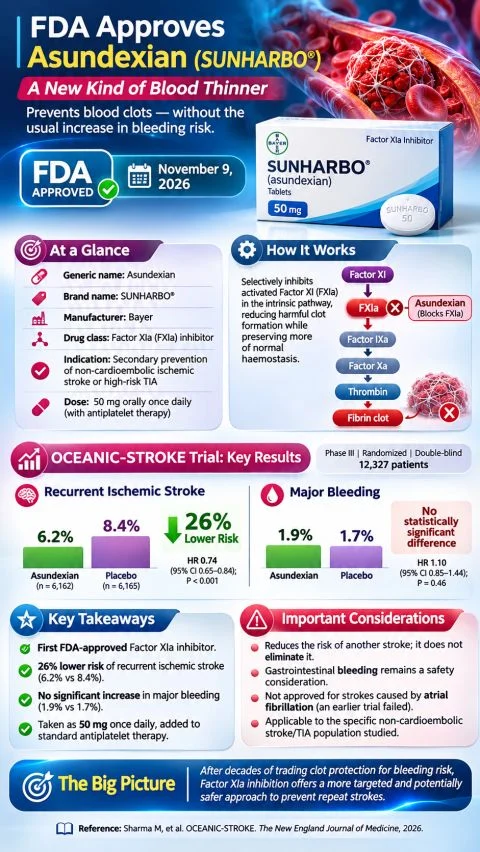
On November 9, 2026, the US FDA approved Asundexian (SUNHARBO®), developed by Bayer — the first approved drug in a new class of anticoagulants known as Factor XIa inhibitors.
What makes it different?
Unlike conventional anticoagulants that target Factor Xa or thrombin, Asundexian selectively inhibits activated Factor XI (FXIa), an important component of the intrinsic coagulation pathway.
The goal?
To prevent pathological thrombosis while preserving more of the body’s natural haemostatic response.
Oceanic-Stroke: Key clinical findings
A landmark Phase III trial involving 12,327 patients demonstrated:
- 26 percent lower relative risk of recurrent ischemic stroke.
- Recurrent ischemic stroke: 6.2 percent with Asundexian versus 8.4 percent with placebo.
- Major bleeding: 1.9 percent versus 1.7 percent, with no statistically significant difference.
- Treatment: 50 mg orally once daily, alongside standard antiplatelet therapy.
Important clinical considerations
- Asundexian reduces stroke risk; it does not eliminate it.
- Gastrointestinal bleeding remains an important safety consideration.
- It is not approved as a replacement for conventional anticoagulation in atrial fibrillation.
- The findings apply to the specific non-cardioembolic stroke prevention population studied.
Why does this matter?
For decades, clinicians have faced a difficult balance between preventing thrombosis and increasing bleeding risk.
Factor XIa inhibition represents a promising approach to achieving more selective antithrombotic protection.
The future of anticoagulation may not simply be about stronger blood thinners — but smarter and more targeted inhibition of coagulation.
A fascinating development for clinicians, haematologists, cardiologists and transfusion medicine specialists!
Key Reference: Sharma M, et al. OCEANIC-STROKE. The New England Journal of Medicine, 2026.”
Other posts featuring Kalyan Roy on Hemostasis Today.
-
Nov 14, 2026, 23:57Jamie S. Y. Ho: Exploring the Mechanisms of Arterial Thrombosis and the Evolution of Antithrombotic Therapy
-
Nov 14, 2026, 23:53Jacopo Imberti: The Past, Present and Future of Arterial Thrombosis Research
-
Nov 14, 2026, 23:48Shrouk Ramadan: Joining the Editorial Review Board of Clinical and Applied Thrombosis and Hemostasis
-
Nov 14, 2026, 23:46Habib Bennaceur: Moving Towards Fewer Limitations for People Living With Haemophilia
-
Nov 14, 2026, 23:44Paul Healy: EU Approves Frehemgo for Haemophilia A
-
Nov 14, 2026, 23:43Mehak Trehan: ASH 2026 Benign Hematology – Ten Abstracts Through an Indian Lens
-
Nov 14, 2026, 23:33Felipe Magalhaes Furtado: Artificial Intelligence Advances PNH Clone Detection Through Machine Learning
-
Nov 14, 2026, 23:33Mona Alfaraj: International Pathology Day Promotes Education in Hemoglobinopathy Diagnostics
-
Nov 14, 2026, 23:33Alexandros Makis: Exploring Vascular Mechanisms and Therapeutic Targets in β-Thalassemia