


Ahmed Abdelsalam: Why Matching ABO and RhD Groups Does Not Guarantee Crossmatch Compatibility
Ahmed Abdelsalam, Medical Laboratory Technician at Bir al-Abd, shared a post on LinkedIn:
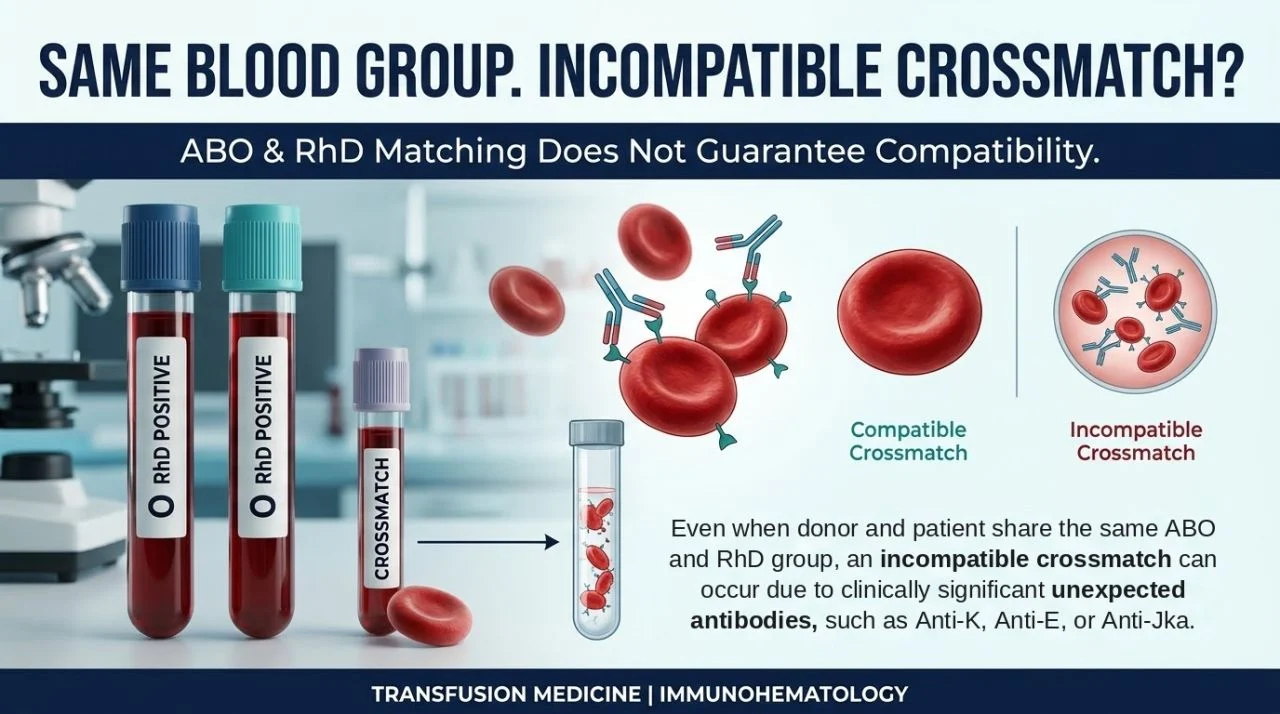
“Same ABO and Rh group, yet the crossmatch is incompatible.
Why?
It happens more often than people expect, and the answer is a core concept in transfusion medicine: matching ABO and RhD does not guarantee compatibility.
Common causes:
1. Unexpected red cell antibodies
- The patient’s plasma may contain antibodies against other antigens, such as Kell, Duffy, or Kidd.
2. Autoantibodies
- Antibodies against the patient’s own red cells can cause positive reactions during compatibility testing.
3. Previous transfusion or pregnancy
- Past exposure can lead to alloantibodies. Even when levels fall below detection, re-exposure can trigger a rapid secondary response.
4. Rouleaux
- High protein levels, for example in myeloma, can mimic agglutination.
5. Cold antibodies
- Cold agglutinins may react at room temperature.
6. Drug interference
- Some therapies, such as daratumumab, can interfere with testing.
7. Technical or clerical error
- Wrong sample, labeling mistakes, or wrong dilution.
Blood grouping tells us the ABO and RhD type.
Crossmatching tells us whether this donor’s red cells are compatible with this patient’s plasma.
In transfusion medicine, compatibility is more than just a blood group.
Your incompatible crossmatch has identical ABO/RhD groups.
What do you check first?
A) Sample and unit identification
B) Antibody screen
C) DAT
D) Repeat the test”
Stay updated with Hemostasis Today.
-
Nov 15, 2026, 10:32Ibrahim Gwarzo: Identifying Care Gaps and Emergency Pain Delays in Sickle Cell Disease at APHA 2026
-
Nov 15, 2026, 10:17Ify Osunkwo: How the Sickle Cell Community Can Influence FDA Drug Development Priorities
-
Nov 15, 2026, 10:06Asma Khalil: New British Society for Haematology Guidance on Paediatric and Neonatal Transfusion
-
Nov 15, 2026, 09:41Girishkumar Modi: Navigating the 2026 Jehovah’s Witness Transfusion Policy Shift in Clinical Practice
-
Nov 15, 2026, 04:31Aakriti Gupta: Anticoagulation for Leaflet Thickening After TAVR
-
Nov 14, 2026, 23:57Jamie S. Y. Ho: Exploring the Mechanisms of Arterial Thrombosis and the Evolution of Antithrombotic Therapy
-
Nov 14, 2026, 23:53Jacopo Imberti: The Past, Present and Future of Arterial Thrombosis Research
-
Nov 14, 2026, 23:48Shrouk Ramadan: Joining the Editorial Review Board of Clinical and Applied Thrombosis and Hemostasis
-
Nov 14, 2026, 23:46Habib Bennaceur: Moving Towards Fewer Limitations for People Living With Haemophilia