


Edward Lee Carter: Are We Ready for FXIa Inhibitors?
Edward Lee Carter, Clinical Pharmacist Practitioner at U.S. Department of Veterans Affairs, shared a post on LinkedIn:
“Factor XIa inhibitors are here. Are our perioperative anticoagulation protocols ready?
The FDA’s November 9 approval of Sunharbo (asundexian) marks an important milestone in antithrombotic therapy.
But it also introduces a new challenge for anticoagulation stewardship.
What happens when a patient receiving a Factor XIa inhibitor needs surgery or an invasive procedure?
In a September 2026 review published in the Journal of Thrombosis and Haemostasis, Spyropoulos and Douketis examined the emerging evidence for perioperative management of Factor XI/XIa inhibitors.
Their findings raise an intriguing possibility:
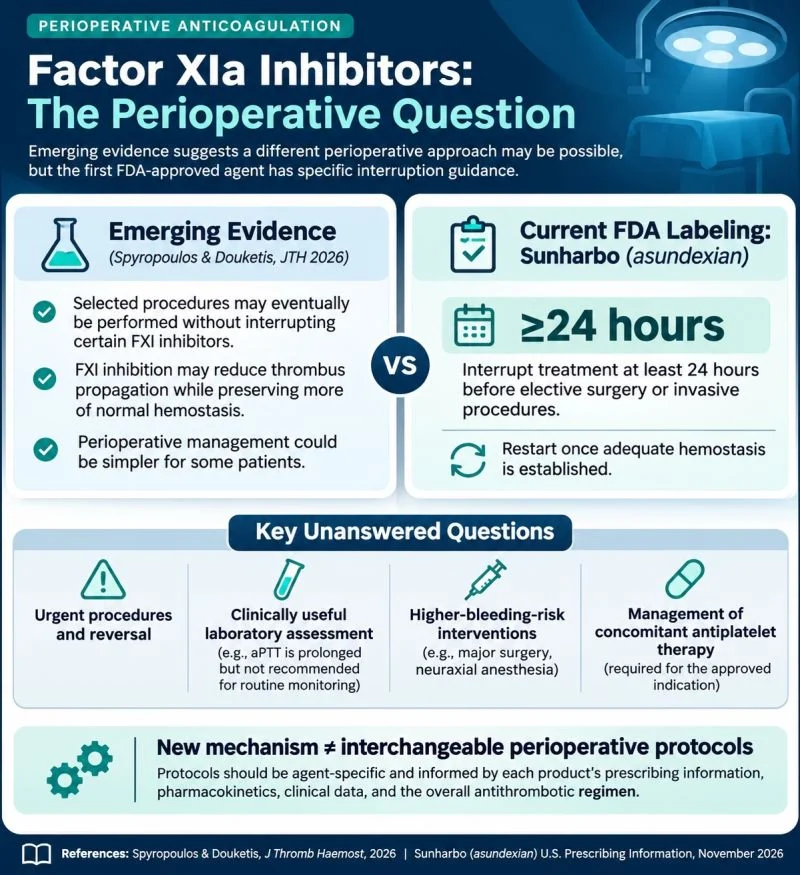
- Selected procedures may eventually be performed without interrupting certain FXI inhibitors.
- Targeting FXI may reduce thrombus propagation while preserving more of normal hemostasis than conventional anticoagulant pathways.
- Perioperative management could become simpler for some patients.
But promising evidence is not the same as an established clinical protocol.
Consider the newly approved asundexian:
FDA prescribing information: Interrupt at least 24 hours before elective surgery or invasive procedures. Restart once adequate hemostasis is established.
Bleeding considerations: Although overall major bleeding was similar to placebo in OCEANIC-STROKE, important bleeding signals were observed, including gastrointestinal bleeding and higher major bleeding rates in certain subgroups.
Unanswered questions: Urgent procedures, laboratory assessment, reversal strategies, and management of higher-bleeding-risk interventions remain areas requiring additional evidence.
And an important distinction: asundexian is approved for selected patients following non-cardioembolic ischemic stroke or high-risk TIA in combination with antiplatelet therapy.
Perioperative planning must therefore consider the entire antithrombotic regimen—not simply the FXIa inhibitor.
My takeaway:
We should resist the temptation to simply apply existing DOAC interruption protocols to this emerging class.
Different mechanisms, pharmacokinetics, and durations of action require agent-specific approaches.
The real opportunity for anticoagulation stewardship is to translate emerging evidence into practical, standardized, and clinically defensible decision support.
A new anticoagulant mechanism deserves a new level of perioperative preparation.
Are we ready?”
More posts featuring Edward Lee Carter on Hemostasis Today.
-
Nov 19, 2026, 12:19Essama Telli: When a Bruise Doesn’t Heal – Recognising the Warning Signs
-
Nov 19, 2026, 11:51Wolfgang Miesbach: Beyond Episomal Gene Therapy in Haemophilia B
-
Nov 19, 2026, 11:18A First Look at WFH CCS 2027
-
Nov 19, 2026, 10:58Does a Higher Measured Factor Level Always Mean Better Protection Against Joint Bleeds? – Global Hemophilia Report
-
Nov 19, 2026, 10:43Strengthening Plasma Management and Patient Access Across Eastern Europe – ISBT
-
Nov 19, 2026, 10:32Rana Al-Hrout: The Hemodilution Trap – Accurate Blast Assessment in Bone Marrow Biopsies
-
Nov 19, 2026, 10:29Maria Panagiota Terzi: Presenting Research on Coagulation Biomarkers in Acute Myocardial Infarction
-
Nov 19, 2026, 10:21Paola Ranalli: Hemophilia and von Willebrand Disease Advancing Care Through Multidisciplinary Collaboration
-
Nov 19, 2026, 10:11Rana Al-Hrout: Iron Deficiency in Heart Failure – Does It Matter Even Without Anemia?