


Fikreab Tesfaye Tefera/LinkedIn
Nov 22, 2026, 21:19
Fikreab Tesfaye Tefera: 10 KeyTakeaways from 2026 ASH Guideline On Diagnosis and Management of Aplastic Anemia
Fikreab Tesfaye Tefera, Internal Medicine Resident at Adama Hospital Medical College, shared a post on LinkedIn:
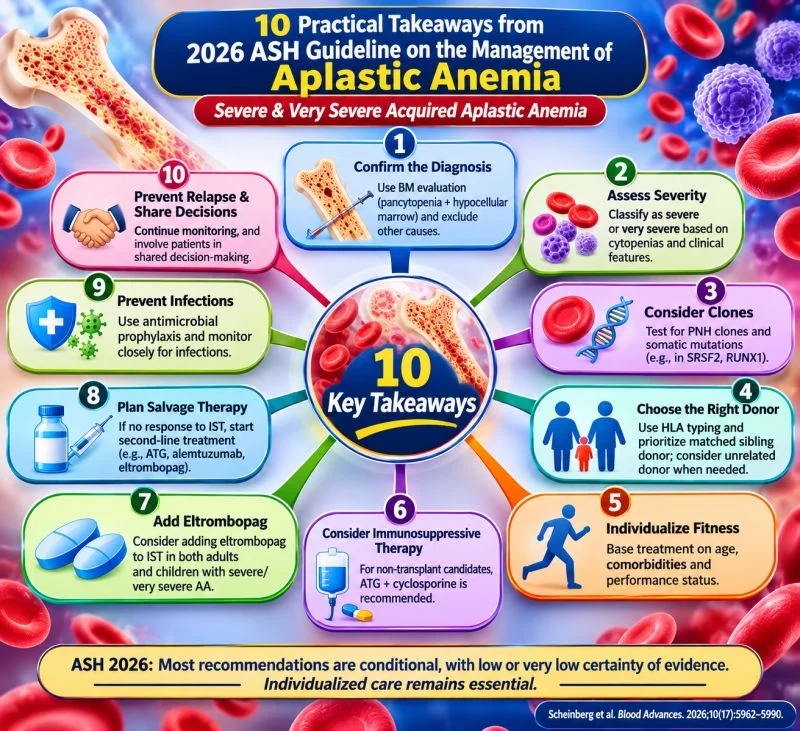
“Rethinking Aplastic Anemia Management: From Diagnosis to Definitive Treatment
10 KeyTakeaways from 2026 ASH Guideline On Diagnosis and Management of Aplastic Anemia
1. Establish the diagnosis
- Perform bone marrow aspirate and biopsy in unexplained persistent pancytopenia.
- Obtain detailed medication, infection, toxin-exposure, and family histories.
- Exclude alternative causes of bone marrow failure.
2. Expand diagnostic evaluation
- Consider PNH clone testing.
- Perform somatic mutation testing.
- Consider telomere-length testing.
- Undertake germline genetic testing when inherited bone marrow failure is suspected.
3. Initiate HLA. typing early
- Perform early HLA typing in transplant- eligible pts with severe or very severe AA.
- Start donor evaluation without unnecessary delay.
4. Individualize first line treatment
- Age low than 40 yrs with an available matched sibling donor, favor allogeneic hematopoietic cell transplantation (HCT) over immunosuppressive therapy (IST).
- Age more than 40 yrs, favor IST over matched-sibling HCT.
- Consider donor availability, comorbidities, performance status, and biological fitness.
5. Consider alternative donor transplantation carefully
- Matched unrelated donor transplantation may be appropriate in selected pts.
- IST is generally favored over haploidentical HCT in the guideline’s age-based frontline recommendations.
6. Optimize immunosuppressive therapy
- Add eltrombopag to standard immunosuppressive therapy with antithymocyte globulin (ATG) and cyclosporine in both adults and children with severe/very severe AA.
7. Plan second line treatment for refractory disease
- Age low than 60 yrs who fail initial IST, favor HCT over a second ATG-based regimen.
- Age more than 60 yrs, either approach may be considered, depending on fitness and donor availability.
8. Manage relapse strategically
- Age low than 60 years, HCT or a second ATG-based regimen may be considered.
- Age more than 60 yrs, favor a second ATG-based regimen over HCT.
9. Do not delay salvage therapy
- Initiate second-line treatment no later than 6 months after ATG if there is no response.
- Consider earlier intervention in very severe AA, particularly with profound neutropenia.
10. Strengthen infection prevention and supportive care
- ANC <500/µL, consider antibiotic and mold-active antifungal prophylaxis.
- Monitor closely for infectious complications and treatment-related toxicity.
- Incorporate patient preferences and shared decision-making.”
Stay updated with Hemostasis Today.
-
Nov 22, 2026, 21:32Maxime Dely: SAGM and PAGGSM – What Do Red Blood Cell Storage Solutions Contain?
-
Nov 22, 2026, 21:28Phil Cranch: 817mL of Plasma and an Hour Well Spent at Lifeblood
-
Nov 22, 2026, 21:24Ella Hinson: Turning Type B Blood into Type O – How Omni Tackles the National Blood Shortage
-
Nov 22, 2026, 21:13Hannah Shalom: How PEMT and CBS Actually Shape Homocysteine and Choline Needs?
-
Nov 22, 2026, 21:07Godfred Oduro: Novo Nordisk Haemophilia and Hemoglobinopathies Foundation Workshop in Ghana
-
Nov 22, 2026, 21:04The EHA-TiF Preceptorship on Hemoglobinopathies has Concluded in Athens, Greece
-
Nov 22, 2026, 13:58DOAC Exposure in Early Pregnancy and Risk of Birth Defects – JTH
-
Nov 22, 2026, 13:45Ahmad Gharehbaghian: Football and Blood Donation Unite for a Humanitarian Cause
-
Nov 22, 2026, 13:34Pranvera Ibrahimi: Where Cardiology Meets Neurology in Stroke Prevention