


Chaza Alaji: Vitamin B6 and Its Essential Role in Blood Formation and Brain Function
Chaza Alaji, Medical Laboratory Specialist and Supervisor at Privat University-Private Laboratory-General Hospital, shared a post on LinkedIn:
“Vitamin B6: The Mitochondrial Architect of Blood Formation – From Heme Synthesis to Brain and Nerve Function
Vitamin B6 is an essential cofactor in over 100 enzymatic reactions, playing a central role in red blood cell production, amino acid metabolism, neurotransmitter synthesis, and immune function.
Its active form, pyridoxal-5-phosphate (PLP), is particularly important for heme synthesis.
1. Vitamin B6: Essential for Heme Synthesis
- Heme synthesis begins inside mitochondria, where glycine combines with succinyl-CoA to form delta-aminolevulinic acid (ALA).
- This reaction is catalyzed by ALA synthase (ALAS), which requires PLP. In developing red blood cells, the ALAS2 isoform plays a key role.
- B6 deficiency can impair heme production and contribute to sideroblastic anemia, in which iron accumulates in the mitochondria of developing erythroblasts.
- Not all sideroblastic anemia is caused by B6 deficiency; genetic defects, medications, and toxins are other causes.
2. Interaction with Other B Vitamins
- Vitamin B6 works closely with other B-complex vitamins:
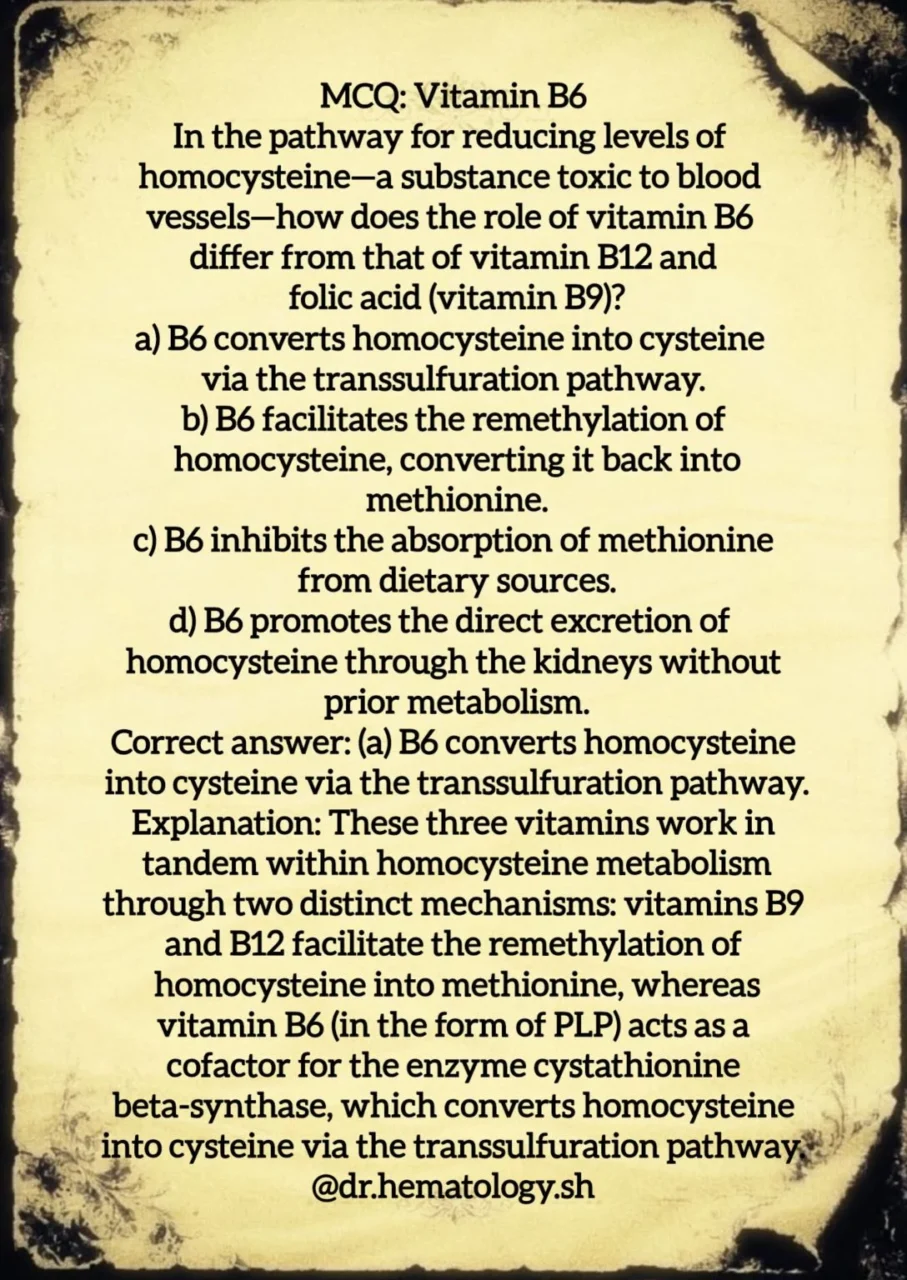
- B6, B9, and B12: Cooperate in homocysteine metabolism. B6 supports the transsulfuration pathway, while B9 and B12 contribute to its remethylation into methionine.
- B2 (Riboflavin): Provides FMN, required for conversion of B6 into its active PLP form.
- B3 (Niacin): B6 participates in converting tryptophan into niacin.
Although elevated homocysteine is associated with vascular risk, lowering it with B-vitamin supplements has not consistently reduced cardiovascular events.
3. Brain and Nervous System Function
PLP is essential for synthesizing neurotransmitters, including GABA, serotonin, dopamine, and norepinephrine.
Deficiency may cause:
- Peripheral neuropathy.
- Irritability and neurological disturbances.
- Seizures in severe cases.
- Glossitis, angular cheilitis, and dermatitis.
4. Recent Research and Safety
- A 2022 study in Human Psychopharmacology reported reduced self-reported anxiety following high-dose B6 supplementation in young adults.
- However, this does not establish B6 as a treatment for anxiety or depression.
- Chronic excessive supplementation can cause sensory peripheral neuropathy.
- The European Food Safety Authority (EFSA) sets the adult tolerable upper intake level at 12 mg/day, highlighting the importance of avoiding unnecessary high-dose supplements.
- Dietary SourcesMeat, fish, poultry, chickpeas, lentils, nuts, potatoes, and bananas are good sources of vitamin B6.
Clinical Take-Home Message
Vitamin B6 links mitochondrial heme synthesis, hemoglobin production, amino acid metabolism, and neurological function.
A small vitamin with a major role in blood formation and cellular health.”
Other posts featuring Chaza Alaji on Hemostatis Today.
-
Nov 25, 2026, 12:50Edward Lee Carter: Beyond CHA₂DS₂-VASc – Are We Measuring the Patient—or Just Scoring the Risk Factors?
-
Nov 25, 2026, 12:26Anne Trezise: The Blood Sample Pathway in Laboratory Diagnostics
-
Nov 25, 2026, 12:18Research Can’t Move Forward Without Funding – American Society of Hematology
-
Nov 25, 2026, 12:14Nicolaus Kröger: Mapping Bone Marrow Recovery After Allogeneic Transplantation for Myelofibrosis
-
Nov 25, 2026, 12:09Melissa McGue: Strengthening Advocacy for Hematology
-
Nov 25, 2026, 11:53Michael Praktiknjo: Early Portal Decompression Associated with Reduced Cirrhosis Decompensation
-
Nov 25, 2026, 11:29Streptococcus oralis Links Platelet Adhesion to Antibody-Dependent Activation – Platelets Journal
-
Nov 25, 2026, 11:08Limb Fat Distribution Linked to Increased Venous Thromboembolism Risk – JTH
-
Nov 25, 2026, 08:57Ndembe Djeni Erwan: Sickle Cell Disease Awareness and Stigma Among Medical Students in Cameroon