


Thirunavukkarasu Angappan: One Swollen Knee – Hemaphillia A Treatment Ladder
Thirunavukkarasu Angappan, Vice President of Operations and Manufacturing at PopVax, shared a post on LinkedIn:
“One swollen knee: what is a hospital still allowed to give?
A boy with hemophilia A wakes with a swollen knee. The district hospital has little factor concentrate, but the blood bank has cryoprecipitate (the factor VIII-rich part of plasma). Which options are safe, and which are last resort?
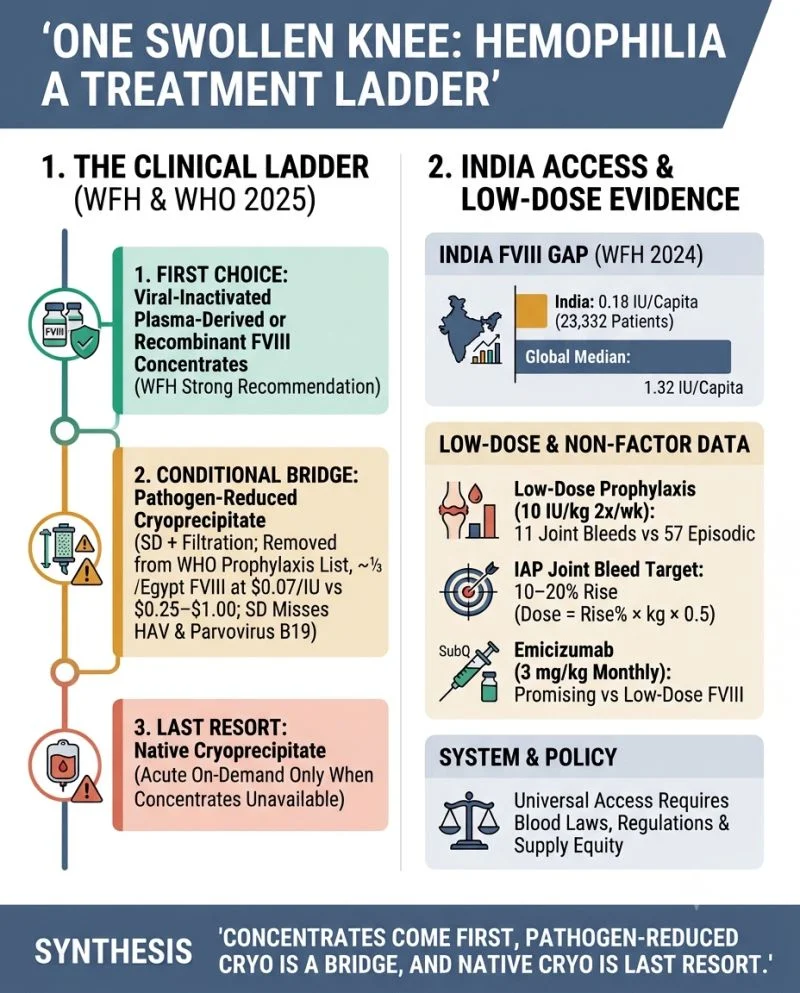
First choice: the World Federation of Hemophilia (WFH) 2020 guideline strongly recommends viral-inactivated plasma-derived or recombinant clotting factor concentrates. It allows cryoprecipitate only where concentrates are unavailable.
Why cryoprecipitate is second best: solvent-detergent (SD) treatment of small pools protects only against lipid-enveloped viruses. As per WFH, it does not inactivate hepatitis A virus or parvovirus B19.
A 2025 signal from the World Health Organization (WHO): its Expert Committee (TRS 1064) removed native and pathogen-reduced cryoprecipitate from the Essential Medicines List for prophylaxis in hemophilia A. Native cryoprecipitate stays as a last resort, and the Committee acknowledged a continuing on-demand role in acute bleeds.
A possible bridge: Faber (2018) describes Cryo-SD/F (SD treatment plus filtration of 30 to 35 pooled units). He reports Egypt covers about one-third of its factor VIII use this way, with the added step at about 0.07 US dollars per international unit (IU), against 0.25 to 1 dollar for concentrates. It is a single-author narrative, prices come from personal communications, and it has no India data.
India’s gap: the WFH Annual Global Survey 2024 (provisional) lists 23,332 people with hemophilia A in India and factor VIII use of 0.18 IU per person, against a global median of 1.32. The report cautions that per-capita figures cannot show the level of care for individual patients.
When stock is thin: in a small Indian randomized trial of 21 children, 10 IU/kg twice weekly gave 11 joint bleeds on prophylaxis against 57 on episodic care. For a joint bleed, the Indian Academy of Pediatrics (IAP) consensus suggests a 10 to 20% factor VIII target when resources are limited, with dose (IU) equals desired rise (%) x weight (kg) x 0.5 .
Beyond factor: a retrospective chart review of 10 patients per arm, led by Patil, reported that emicizumab 3 mg/kg monthly looked promising against low-dose factor VIII.
The system behind supply: Mammen et al. (2021) find inequity in access to blood, and say appropriate laws, regulations and policies are critical for universal access.
Synthesis: the ladder is clear on paper. Concentrates come first, pathogen-reduced cryoprecipitate is a conditional bridge, and native cryoprecipitate is a last resort. What is unclear is how many districts reach even the first rung.
Should India’s next investment be wider concentrate access or pathogen-reduced cryoprecipitate in district blood banks?”
Stay updated with Hemostasis Today.
-
Nov 27, 2026, 14:15Alejandro González: Inclisiran – From LDL-C Reduction to Cardiovascular Outcomes
-
Nov 27, 2026, 14:07Christina Pohlman: Improving Care for Pregnant Individuals With APS
-
Nov 27, 2026, 13:52David McIntosh: A Call for More Blood Donations
-
Nov 27, 2026, 13:38Transplant-Associated Thrombotic Microangiopathy: New Consensus Criteria for Diagnosis and Risk Assessment After Transplant
-
Nov 27, 2026, 13:24Shivanand Kumatagi: Bombay Blood Group
-
Nov 27, 2026, 13:06Abdul Muqtadir Abbasi: Iron Deficiency in Men – Finding the Underlying Cause
-
Nov 27, 2026, 12:57Wolfgang Miesbach: Successful AAV Redosing in Severe Hemophilia B
-
Nov 27, 2026, 12:44Mehran Ghasemzadeh: The Hidden Dysfunction in Chronic ITP
-
Nov 27, 2026, 12:31Leonardo Roever: Platelet Activation in Myocardial Microvascular Obstruction