


Edward Lee Carter: Peptide Compounding – Kentucky Draws a Regulatory Line
Edward Lee Carter, Clinical Pharmacist Practitioner at U.S. Department of Veterans Affairs, shared a post on LinkedIn:
“Peptide Compounding: Kentucky Draws a Regulatory Line
Federal enforcement discretion does not equal FDA approval, which does not equal authorization under state law.
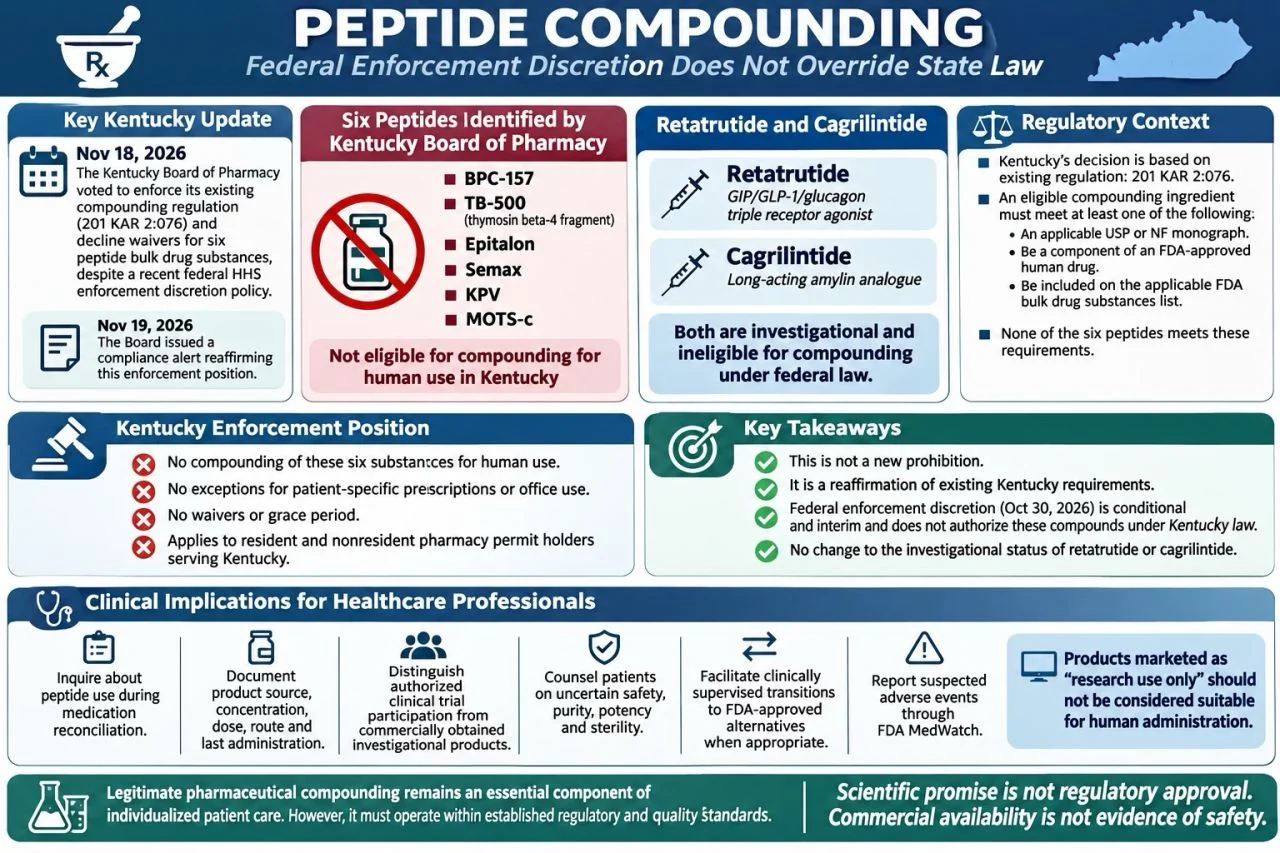
On November 18, 2026, the Kentucky Board of Pharmacy voted to enforce its existing compounding regulation (201 KAR 2:076) and decline waivers for six peptide bulk drug substances covered by a recent federal HHS enforcement discretion policy.
The Board’s November 19 compliance alert identifies:
- BPC-157
- TB-500 (thymosin beta-4 fragment)
- Epitalon
- Semax
- KPV
- MOTS-c
None satisfies Kentucky’s existing ingredient eligibility requirements for human drug compounding.
Kentucky’s enforcement position:
- No compounding of these substances for human use.
- No exceptions for patient-specific prescriptions or office use.
- No waivers or grace period.
- Applies to resident and nonresident pharmacy permit holders serving Kentucky.
This is not a new prohibition. It is a reaffirmation of existing regulatory requirements.
What about retatrutide and cagrilintide?
Although not included in the six-peptide policy, both remain investigational and ineligible for compounding under federal law.
- Retatrutide – GIP/GLP-1/glucagon triple receptor agonist.
- Cagrilintide – long-acting amylin analogue.
Promising clinical trial outcomes cannot be extrapolated to unapproved products obtained from commercial peptide suppliers.
Clinical implications
Healthcare professionals should:
- Specifically inquire about peptide use during medication reconciliation.
- Document the product source, concentration, dose and route.
- Distinguish authorized clinical trial participation from commercially obtained investigational products.
- Counsel patients regarding uncertain safety, potency, purity and sterility.
- Facilitate clinically supervised transitions to FDA-approved alternatives when appropriate.
- Report suspected adverse events through FDA MedWatch.
Products marketed as ‘research use only’ should not be considered suitable for human administration.
Legitimate pharmaceutical compounding remains an essential component of individualized patient care. However, it must operate within established regulatory and quality standards.
Scientific promise is not regulatory approval. Commercial availability is not evidence of safety.
Medication stewardship must extend beyond the medications we prescribe to include the products our patients obtain elsewhere.
References in the first comment.
Views expressed are my own.”
More posts featuring Edward Lee Carter on Hemostasis Today.
-
Nov 28, 2026, 06:42Neema Ngugi: Understanding and Managing Anaemia in Chronic Kidney Disease
-
Nov 28, 2026, 05:40Sneha Singh: Why Can Haemophilic Arthropathy Progress even When Obvious Joint Bleeds are Prevented by Modern Prophylaxis?
-
Nov 28, 2026, 05:37Higher Cerebral Small Vessel Disease Burden Predicts Poorer Thrombectomy Recovery, Though Not Eligibility – International Journal of Stroke
-
Nov 28, 2026, 05:33Cecilia Precious Teko: A Closer Look at Blood
-
Nov 28, 2026, 05:12Eileen Cher: Every Donation Makes a Difference
-
Nov 28, 2026, 04:39Rasiqh Wadud: PIEZO1 and Phosphatidylserine Exposure
-
Nov 28, 2026, 04:23Setayesh Malekzadeh: A Closer Look at Reticulocytes
-
Nov 28, 2026, 04:12Muhammet Özbilen: The Unseen Gap in Iron Deficiency Diagnosis in Women
-
Nov 28, 2026, 02:28Christian Ruff: Is Your Health System Ready for Factor XI/XIa Inhibitors?