


Chaza Alaji: Beyond Routine Tests – Investigating Cerebral Ischemia in Young Adults
Chaza Alaji, Medical Laboratory Specialist and Supervisor at Privat University-Private Laboratory-General Hospital, shared a post on LinkedIn:
“Transient Cerebral Ischemia in a Young Adult: When Routine Tests Are Not Enough
How should we approach a man in his twenties presenting with transient numbness and tingling in the left arm and leg, accompanied by temporary visual loss, despite normal initial imaging and normal PT, aPTT, and INR?
Normal initial investigations do not exclude cerebral ischemia or TIA. MRI with diffusion-weighted imaging (DWI) is more sensitive than CT for detecting early ischemic lesions.
1. Vascular and cardiac causes
Consider:
Cervical artery dissection.
Intracranial vascular abnormalities, including moyamoya.
Cardiac embolic sources, arrhythmias, and patent foramen ovale (PFO).
CTA/MRA, ECG, cardiac monitoring, and echocardiography may be indicated.
Migraine aura is an important differential diagnosis. Gradually spreading positive symptoms may suggest migraine, while sudden negative symptoms may suggest ischemia, although overlap exists.
2. Antiphospholipid syndrome (APS)
APS is an acquired thrombophilia associated with arterial and venous thrombosis.
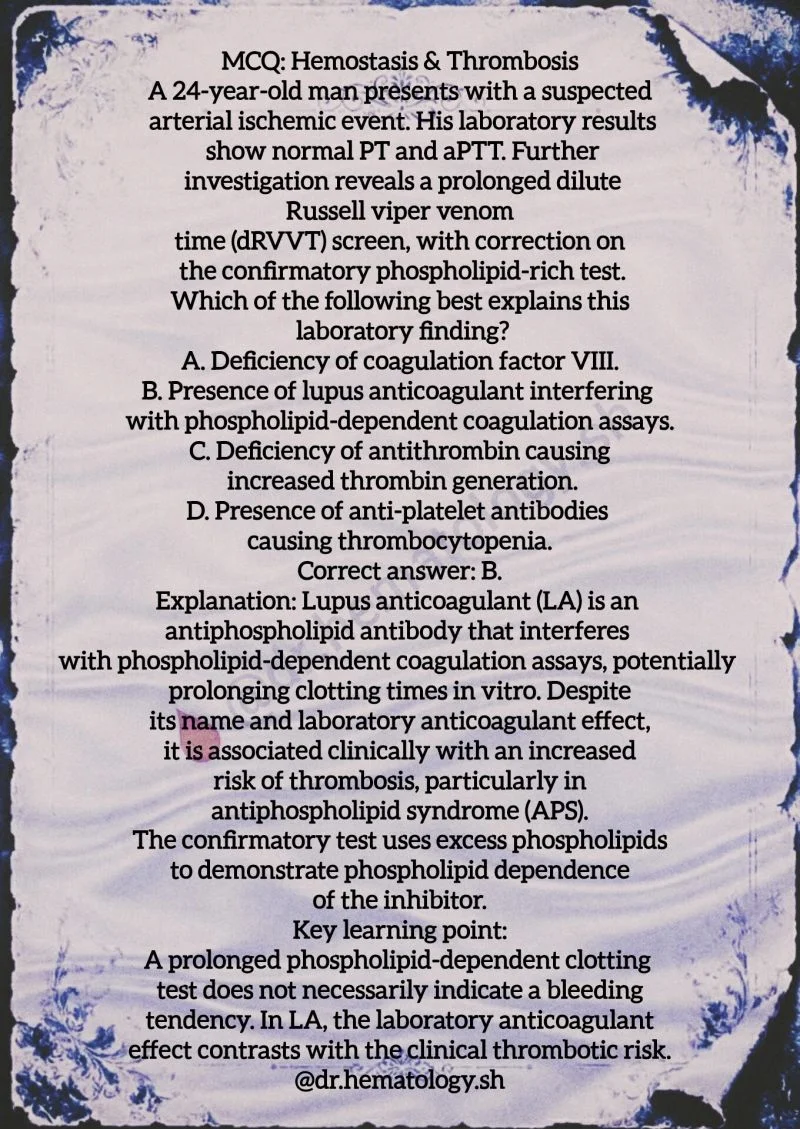
A normal aPTT does not exclude lupus anticoagulant (LA). Targeted testing may include:
- LA (e.g., dRVVT).
- Anticardiolipin antibodies (IgG/IgM).
- Anti-β2-glycoprotein I (IgG/IgM).
Positive antibodies must persist on repeat testing at least 12 weeks apart. Anticoagulants may interfere with LA testing.
3. Natural anticoagulant deficiencies
Protein C, protein S, and antithrombin deficiencies are mainly associated with venous thrombosis; their link to arterial ischemia is less established.
Testing should be selective because acute thrombosis, pregnancy, hormones, and anticoagulants may affect results.
4. Homocysteine and MTHFR
Consider measuring plasma homocysteine when clinically indicated, alongside vitamin B12 and folate assessment.
Markedly elevated levels in young patients may suggest inherited homocystinuria.
Routine MTHFR genetic testing is not recommended for thrombophilia screening. Factor V Leiden and prothrombin G20210A are primarily associated with venous rather than arterial thrombosis.
Key message
Normal PT, aPTT, and INR do not exclude cerebral ischemia or thrombophilia. A structured approach combining urgent neurological assessment, vascular and cardiac investigations, and targeted laboratory testing is essential.”
Other posts featuring Chaza Alaji on Hemostatis Today.
-
Nov 28, 2026, 08:27Mandy Lauw: Sharing Expertise, Advancing Care – Highlights From EXPERT-PE
-
Nov 28, 2026, 08:03Saskia Middeldorp: Science and Collaboration – Learning at the EXPERT-PE Conference
-
Nov 28, 2026, 07:42Edward Lee Carter: Peptide Compounding – Kentucky Draws a Regulatory Line
-
Nov 28, 2026, 06:42Neema Ngugi: Understanding and Managing Anaemia in Chronic Kidney Disease
-
Nov 28, 2026, 05:40Sneha Singh: Why Can Haemophilic Arthropathy Progress even When Obvious Joint Bleeds are Prevented by Modern Prophylaxis?
-
Nov 28, 2026, 05:37Higher Cerebral Small Vessel Disease Burden Predicts Poorer Thrombectomy Recovery, Though Not Eligibility – International Journal of Stroke
-
Nov 28, 2026, 05:33Cecilia Precious Teko: A Closer Look at Blood
-
Nov 28, 2026, 05:12Eileen Cher: Every Donation Makes a Difference
-
Nov 28, 2026, 04:39Rasiqh Wadud: PIEZO1 and Phosphatidylserine Exposure