


Peter A. Everts: PRP Variability and the Path Toward Precision Orthobiologics
Peter A. Everts, Senior Director Medical Affairs at Bioventus, shared a post on LinkedIn about a recent aticle he and his colleagues co-authored, published in International Journal of Molecular Sciences, adding:
“Why do two patients receiving ‘PRP’ so often receive two very different biologics?
That question is at the heart of our new narrative review, now published open access in the International Journal of Molecular Sciences.
Precision Platelet Rich Plasma: Platelet Dose, Platelet Quality, and Platelet Leukocyte Crosstalk as Candidate Regulators of Biological Efficacy
Six years after our 2020 review, we revisit PRP performance with a clear proposition: much of the heterogeneity in clinical outcomes reflects unmeasured variability in the injectate, not a lack of biological effect.
We therefore argue that every preparation should be described by its variables: delivered platelet dose, platelet quality, leukocyte subtype profile, erythrocyte content, plasma components, and activation method.
Viewed this way, PRP is a multicellular biologic whose proteome extends far beyond a handful of growth factors, with plasma proteins and extracellular vesicles contributing substantially.
Platelets themselves vary in size, age, and granule content, and we discuss these features as plausible modifiers of PRP activity, noting that the evidence remains indirect.
A central part of the review examines how platelets communicate with leukocytes via P selectin PSGL 1 and CD40L signaling, platelet leukocyte aggregates, chemokines, and neutrophil extracellular traps, and how this crosstalk may shape neutrophil, monocyte, and macrophage phenotypes.
Clinical data in knee osteoarthritis suggest dose response relationships, although optimal thresholds remain undefined.
We close with the angiogenic, immunomodulatory, and analgesic mechanisms of PRP and the research priorities that could move the field toward precision orthobiologics.
Together, these insights lay the groundwork for an updated PRP platelet metric that moves beyond platelet count alone by integrating the delivered dose with platelet phenotype including size, age, and activation state and with mitochondrial content and function as indicators of platelet quality and bioenergetic capacity.”
Title: Precision Platelet-Rich Plasma: Platelet Dose, Platelet Quality, and Platelet–Leukocyte Crosstalk as Candidate Regulators of Biological Efficacy: A Narrative Review
Authors: Peter A. Everts, José Fábio Lana, Luga Podesta, Eric J. Strauss, Scott A. Rodeo, Leonardo P. Oliveira, Jane Fitzpatrick, Ken Mautner, Thomas Buchheit, Robert W. Alexander, Mikel Sánchez, Diego Delgado, Andre van Zundert, Luyddy Pires, Kentaro Onishi, Lee Smith, Prathap Jayaram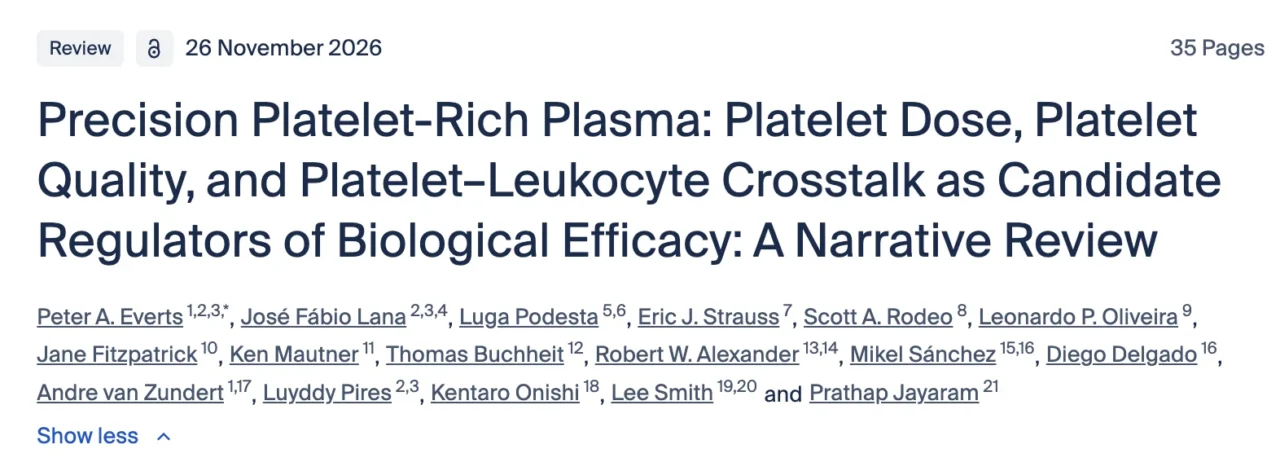
Stay updated on all scientific advances with Hemostasis Today.
-
Nov 28, 2026, 14:12Ahmed Kamal: RBC Morphological Abnormalities – Key Diagnostic Clues in Hematological Disorders
-
Nov 28, 2026, 14:07Hanie Salah: Can Administering 100% Pure Oxygen at 2.5 Times Atmospheric Pressure Actually Reduce Oxidative Damage?
-
Nov 28, 2026, 14:01Intissar Haddiya: Antihypertensive Treatment Lowers Major Cardiovascular Events Even in Low-Risk Patients
-
Nov 28, 2026, 13:55Emily Bury: SVUH Thrombosis Team Raising Awareness for World Thrombosis Day!
-
Nov 28, 2026, 13:55Sanjeev Bagai: SARSCoV2 Infection and Long‐Term Risk of First‐Time PE and DVT
-
Nov 28, 2026, 13:48Does the Location of the Deletion of F8 Gene Matter for ITI outcome? – RPTH Journal
-
Nov 28, 2026, 12:10Yannig Querel: Recognising Undiagnosed Bleeding Disorders in Women and Girls
-
Nov 28, 2026, 12:09Diane J.: Understanding the Impact of Sickle Cell Disease on Children’s Lives
-
Nov 28, 2026, 11:38Ohad Houri: Low-Dose Aspirin for Preeclampsia Prevention in Women with Heart Disease