


Iyas Daghlas: Contemporary Rates of Ischemic Stroke Following High-Risk TIA
Iyas Daghlas, Vascular Neurology Fellow and Stroke Researcher at the University of California, shared on LinkedIn about a recent article he and his colleagues co-authored, adding:
”Our new paper, now out in JAHA — Journal of the American Heart Association, revisits contemporary rates of ischemic stroke following high-risk TIA.
This analysis was motivated by the notion that ABCD2 scores estimate the ‘pre-treatment’ risk of ischemic stroke.
In high-risk patients, these estimates do not incorporate the impact of highly effective contemporary therapies (namely dual antiplatelet therapy).
Indeed, the selection of high-risk patients for potential admission is best informed by the ‘post-treatment’ / residual risk of ischemic stroke after DAPT.
Using high-quality data from the pivotal POINT trial, we aimed to quantify residual ischemic stroke risk following DAPT in patients with high-risk TIA.
What we found:
- As expected, the residual stroke risk is several fold lower than the risk predicted by ABCD2 (2 days: 1.3% vs 5.1%)
- In fact, the observed risk now approximates what we traditionally consider “low-risk” ABCD2 strata (2 day risk historical estimate: 1%)
- Absence of infarction on baseline neuroimaging reduces risk even further—down to 0.8% at 2 days – further highlighting that neuroimaging can powerfully stratify/reclassify risk in patients with clinically diagnosed TIA on the basis of resolved symptoms (many of whom actually have strokes!)
Although ABCD2 may remain useful for identifying patients who benefit from treatment, its historical risk estimates ‘substantially overstate’ risk in patients receiving contemporary therapy.
This raises the question – if residual risk after treatment is this low, is hospital admission for monitoring cost-effective or necessary?
(Diagnostic evaluation is a separate consideration..).
Lastly, these event rates (or lack thereof) may be helpful for planning future clinical trials of high-risk TIA patients.
Grateful to coauthors Michelle Caunca and Anthony Kim!!”
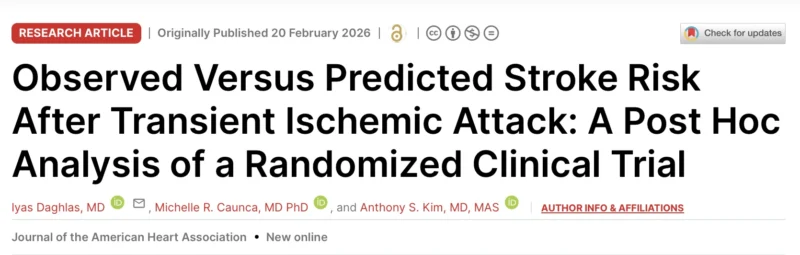
Title: Observed Versus Predicted Stroke Risk After Transient Ischemic Attack: A Post Hoc Analysis of a Randomized Clinical Trial
Authors: Iyas Daghlas, Michelle Caunca, Anthony Kim
Read the Full Article on Journal of the American Heart Association
Stay updated on all scientific advances with Hemostasis Today.
-
Aug 23, 2026, 17:51Gurpreet Kaurr: A Proud Milestone in Haematology and Oncology
-
Aug 23, 2026, 17:33Kathrine Kaspersen: How Voluntary Plasma Donors Helped Transform Denmark’s Plasma Supply
-
Aug 23, 2026, 16:51Sthanu Subramanian: Empagliflozin and a Rise in Hematocrit
-
Aug 23, 2026, 16:50Lale Tokgözoğlu: New PCSK9i Research Published in the European Heart Journal
-
Aug 23, 2026, 16:44Eric Gehrie: Your 2026 Guide to the Essentials of Transfusion Medicine
-
Aug 23, 2026, 16:35Thomas Dayspring: The Overlooked Pathway in Cholesterol Homeostasis
-
Aug 23, 2026, 16:28Evan Mapelu: The People Who Make Cancer Care Meaningful
-
Aug 23, 2026, 16:09Felice Gragnano: New Publication on Aspirin Discontinuation After PCI for Acute Coronary Syndromes
-
Aug 23, 2026, 16:06Mostafa Faisal: Donor Type and Long-Term Quality of Life After HCT for Severe Aplastic Anemia