


Jean Terrier: The Relationship Between DOAC Plasma Concentrations and Clinical Outcomes
Jean Terrier, Clinical Pharmacologist and Toxicologist at University of Rhode Island, shared a post on LinkedIn about a recent article he and his colleagues co-authored, adding:
“Should we publish neutral results?
In clinical research, positive findings often receive the most attention.
But what about studies showing no significant association?
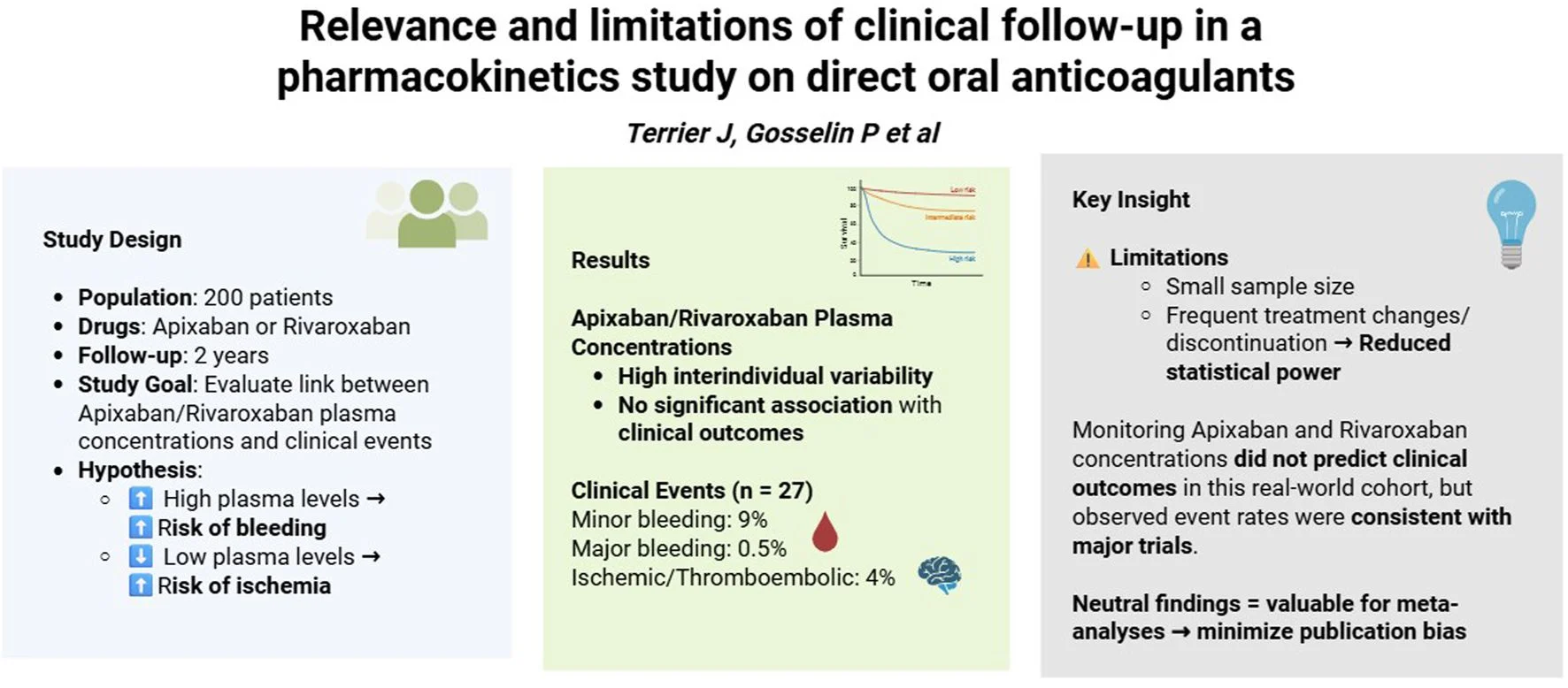
In our recent study – ‘Relevance and limitations of clinical follow-up in a pharmacokinetic study on direct oral anticoagulants’ — conducted within the OptimAT cohort at Geneva University Hospitals, we explored the relationship between DOAC plasma concentrations (apixaban and rivaroxaban) and clinical outcomes over 2 years.
Importantly, the analysis of associations between drug exposure and clinical events was a secondary objective of the OptimAT study.
In 200 hospitalized patients, we analyzed AUC, C-max, and C-trough, and recorded ischemic, thromboembolic, and bleeding events during 2 years follow-up.
What did we observe?
We found no significant association between:
- High apixaban/rivaroxaban plasma concentrations and bleeding events
- Low apixaban/rivaroxaban plasma concentrations and ischemic/thromboembolic events
These are neutral findings – and they matter.
Of course, the study had limitations — limited statistical power due to sample size and a high rate of treatment modifications (41%) reducing the number of evaluable patients.
It is also important to highlight that larger and more recent studies have since reported clearer associations between DOAC concentrations and clinical outcomes.
Our findings do not contradict these data; they reflect the constraints of a pharmacokinetic study not primarily designed for clinical endpoint assessment.
So why publish neutral results?
Because they:
- Help reduce publication bias
- Provide a more balanced and transparent evidence base
- Contribute valuable data for future meta-analyses
- Strengthen scientific integrity and reproducibility
Science advances not only through significant results, but through complete and honest reporting.
Huge thanks to my co-author Pauline Gosselin for her outstanding work in ensuring a rigorous two-year follow-up of all patients, Christophe Combescure, Pierre Fontana, Youssef Daali, and Jean-Luc Reny, and the entire OptimAT Study Team, for their rigorous work, collaboration, and commitment to high-quality clinical research.”
Title: Relevance and limitations of clinical follow-up in a pharmacokinetic study on direct oral anticoagulants
Authors: Jean Terrier, Pauline Gosselin, Christophe Combescure, Pierre Fontana, Youssef Daali, Jean-Luc Reny
Read the Full Article on Frontiers in Pharmacology.
Stay updated on all scientific advances with Hemostasis Today.
-
Sep 25, 2026, 10:49Shefina S: From Presenting to Hosting at TRANSCON 2026
-
Sep 25, 2026, 10:37Michelle Leona Cecil: Hemophilia Advocacy and the Power of Community
-
Sep 25, 2026, 10:13Michael Baria: Platelet Concentration and PRP Outcomes in Partial Rotator Cuff Tears
-
Sep 25, 2026, 09:49Haley Coleman: Volunteering to Support Hemophilia Awareness
-
Sep 25, 2026, 08:55Hitarth Mehta: BHMS Students Gain Practical Exposure to Haemophilia Diagnosis
-
Sep 25, 2026, 07:25Varun Capoor: How Therapeutic Apheresis and Transfusion Medicine Can Complement Clinical Management in SCD
-
Sep 25, 2026, 07:14Manshi Kesharwani: SAK-GQDs Modulate Thrombus Burden and Endothelial Function in Deep Vein Thrombosis
-
Sep 25, 2026, 06:20Farjah Hassan Algahtani: How Can We Better Identify Patients at Risk of Blood Clots after Metabolic and Bariatric Surgery?
-
Sep 25, 2026, 05:59Carla Lewis: Kids Conquering Sickle Disease Joins Nemours Children’s Hospital for 2nd Annual Awareness Event