


Giordano Botta: From the ‘Power of Zero’ to a Precise Understanding of Cardiovascular Risk
Giordano Botta, CEO and Co-Founder of Allelica, shared a post on LinkedIn about a recent article he and his colleagues co-authored, adding:
“For years, cardiology has referred to the ‘power of zero.’
A coronary artery calcium (CAC) score of 0 has been considered highly reassuring, often used to defer preventive therapies such as statins.
But this reassurance does not apply to everyone.
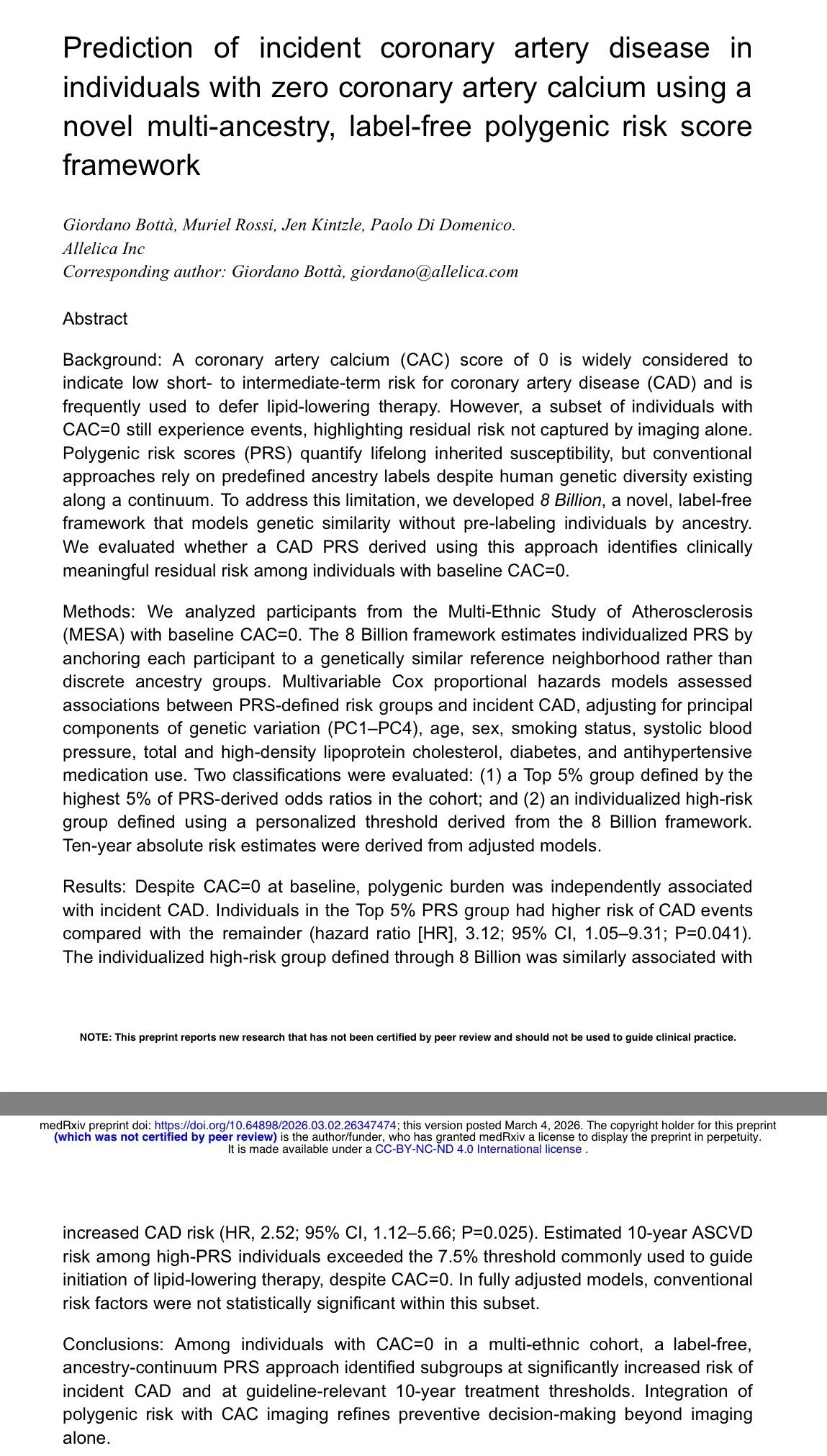
In a new preprint by our team at Allelica, Inc, we show that the concept of the power of zero is misleading for individuals with high polygenic risk for coronary artery disease (CAD).
Even in the absence of calcified plaque, individuals with high PRS have a risk of CAD that exceeds the thresholds used in guidelines to recommend statin therapy.
CAC equals 0 does not eliminate risk when PRS is high.
This finding highlights an important limitation of CAC scoring.
CAC measures calcified plaque, but atherosclerosis frequently begins as non-calcified soft plaque, which is not detected by CAC scans.
Imaging studies using serial coronary CT angiography (CCTA) have shown that individuals with high PRS tend to have a higher burden of non-calcified dangerous plaque and experience faster progression of these plaques over time.
This is where the future of imaging becomes interesting.
CCTA allows visualization of the full spectrum of atherosclerosis, including the soft plaques that CAC scans cannot detect.
In the context of precision prevention, combining genetic risk with advanced imaging will allow us to identify individuals who appear low risk today but are already on a trajectory toward a heart attack.
At Allelica, we believe the future of cardiovascular prevention will integrate:
- Inherited risk (polygenic risk score)
- Advanced imaging (coronary CT angiography)
- Clinical risk factors
Moving from the ‘power of zero’ to a precise understanding of cardiovascular risk.”
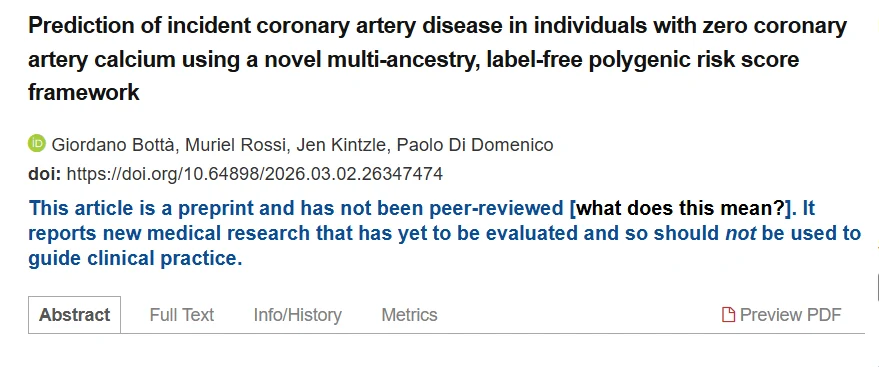
Title: Prediction of incident coronary artery disease in individuals with zero coronary artery calcium using a novel multi-ancestry, label-free polygenic risk score framework
Authors: Giordano Bottà, Muriel Rossi, Jen Kintzle, Paolo Di Domenico
Read the Full Article on MedRxiv
Stay updated with Hemostasis Today.
-
Sep 14, 2026, 20:53YoonHwa An: Rusfertide in Polycythemia Vera – From Clinical Benefit to Strategic Value
-
Sep 14, 2026, 20:52Andres Alberto Mercado Pompa: External Validation of Prognostic Risk Scores in Cerebral Venous Thrombosis
-
Sep 14, 2026, 20:50Balaji Kirushnan: Advancing Regional Citrate Anticoagulation in CRRT – From Experience to Implementation
-
Sep 14, 2026, 20:48Valerie Dehondt: Nutritional Anemia Is Associated With Increased Risk of Severe COPD Exacerbations
-
Sep 14, 2026, 20:46Nupur Choudhury: Exploring AI-Based Detection of Anemia Using Eye and Fingernail Images
-
Sep 14, 2026, 20:44Shamee Shastry: Chart Before You Chase – Diagnosing Drug-Induced Hemolytic Anemia
-
Sep 14, 2026, 20:43David Reiner: Blood Tests That Can Reveal Nutrition Clues
-
Sep 14, 2026, 20:40Giuseppe Biondi Zoccai: Balancing Thrombosis and Bleeding in Acute MI With Hemophilia A
-
Sep 14, 2026, 20:39Kemal Karaagac: Kounis Syndrome as a Possible Cause of Very Late Stent Thrombosis