


Leonardo Roever: Brain Age as a Biomarker of Neuroplasticity and Motor Recovery After Stroke
Leonardo Roever, CEO of Brazilian Evidence-Based Health Network, shared on LinkedIn about a recent article by Gilsoon Park et al, published in The Lancet Digital Health:
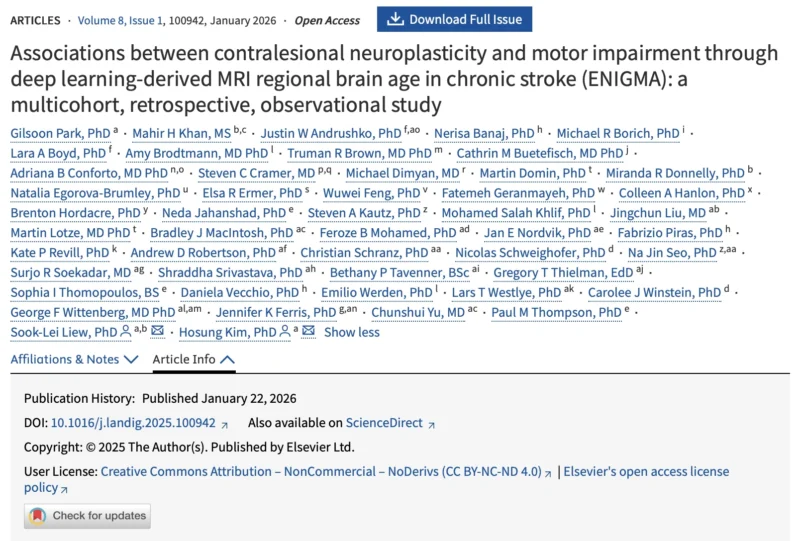
”Associations between contralateral neuroplasticity and motor impairment through deep learning-derived regional brain age in MRI in chronic stroke (ENIGMA): an observational, retrospective, multicenter study
Stroke leads to complex brain changes, both structural and functional, that specifically affect motor outcomes.
Predicted brain age difference (PBAD) has emerged as a sensitive biomarker of both sensorimotor and cognitive function after stroke.
A previous study found a higher global brain PBAD associated with worse motor function after stroke.
However, the association between local stroke lesion burden, regional brain age, and motor impairment is unclear.
This study aimed to investigate the associations between focal lesion damage, regional brain PBAD in both hemispheres, and motor outcomes in chronic stroke, and to identify key predictors of motor impairment.
The findings of this study reveal that larger stroke lesions are associated with accelerated aging in the ipsilateral hemisphere and, paradoxically, with decelerated brain aging in the contralateral hemisphere, suggesting compensatory neural mechanisms.
Regional brain age assessment can serve as a biomarker for neuroplasticity and guide targeted interventions to improve motor recovery after stroke.”
Title: Associations between contralesional neuroplasticity and motor impairment through deep learning-derived MRI regional brain age in chronic stroke (ENIGMA): a multicohort, retrospective, observational study
Authors: Gilsoon Park, Mahir H Khan, Justin W Andrushko, Nerisa Banaj, Michael R Borich, Lara A Boyd, Amy Brodtmann, Truman R Brown, Cathrin M Buetefisch, Adriana B Conforto, Steven C Cramer, Michael Dimyan, Martin Domin, Miranda R Donnelly, Natalia Egorova-Brumley, Elsa R Ermer, Wuwei Feng, Fatemeh Geranmayeh, Colleen A Hanlon, Brenton Hordacre, Neda Jahanshad, Steven A Kautz, Mohamed Salah Khlif, Jingchun Liu, Martin Lotze, Bradley J MacIntosh, Feroze B Mohamed, Jan E Nordvik, Fabrizio Piras, Kate P Revill, Andrew D Robertson, Christian Schranz, Nicolas Schweighofer, Na Jin Seo, Surjo R Soekadar, Shraddha Srivastava, Bethany P Tavenner, Gregory T Thielman, Sophia I Thomopoulos, Daniela Vecchio, Emilio Werden, Lars T Westlye, Carolee J Winstein, George F Wittenberg, Jennifer K Ferris, Chunshui Yu, Paul M Thompson, Sook-Lei Liew, Hosung Kim
Read the Full Article on The Lancet Digital Health
Stay updated on all scientific advances with Hemostasis Today.
-
Sep 14, 2026, 20:53YoonHwa An: Rusfertide in Polycythemia Vera – From Clinical Benefit to Strategic Value
-
Sep 14, 2026, 20:52Andres Alberto Mercado Pompa: External Validation of Prognostic Risk Scores in Cerebral Venous Thrombosis
-
Sep 14, 2026, 20:50Balaji Kirushnan: Advancing Regional Citrate Anticoagulation in CRRT – From Experience to Implementation
-
Sep 14, 2026, 20:48Valerie Dehondt: Nutritional Anemia Is Associated With Increased Risk of Severe COPD Exacerbations
-
Sep 14, 2026, 20:46Nupur Choudhury: Exploring AI-Based Detection of Anemia Using Eye and Fingernail Images
-
Sep 14, 2026, 20:44Shamee Shastry: Chart Before You Chase – Diagnosing Drug-Induced Hemolytic Anemia
-
Sep 14, 2026, 20:43David Reiner: Blood Tests That Can Reveal Nutrition Clues
-
Sep 14, 2026, 20:40Giuseppe Biondi Zoccai: Balancing Thrombosis and Bleeding in Acute MI With Hemophilia A
-
Sep 14, 2026, 20:39Kemal Karaagac: Kounis Syndrome as a Possible Cause of Very Late Stent Thrombosis