


Bhavna Gupta: When Not to Use AI in Clinical Practice
Bhavna Gupta, AI Implementation Consultant, Anesthesiologist and Associate Professor at AIIMS Rishikesh, shared a post on LinkedIn:
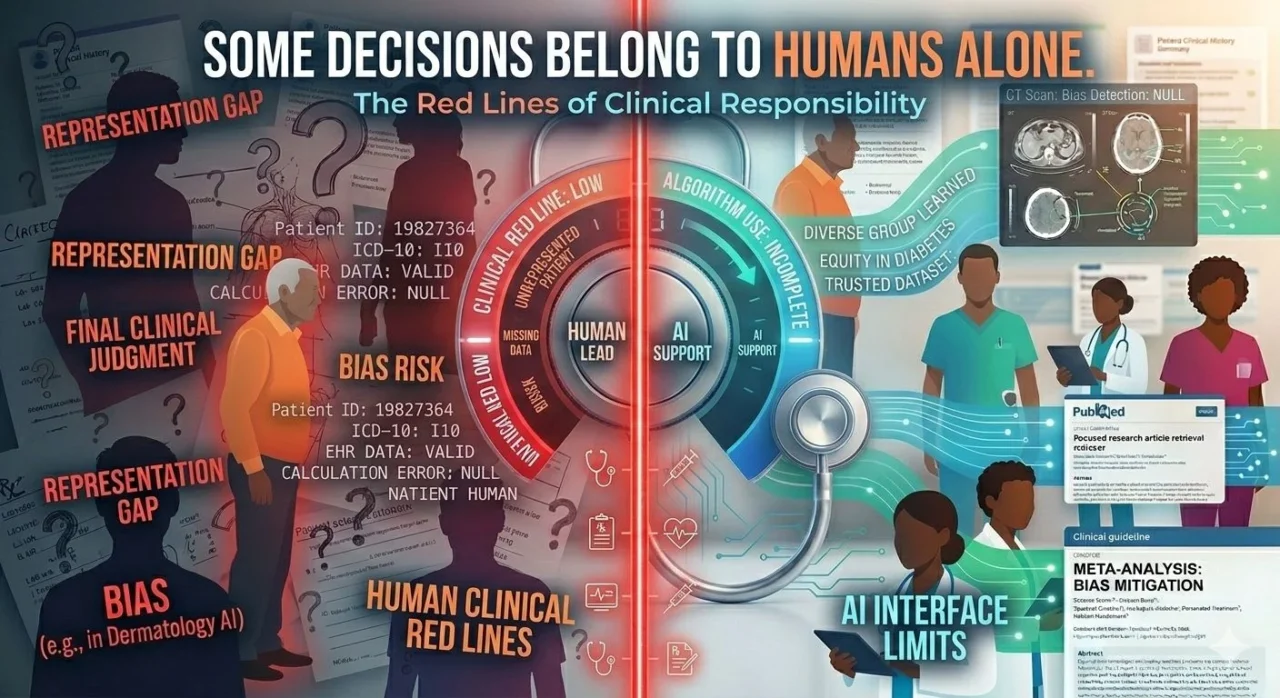
“When not to use AI – the clinical red lines.
A junior doctor asked last week:
‘Can I use AI to help decide ICU triage during a mass casualty?’
My answer was immediate:
‘No.’
Not ‘be careful.’
Not ‘with caution.’
No.
Because some decisions are too important to delegate.
Even partially
Here’s what I’ve learned:
AI can assist thinking.
It cannot replace accountability.
And there are lines – clear, non-negotiable lines-
Where AI should not cross.
Red Line 1: Life-or-death decisions
Do not use AI to:
Decide who gets ICU admission
Determine code status recommendations
Choose between treatment options when outcome is uncertain
Why?
These require moral judgment.
Context you can see but can’t quantify.
Things AI cannot process.
A patient’s wishes. Family dynamics. Quality of life considerations.
These are human decisions.
Red Line 2: Dosing critical medications
Do not use AI to calculate:
Vasopressor doses
Anticoagulation adjustments
Chemotherapy protocols
Insulin sliding scales
Why?
We covered this earlier – AI is terrible at math.
And when the math involves life-sustaining drugs-
Your brain. Not the algorithm.
Red Line 3: Interpreting imaging without verification
Do not use AI to:
Make final radiology diagnoses
Clear trauma scans alone
Determine surgical necessity from images
Why?
AI can miss subtle findings.
Or hallucinate findings that aren’t there.
You need human eyes on critical images.
Red Line 4: Replacing informed consent discussions
Do not use AI to:
Explain procedure risks to patients
Generate consent forms without review
Answer patient questions about surgery
Why?
Consent requires nuance. Reading the room.
Understanding what the patient actually understands.
AI can’t do that.
Red Line 5: Making diagnoses in high-stakes presentations
Do not use AI to:
Diagnose chest pain in the ED
Interpret sepsis workups
Evaluate acute neuro changes
Why?
AI gives probabilities based on patterns.
You see the patient in front of you.
Their color. Their distress. The things that don’t fit the pattern.
That’s diagnostic gold AI doesn’t have.
The framework:
Ask yourself:
‘If this goes wrong, can I defend using AI?’
If the answer involves:
‘Well, the AI said…’
Don’t use AI
These require accountability only humans can give.
The rule I follow:
If a lawyer, ethics committee, or grieving family asks:
‘Why did you make that decision?’
And your answer includes:
‘The AI suggested…’
You crossed a line.
Here’s the truth:
AI is a tool.
Like a stethoscope. Like a lab value.
It informs. It doesn’t decide.
When you use it-
You’re still the one accountable.
Your name. Your license. Your judgment.
So use it where it helps.
Refuse it where it replaces.
The line isn’t always clear.
But when you’re unsure-
Ask yourself:
‘Would I be comfortable explaining this decision to this patient’s family?’
If the answer involves hiding AI’s role-
Don’t use it.”
Stay updated with Hemostasis Today.
-
Nov 17, 2026, 10:41Elena Petkovic։ Highlights from the ISBT–WHO Plasma Management Workshop
-
Nov 17, 2026, 10:30Cheng-Hock Toh: Haematology Is Everywhere – But Is It Recognised?
-
Nov 17, 2026, 10:23Akshat Jain: The Importance of Knowing Your Sickle Cell Status
-
Nov 17, 2026, 10:12Caitlin Raymond: What Does Apheresis Really Cost?
-
Nov 17, 2026, 05:47Multidisciplinary Teams Kick Off SAHF MASAC ES 2026 with Pre-Symposium Workshops – South African Haemophilia Foundation
-
Nov 17, 2026, 05:41Boitumelo Malatji: South African Delegation Advances Advocacy Strategies at NNHF Southern Africa Workshop
-
Nov 17, 2026, 05:36Joining the PACTA Uganda Mental Health and Addiction Community Camp 2026 – Tackle Sickle Cell Africa
-
Nov 17, 2026, 05:30Nathan Connell: Women’s Hematology Summit 2027 to Address Hematologic Health Across the Lifespan
-
Nov 17, 2026, 05:25Mane Kurghinyan: Representing Armenia and HemAI Dynamics at the Falling Walls Lab Global Finale 2026