


Ifeanyichukwu Ifechidere: Which Coagulation Factors Are Not Involved in Bleeding?
Ifeanyichukwu Ifechidere, Specialist Biomedical Scientist at Sheffield Teaching Hospitals NHS Foundation Trust, shared a post on LinkedIn:
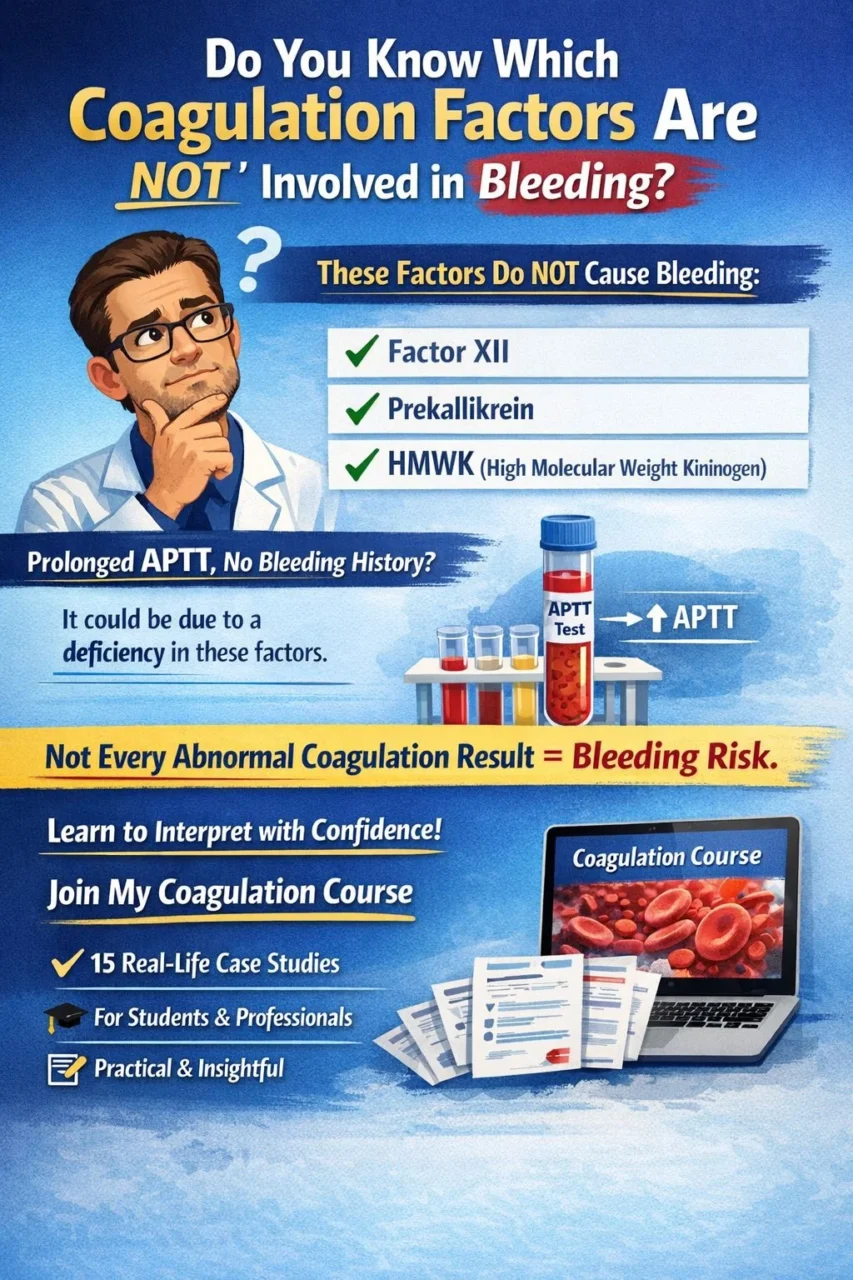
Do You Know Which Coagulation Factors Are Not Involved in Bleeding?
This is one of those questions that separates surface-level understanding from true clinical insight.
Most people assume:
If a coagulation factor is abnormal, bleeding risk must increase.
But that’s not always true.
Let’s break it down:
There are specific factors in the coagulation cascade that, when deficient, do NOT typically cause bleeding:
- Factor XII
- Prekallikrein
- High Molecular Weight Kininogen (HMWK)
Why does this matter?
These factors belong to the contact activation pathway (intrinsic pathway in vitro).
They are essential for laboratory clotting tests (like APTT)
But not essential for in vivo haemostasis
Clinical implication:
A patient may present with:
- Markedly prolonged APTT
- No bleeding history
And the reason could be a deficiency in one of these factors.
This is where many get it wrong:
- Unnecessary delays in procedures
- Incorrect clinical concern
- Misinterpretation of lab results
Key takeaway:
- Not every abnormal coagulation result equals bleeding risk.
- Understanding which factors matter clinically is what transforms you from someone who reports results – to someone who interprets with authority.
Want to build real confidence in coagulation interpretation?
I’ve created a fundamental coagulation course built around 15 real-life case studies – designed for:
- Students
- Interns
- Practicing professionals
This is not theory – heavy learning.
It’s focused on helping you:
- Recognise patterns instantly
- Avoid common interpretation mistakes
- Think like a specialist in real lab scenarios
Because confidence in coagulation doesn’t come from memorising pathways – it comes from seeing and solving real cases.”
More posts featuring Ifeanyichukwu Ifechidere on Hemostasis Today.
-
Oct 7, 2026, 16:44Amor Salah: 2026 NCS/SCCM Guidelines for Managing Antithrombotic-Associated ICH
-
Oct 7, 2026, 16:04NETs in Thrombosis: From Mechanism to Therapeutic Target
-
Oct 7, 2026, 15:28Amir Samimi: Prognostic Value of Platelet Count in Resected HNSCC
-
Oct 7, 2026, 15:21Eloïse Laouenan: Bridging Immunity and Thrombosis in MVTE
-
Oct 7, 2026, 15:10Uthra Sundaram: Honouring Donors During International Plasma Awareness Week
-
Oct 7, 2026, 15:04Daniel Victor Ortigoza: Should Frail Older Patients With AF Switch From VKA to DOACs?
-
Oct 7, 2026, 14:53Susan Noone: Donor Turned Recipient Shares Lifesaving Transfusion Story
-
Oct 7, 2026, 14:49Aimee Burtenshaw: The Impact of the Infected Blood Inquiry on Hospital Transfusion Laboratories
-
Oct 7, 2026, 14:41Vikash Jaiswal: Does Timing Matter for Calcium in Pre-Eclampsia Prevention?