

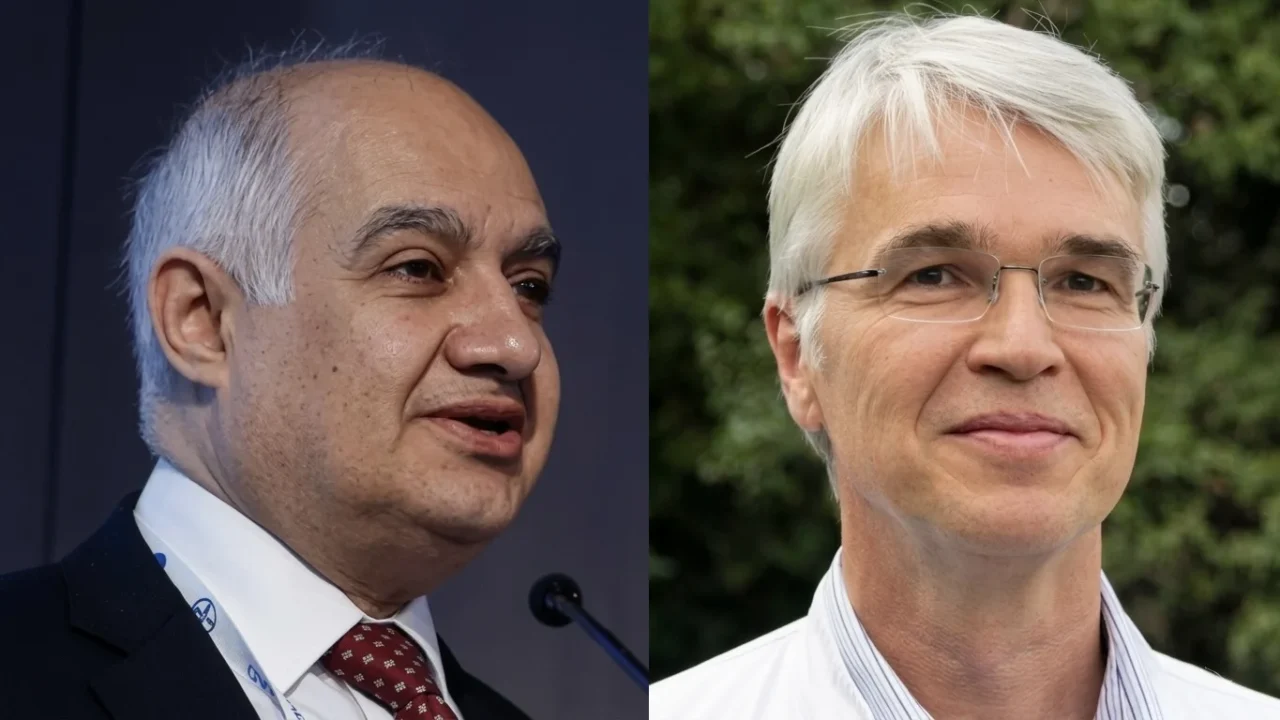
Wolfgang Miesbach: The Benefit with Hemophilia Rebalancing Agents Is Real, But So Are The Open Questions
Wolfgang Miesbach, Professor of Medicine at Frankfurt University Hospital, shared on LinkedIn about a recent article by Michael Makris, published in JTH:
”The benefit is real. But so are the open questions
Great comment by Michael Makris: Rebalancing agents are a genuine paradigm shift – inhibiting antithrombin (fitusiran) or TFPI (concizumab, marstacimab) to restore thrombin generation without replacing the missing factor.
But as Makris notes, the term ‘rebalancing’ gives a false sense of security.
Antithrombin has a normal range of 85–115% – far narrower than any other coagulation factor – and heterozygous deficiency alone carries a 17-fold elevated thrombotic risk.
What the studies show:
- Fitusiran (initial fixed-dose regimen): 23 events/1,000 pt-years – trial paused; the approved AT-based regimen (targeting antithrombin levels of 15–35%) still yields 8/1,000 pt-years
- Befovacimab: development terminated after 3 events – ischaemic stroke, retinal artery occlusion, cerebral venous sinus thrombosis
- Concizumab: 1.9% of trial patients affected – full person-year data still unpublished
- Marstacimab: clean phase 3 BASIS data – but events in phase 1, OLE, and a fatal thrombotic stroke reported at EAHAD 2026
Makris demands: full transparency on thrombotic rates per 1,000 person-years with 95% CIs.
The EUHASS registry, with rates of 0.93/1,000 pt-years for emicizumab and ~2.5 for bypassing agents, sets the reference point.
His pragmatic advice: avoid these agents for now in high-risk patients – elderly, CVD, thrombophilia, obesity, poorly mobile, cancer, uncontrolled hypertension, or family history of thrombosis — until EUHASS and other registries provide robust real-world evidence.
The benefit is real. But so are the open questions.”
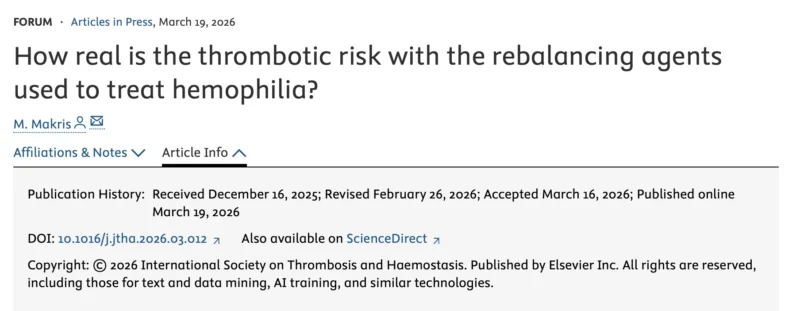
Title: How real is the thrombotic risk with the rebalancing agents used to treat hemophilia?
Author: Michael Makris
Read the Full Article on JTH
Stay updated on all scientific advances with Hemostasis Today.
-
Sep 30, 2026, 01:52Javed Anees: DADA2 – When a Young Stroke Is More Than a Stroke
-
Sep 30, 2026, 01:51How a Venous Thrombus Becomes Revascularized – ISTH
-
Sep 29, 2026, 22:45Victor Agunyego: Paracetamol – The Most Common Drug We Underestimate
-
Sep 29, 2026, 22:42Nova Sinclair: Advancing the Future of Hematology – Meet Our 2027 Organizing Committee
-
Sep 29, 2026, 22:41Lorenz Räber: Intracoronary Imaging in PCI – Why, When, How, and Which Modality?
-
Sep 29, 2026, 22:31Selma Turkovic: Pleased to Deliver the Opening Presentation at Kingston Hospital
-
Sep 29, 2026, 22:31Miguel Teran: Ultrasound and Simulation in Arterial Blood Sampling
-
Sep 29, 2026, 22:28Mohammad Refaei: Navigating Your Career in Hematology From Training to Practice
-
Sep 29, 2026, 22:27Matteo Foschi: 10 Clinical Pearls for Antithrombotic Therapy in Secondary Stroke Prevention