


Akshat Jain: Turning Real-World Data into Smarter Prophylaxis for Hemophilia A
Akshat Jain, Hematology Pediatric Workforce Task Force at American Society of Hematology, shared on LinkedIn about a recent article he and his colleagues co-authored, adding:
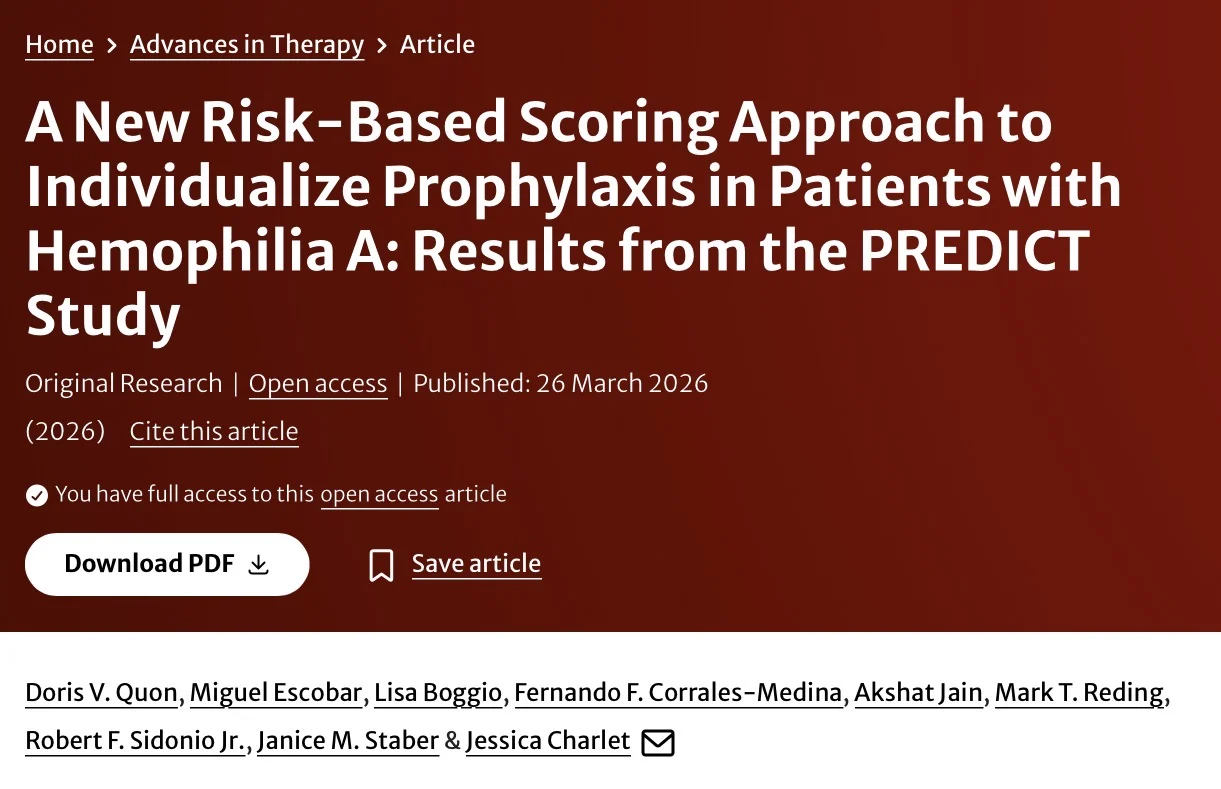
“Excited to share that our paper — A New Risk-Based Scoring Approach to Individualize Prophylaxis in Patients with Hemophilia A: Results from the PREDICT Study – is now published in Advances in Therapy!
Transitioning patients from standard half-life (SHL)
Factor VIII concentrates to extended half-life (EHL) products has relied on trial and error. The PREDICT study set out to change that.
What we did
We developed and prospectively tested a novel clinical risk score built from five real-world phenotypic and biological variables:
- Annualised bleeding rate (ABR)
- Treatment frequency on SHL therapy
- Number of active target joints
- von Willebrand factor (vWF) antigen levels
- Physical activity level
Patients were scored as low, medium, or high risk – and prophylaxis with damoctocog alfa pegol were individualised accordingly, across 14 US centres.
What we found
- 70.6% of evaluable participants achieved a favourable outcome — improved bleeding rates and/or reduced infusion frequency compared to their prior SHL regimen
- Mean annualised bleeding rate fell by 8.01
- Infusion frequency reduced by a mean of 6.9 infusions/month
- 25 active target joints identified at baseline → 96% resolved by study completion
- No participant experienced an increase in monthly infusion frequency
- No new safety signals identified
Why this matters globally
Millions of people with haemophilia A worldwide remain on suboptimal or over-burdensome prophylaxis regimens — not because better options don’t exist, but because clinicians lack a structured, evidence-based tool to guide individualised dosing decisions, particularly when full pharmacokinetic profiling is not feasible.
The PREDICT scoring system offers a practical, reproducible, clinic-ready framework that can be applied without complex PK testing. For patients in resource-limited settings, in community haemophilia treatment centres this has the potential to meaningfully shift the standard of care.
Huge thanks to the Bayer team and co-investigators Robert Sidonio, Fernando Corrales-Medina Jessica Charlet Doris Quon etc. the patients who gave their time, and the teams at all 14 participating centres.”
Title: A New Risk-Based Scoring Approach to Individualize Prophylaxis in Patients with Hemophilia A: Results from the PREDICT Study
Authors: Doris V. Quon, Miguel Escobar, Lisa Boggio, Fernando F. Corrales-Medina, Akshat Jain, Mark T. Reding, Robert F. Sidonio Jr., Janice M. Staber, Jessica Charlet
Read the Full Article on Advanced in Therapy
Stay updated on all scientific advances with Hemostasis Today.
-
Oct 7, 2026, 16:44Amor Salah: 2026 NCS/SCCM Guidelines for Managing Antithrombotic-Associated ICH
-
Oct 7, 2026, 16:04NETs in Thrombosis: From Mechanism to Therapeutic Target
-
Oct 7, 2026, 15:28Amir Samimi: Prognostic Value of Platelet Count in Resected HNSCC
-
Oct 7, 2026, 15:21Eloïse Laouenan: Bridging Immunity and Thrombosis in MVTE
-
Oct 7, 2026, 15:10Uthra Sundaram: Honouring Donors During International Plasma Awareness Week
-
Oct 7, 2026, 15:04Daniel Victor Ortigoza: Should Frail Older Patients With AF Switch From VKA to DOACs?
-
Oct 7, 2026, 14:53Susan Noone: Donor Turned Recipient Shares Lifesaving Transfusion Story
-
Oct 7, 2026, 14:49Aimee Burtenshaw: The Impact of the Infected Blood Inquiry on Hospital Transfusion Laboratories
-
Oct 7, 2026, 14:41Vikash Jaiswal: Does Timing Matter for Calcium in Pre-Eclampsia Prevention?