


Santagata Davide: Atypical Vascular Events Revealing Underlying Clonal Autoinflammation
Santagata Davide, Resident in Internal Medicine at University of Insubria, shared a post on LinkedIn about the recent article published in Internal and Emergency Medicine, co-authored by him and his colleagues, adding:
“Sometimes an unusual thrombosis is much more than a vascular event.
We are excited to share our new case report published in Internal and Emergency Medicine
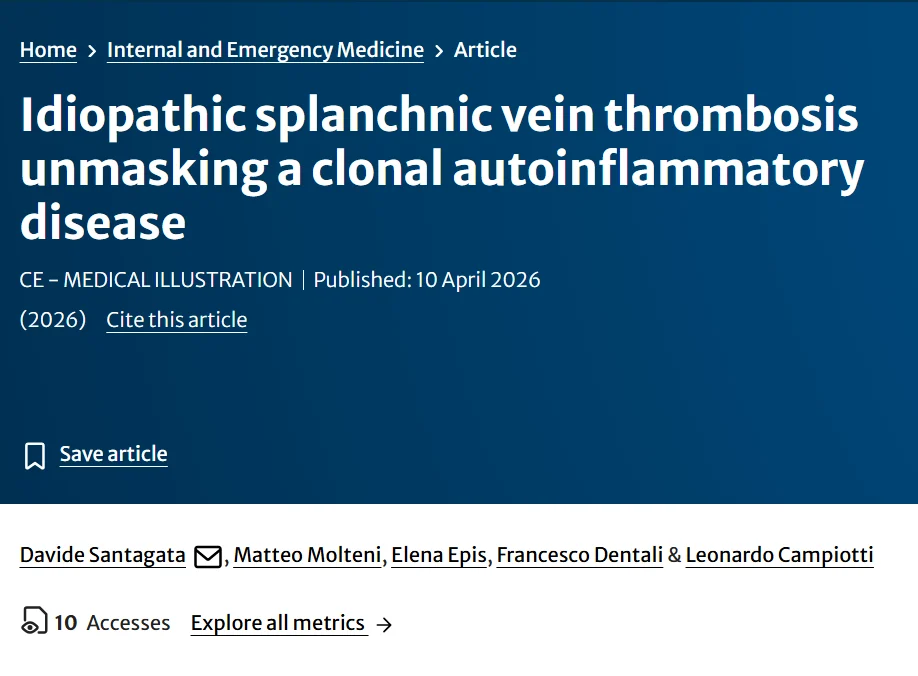
‘Idiopathic splanchnic vein thrombosis unmasking a clonal autoinflammatory disease’
In this case, extensive splanchnic vein thrombosis was the first major clue to an underlying VEXAS syndrome, later confirmed by UBA1 mutation testing.
The report underlines three key clinical messages: unusual-site thrombosis may hide a systemic hematologic/autoinflammatory disorder, the peripheral blood smear can offer an early and accessible diagnostic clue, and management often requires balancing anticoagulation with inflammation control.
Congratulations to all co-authors for this collaborative work.”
Title: Idiopathic splanchnic vein thrombosis unmasking a clonal autoinflammatory disease
Authors: Davide Santagata, Matteo Molteni, Elena Epis, Francesco Dentali, Leonardo Campiotti
Stay updated on all scientific advances with Hemostasis Today.
-
Sep 29, 2026, 13:12Wolfgang Miesbach: Teclistamab Targets the Source of Pathogenic Autoantibodies
-
Sep 29, 2026, 12:37Dan Milikovsky: Uncovering Cerebrovascular Injury in Sickle Cell Disease
-
Sep 29, 2026, 12:02Hajra Malik: Bridging Language Gaps in Hematology With AI
-
Sep 29, 2026, 11:57Joan Montaner: Can Blood Test Identify Intracerebral Hemorrhage Within Minutes?
-
Sep 29, 2026, 11:43From Years Without Answers to Life With Hemophilia Care – WFH
-
Sep 29, 2026, 11:32Sara Al Dallal: Transforming Hemophilia Care Across the Gulf
-
Sep 29, 2026, 11:21Richard Davis: Rapid Rescue in Massive Pulmonary Embolism
-
Sep 29, 2026, 11:14Nissan Brown: Every Step Counts for the Hemophilia Community
-
Sep 29, 2026, 11:03Zain Khalpey: SINGLE AF Adds New Evidence to the Anticoagulation Debate