

Chokri Ben Lamine: Clinical Insights into Glanzmann Thrombasthenia and Heavy Menstrual Bleeding
Chokri Ben Lamine, Adult Hematology and SCT Assistant Consultant at Oncology Center of Excellence at King Faisal Specialist Hospital and Research Center, shared a post on X:
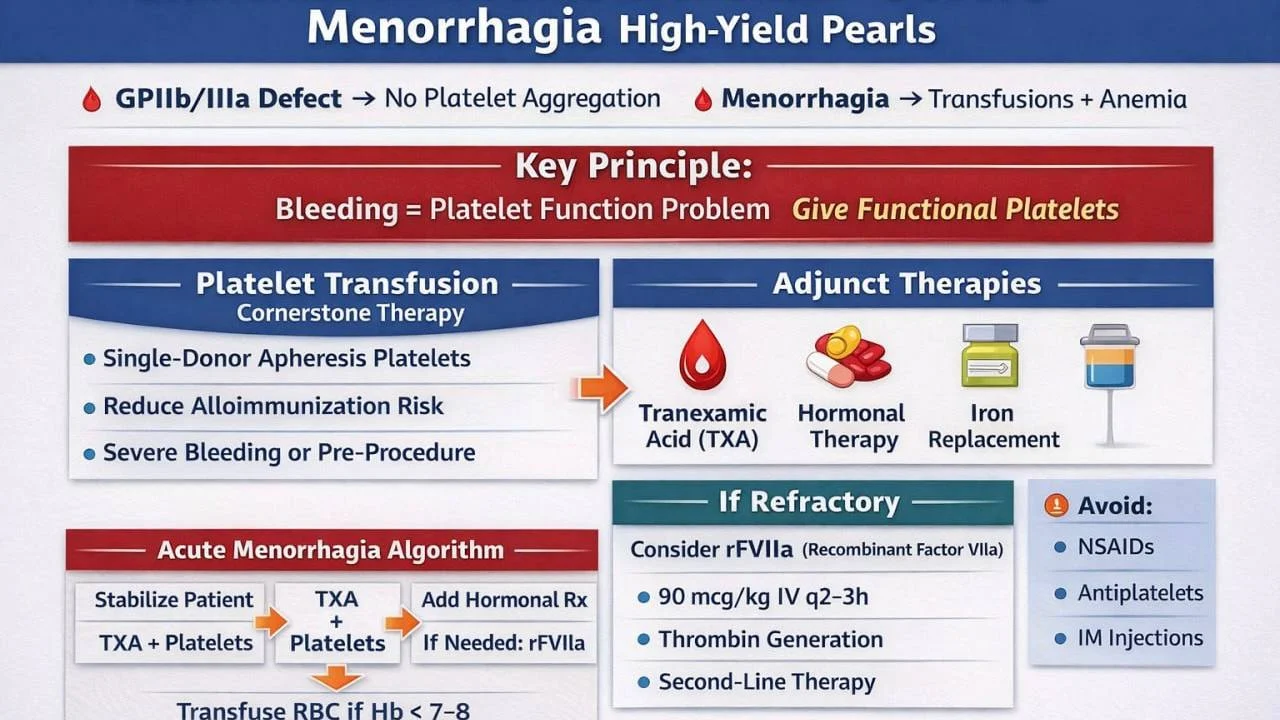
”Glanzmann Thrombasthenia and Severe Menorrhagia – High-Yield Pearls
Glanzmann thrombasthenia (GT) is caused by defect in GPIIb/IIIa (αIIbβ3)
Platelet count normal but aggregation absent resulting in severe mucosal bleeding
Menorrhagia is a major morbidity driver in GT
It leads to recurrent transfusion requirements iron deficiency anemia
Key principle:
- Bleeding is a platelet function problem and give functional platelets
- Platlet transfusion is the cornerstone of therapy in severe bleeding
Rationale:
- GT platelets lack GPIIb/IIIa
- Transfused normal donor platelets restore aggregation
- Provide functional fibrinogen bridging, resulting in a stable clot
This is pathophysiologically targeted therapy
Indication for platelets:
- Severe menorrhagia (Hb drop / hemodynamic impact)
- Active uncontrolled bleeding
- Pre-procedure
Preferred product:
- Single-donor apheresis platelets
- Reduce alloimmunization risk
Major limitation:
Alloimmunization to:
- HLA antigens
- GPIIb/IIIa
Consequence:
- Platelet refractoriness leads to reduced efficacy
Therefore:
- Use platelets judiciously but early when indicated
Adjunct therapy (always combine):
Tranexamic acid (TXA)
- Stabilizes clot
- Dose: 1–1.5 g PO/IV q8h
Hormonal therapy
- Combined OCPs or progesterone
- Decreased endometrial shedding
Iron replacement
- Oral or IV
If platelet refractoriness OR antibodies present:
- rFVIIa (NovoSeven® – eptacog alfa)
Dose:
- 90 µg/kg IV q2–3h
Mechanism:
- Generates thrombin independent of platelet aggregation
rFVIIa is second-line therapy, not first-line.
Avoid overusing rFVIIa early if platelets still effective
Acute severe menorrhagia algorithm:
- Stabilize patient with IV fluids, with or without RBC transfusion.
- Start TXA immediately
- Give platelet transfusion early
- Add hormonal therapy
- If refractory, give rFVIIa.
Transfusion thresholds:
- Hemoglobin less than 7–8 or symptomatic leads to RBC transfusion
Avoid:
- NSAIDs
- Antiplatelets
- IM injections
Long-term prevention:
- Continuous OCPs
- LNG-IUS (Mirena® – levonorgestrel IUD)
- Cyclic TXA during menses
Goal:
- Minimize need for platelet transfusions
Special situations:
- Adolescents require early hormonal control
Pregnancy requires MDT (hematology plus OB)
Pre-procedure:
- Platelets with or without TXA with or without rFVIIa depending on severity
Key clinical insight:
- Platelets treat the defect, whereas rFVIIa bypasses it
Always prioritize platelet transfusion FIRST in severe bleeding
Preserve platelet efficacy by avoiding unnecessary exposure.
Use combined mechanistic and supportive therapy.
OSCE Scenario:
- 20F GT, Hb 6.8, ongoing heavy bleeding
- TXA plus RBC transfusion and apheresis platelets FIRST
- If poor response, rFVIIa
MCQ:
First-line therapy in severe GT menorrhagia (no antibodies)?
- rFVIIa
- TXA alone
- Platelet transfusion
- Warfarin
Answer: C – replaces defective platelet function.”
More posts featuring Chokri Ben Lamine on Hemostasis Today.
-
Sep 22, 2026, 06:35Mahmoud Hanafy: Hayat National Hospitals Achieves AABB Accreditation
-
Sep 22, 2026, 06:01Nikola Pantic: New ASH ITP Guidelines Transform First-Line Treatment
-
Sep 22, 2026, 04:43Michael Cahillane: Highlights From BBTS2026 in Glasgow
-
Sep 22, 2026, 04:15Wolfgang Miesbach: First AAV Gene Therapy Data in Adolescents With Haemophilia B
-
Sep 22, 2026, 04:03Emmanuel J Favaloro: 100 Years of VWD – A Special Virtual Issue
-
Sep 22, 2026, 03:31Mostafa Elshazly: How Is Humidification Used During Non Invasive Ventilation?
-
Sep 22, 2026, 03:05Sumyea Kabir: Jehovah’s Witnesses Update Their Position on Blood Components
-
Sep 22, 2026, 02:33Gerardo Moscatelli: The Spike Protein Cascade – From Endothelial Binding to Vascular Collapse
-
Sep 21, 2026, 20:56George Touma: ApoB Should Be Central to All Lipid Guidlines