


William Wallace: Hidden Vitamin B12 Deficiency and Better Testing Methods
William Wallace, Co-Founder and Chief Scientific Officer at Supplement Success Solutions, shared a post on X about a recent article by Ralph Carme, published in The American Journal of Clinical Nutrition, adding:
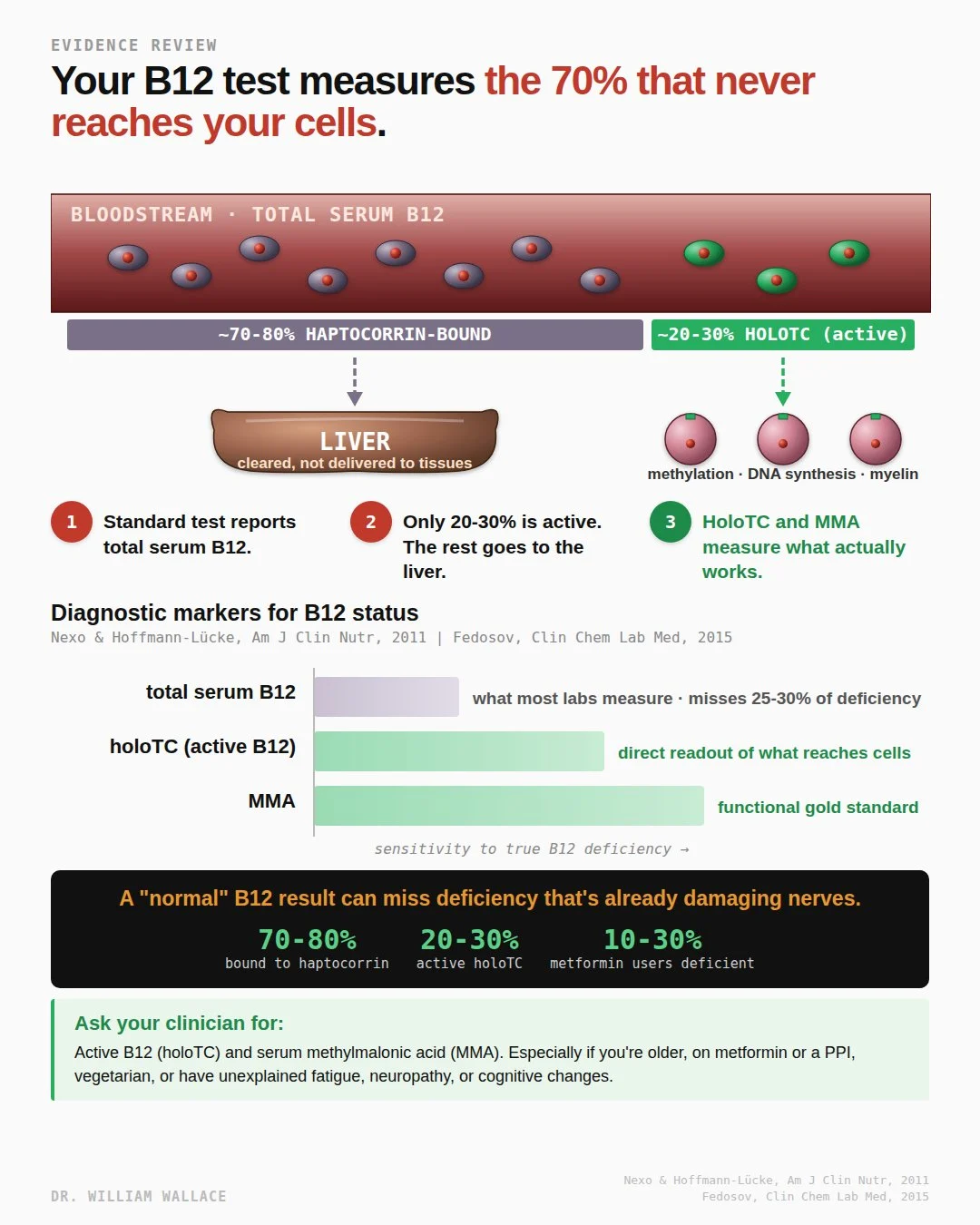
“Your B12 test measures two things and cannot distinguish between them.
Seventy to eighty percent of circulating vitamin B12 is bound to haptocorrin. The liver clears this fraction, and it never reaches the cells.
Twenty to thirty percent is bound to transcobalamin. This is the biologically active fraction that is actually delivered to tissues.
Clinicians refer to it as holo transcobalamin.
Standard serum vitamin B12 tests add both fractions together. A result that appears ‘normal’ can still mask a cellular deficiency, and these
tests miss approximately twenty-five to thirty percent of true deficiency cases.
The better tests are:
- Holo transcobalamin, which directly measures the active fraction
- Methylmalonic acid, which rises only when cellular vitamin B12 is truly insufficient and is considered a functional gold standard
- Homocysteine, which also rises in deficiency but is less specific because it can also increase with low folate, low vitamin B6, mthfr variants, kidney issues, aging. Less specific.
Who should care: adults over sixty years of age, long-term metformin users (ten to thirty percent develop deficiency), proton
pump inhibitor users, vegetarians and vegans, and anyone with unexplained fatigue, neuropathy, cognitive changes, or macrocytic anemia.
If vitamin B12 is reported as normal but symptoms do not match, it is reasonable to request holo transcobalamin and methylmalonic acid
testing.”
Title: Biomarkers of cobalamin (vitamin B-12) status in the epidemiologic setting: a critical overview of context, applications, and performance characteristics of cobalamin, methylmalonic acid, and holotranscobalamin II
Authors: Ralph Carme
Stay updated with Hemostasis Today.
-
Sep 30, 2026, 01:52Javed Anees: DADA2 – When a Young Stroke Is More Than a Stroke
-
Sep 30, 2026, 01:51How a Venous Thrombus Becomes Revascularized – ISTH
-
Sep 29, 2026, 22:45Victor Agunyego: Paracetamol – The Most Common Drug We Underestimate
-
Sep 29, 2026, 22:42Nova Sinclair: Advancing the Future of Hematology – Meet Our 2027 Organizing Committee
-
Sep 29, 2026, 22:41Lorenz Räber: Intracoronary Imaging in PCI – Why, When, How, and Which Modality?
-
Sep 29, 2026, 22:31Selma Turkovic: Pleased to Deliver the Opening Presentation at Kingston Hospital
-
Sep 29, 2026, 22:31Miguel Teran: Ultrasound and Simulation in Arterial Blood Sampling
-
Sep 29, 2026, 22:28Mohammad Refaei: Navigating Your Career in Hematology From Training to Practice
-
Sep 29, 2026, 22:27Matteo Foschi: 10 Clinical Pearls for Antithrombotic Therapy in Secondary Stroke Prevention