


Ney Carter Borges: Endothelial Senescence as a Central Driver of Adipose Dysfunction in Heart Failure and Type 2 Diabetes
Ney Carter Borges, Member Cardiologist of Global Physician Association at Cleveland Clinic Florida, shared a post on LinkedIn:
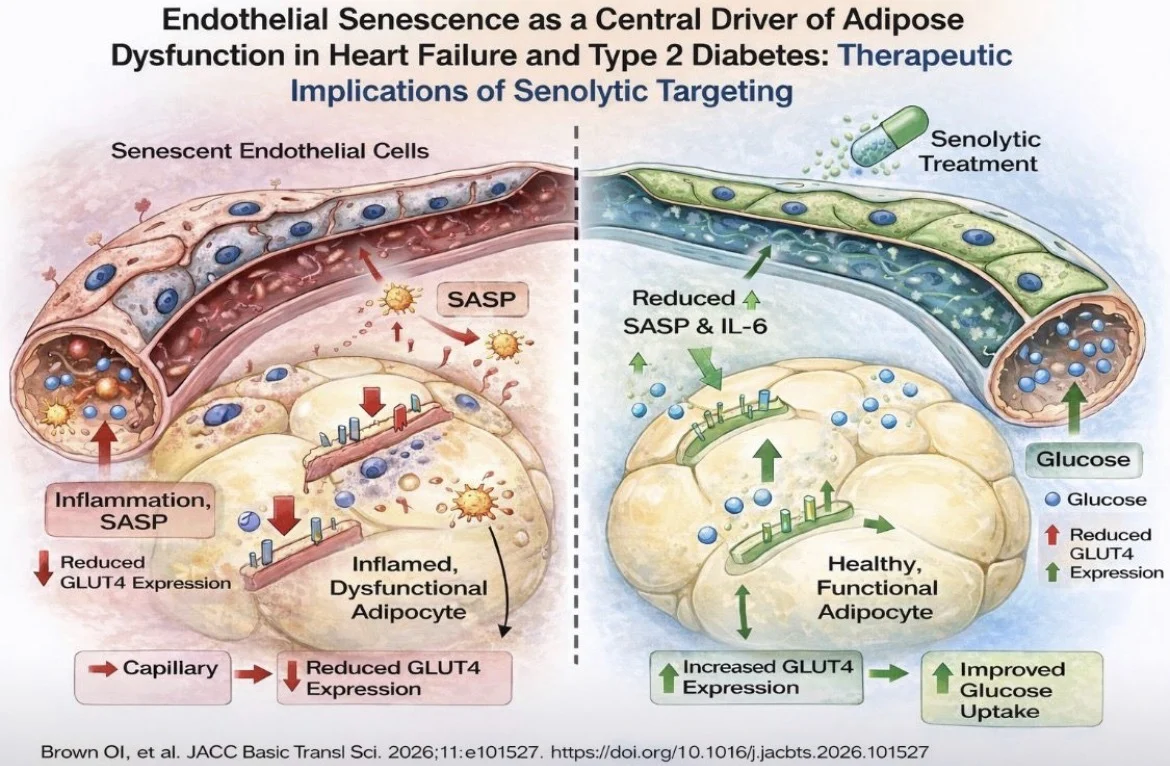
“Endothelial Senescence as a Central Driver of Adipose Dysfunction in Heart Failure and Type 2 Diabetes:
Therapeutic Implications of Senolytic Targeting
This translational study investigates the role of endothelial senescence in subcutaneous adipose tissue (SAT) dysfunction among patients with heart failure and type 2 diabetes (HFDM).
Using human SAT biopsies, the authors demonstrate that microvascular endothelial cells (MVECs) from HFDM patients exhibit a clear senescent phenotype, characterized by increased senescence-associated β-galactosidase activity, reduced proliferative and angiogenic capacity, mitochondrial dysfunction, and a proinflammatory secretory profile (SASP).
Functionally, these senescent endothelial cells drive maladaptive cross-talk with adipocytes.
In coculture experiments, they induce a proinflammatory adipocyte phenotype marked by increased interleukin-6 expression, reduced adiponectin, impaired GLUT4 expression, and decreased glucose uptake—key features of metabolic dysfunction.
This establishes endothelial senescence as a central mechanistic link between vascular dysfunction and impaired adipose metabolic regulation in HFDM.
Importantly, the study identifies digoxin, at therapeutic concentrations, as a potential senolytic agent.
Treatment with digoxin significantly reduced endothelial senescence markers, improved mitochondrial function and proliferation, and attenuated inflammatory cytokine secretion.
Consequently, adipocytes exposed to digoxin-treated endothelial cells demonstrated improved glucose uptake and a more favorable metabolic phenotype.
These findings introduce a novel paradigm in cardiometabolic disease:
Endothelial senescence is not merely a bystander but an active driver of adipose tissue dysfunction.
Therapeutically targeting senescent endothelial cells may therefore represent a promising strategy to restore metabolic homeostasis in high-risk HFDM populations.
However, clinical translation requires caution given digoxin’s narrow therapeutic window and the need for in vivo validation.
Overall, this study provides strong mechanistic insight and opens new avenues for senescence-targeted therapies in cardiometabolic disease.”
More posts featuring Ney Carter Borges on Hemostasis Today.
-
Sep 14, 2026, 16:14Susanne Lager: Isthmin-2 Emerges as an Early Predictor of Pregnancy Complications
-
Sep 14, 2026, 15:53Leonard Valentino: Advancing a New Model of Patient-Led Research
-
Sep 14, 2026, 15:48Adishwar Rao: LAAC vs Oral Anticoagulation in Atrial Fibrillation
-
Sep 14, 2026, 15:36Lesley Van Wyk: Hemolytic Anemia Quick Revision – Tips and Tricks
-
Sep 14, 2026, 15:35Maha Othman: ISTH-BAT Reference Ranges Validated Across Five Continents in Children
-
Sep 14, 2026, 15:30Umberto Pensato։ Left Ventricular Dysfunction and DOAC Benefit in ESUS
-
Sep 14, 2026, 15:22Meral Kayikcioglu: Why Do Women and Men Differ in LDL-C Management?
-
Sep 14, 2026, 15:22James Crowley: The Complex Role of CRP in Cardiovascular Risk and Atherosclerosis
-
Sep 14, 2026, 15:16Factor XIII Deficiency An Often-Missed Bleeding Disorder