


Ifeanyichukwu Ifechidere: The Critical Role of Calibrator Specificity in Anticoagulation Monitoring
Ifeanyichukwu Ifechidere, Specialist Biomedical Scientist at Sheffield Teaching Hospitals NHS Foundation Trust, shared a post on LinkedIn:
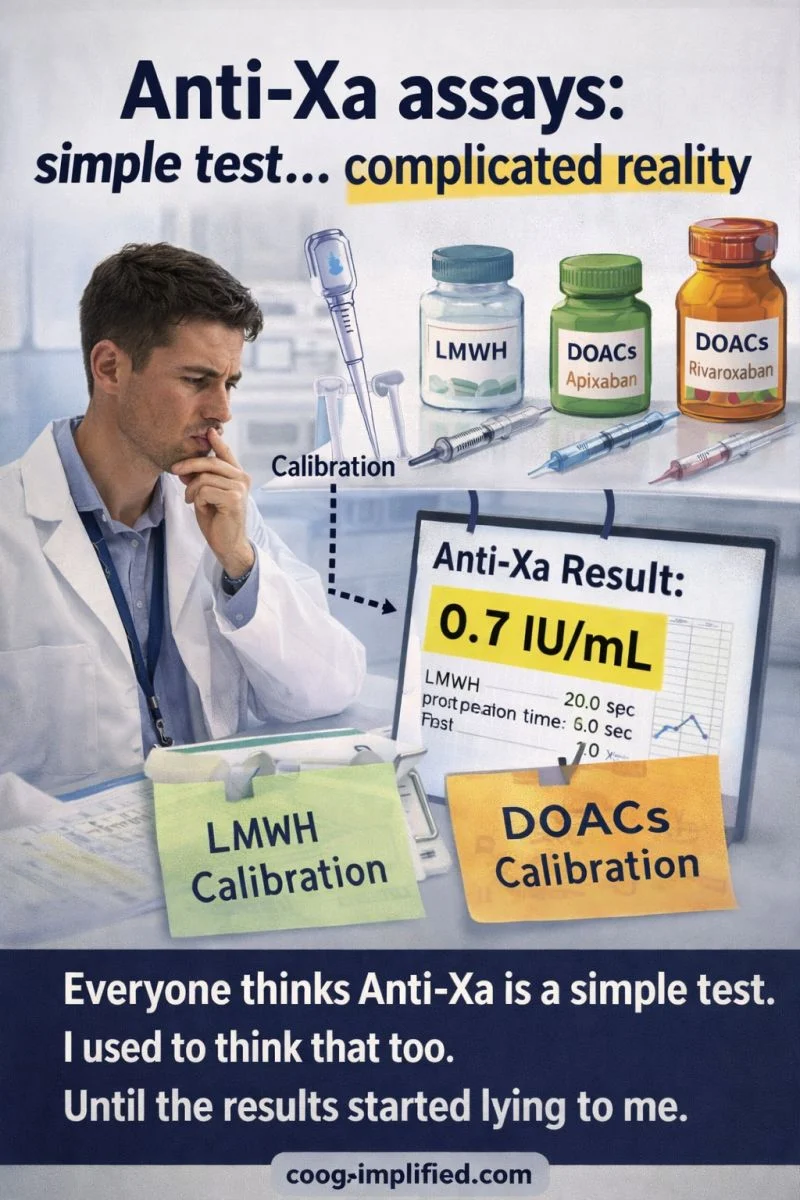
“Everyone thinks Anti-Xa is a simple test.
I used to think that too.
Until the results started lying to me.
Let me save you the confusion
The Anti-Xa assay gets ordered daily in most coag labs.
- Monitoring LMWH in pregnancy.
- Checking heparin levels in renal patients.
- Screening for DOAC levels before emergency surgery.
It looks straightforward on the analyser screen.
Sample in. Number out.
But behind that single number is a minefield that most labs are quietly navigating.
Let’s start with calibration.
Because this is where it gets uncomfortable.
Your Anti-Xa result is only as trustworthy as the calibrator you used to generate it.
And here’s the problem:
Calibrators are not interchangeable.
LMWH calibrators. UFH calibrators.
Each one has a different anti-Xa to anti-IIa ratio.
Different molecular weight distribution. Different pharmacokinetic behaviour in plasma.
If your lab is using a UFH calibrator to monitor a patient on dalteparin?
Your result is wrong.
Not slightly off. Potentially clinically wrong.
Now let’s talk about DOACs.
Because this is where the conversation gets even more complex.
Rivaroxaban. Apixaban. Edoxaban.
All direct Factor Xa inhibitors. All showing up on an Anti-Xa assay.
But here’s what doesn’t get said enough:
A standard Anti-Xa assay calibrated for LMWH will not accurately quantify a DOAC level.
The assay chemistry is similar. The principle feels the same.
- But the binding kinetics are different.
- The calibration curve is different.
- The therapeutic ranges are completely different.
Without a DOAC-specific calibrator and dedicated reference ranges — you are not measuring a DOAC level.
You are generating a number that looks like a result.
There is a difference.
And yet — how many labs are receiving Anti-Xa requests on DOAC patients with no specific calibration?
How many BMS scientists are reporting those numbers without knowing the distinction?
How many clinicians are making anticoagulation decisions on the back of them?
This is not a criticism.
It’s a system problem.
One that starts with education.
Here’s what every BMS working in the coag lab needs to know cold:
- Anti-Xa is not a universal heparin test — it’s a calibrator-specific assay
- LMWH calibrators must match LMWH being monitored
- DOACs require dedicated calibrators — chromogenic DOAC-specific where available
- Therapeutic ranges for LMWH peak/trough are NOT the same as DOAC ranges
- Sample timing relative to dose is critical — and often missing on the request form
- Chromogenic substrate assays can be affected by high bilirubin, lipaemia, and haemolysis — always check interferences.
This is exactly the kind of thing that doesn’t make it into routine training.
If you’re a biomedical scientist who wants to genuinely understand the coag tests you run — not just report the numbers — this is what Coag Simplified was built for.
Subscribe now.
Because understanding why a result means what it means?
That’s what separates a technician from a specialist.”
Other posts featuring Ifeanyichukwu Ifechidere on Hemostasis Today.
-
Sep 18, 2026, 17:48Ronak H. Mistry: Updated ASH Guidelines Bring New Focus to Iron Deficiency
-
Sep 18, 2026, 17:32Hassan Kawtharany: New Ferritin Cutoffs for the Diagnosis of Iron Deficiency With or Without Anemia
-
Sep 18, 2026, 17:20Abhishek G P: GAVE as an Important Cause of Chronic Gastrointestinal Blood Loss
-
Sep 18, 2026, 17:08Irem Karaman Sebin: ASH 2026 Changes a Key Concept in Iron Deficiency
-
Sep 18, 2026, 16:51Adarsh Krishnan Sundara Rajan: Is VTE the Most Underdiagnosed Critical Threat in Modern Healthcare?
-
Sep 18, 2026, 16:19CRISPR and Hemophilia: The Next Frontier of In Vivo Gene Editing
-
Sep 18, 2026, 16:13Christian Irsara: PF4 Immunothrombosis Following Natural Adenovirus Infection
-
Sep 18, 2026, 16:10Leo Nicolai։ The Spleen Emerges as a Key Regulator of Thromboinflammation
-
Sep 18, 2026, 16:05Targeting Factor XI to Reduce Thrombosis Without Compromising Hemostasis – ISTH