


Ney Carter Borges: Endothelial Senescence as a Central Driver of Adipose Dysfunction in Heart Failure and Type 2 Diabetes
Ney Carter Borges, Member Cardiologist of Global Physician Association at Cleveland Clinic Florida, shared a post on LinkedIn:
“Endothelial Senescence as a Central Driver of Adipose Dysfunction in Heart Failure and Type 2 Diabetes:
Therapeutic Implications of Senolytic Targeting
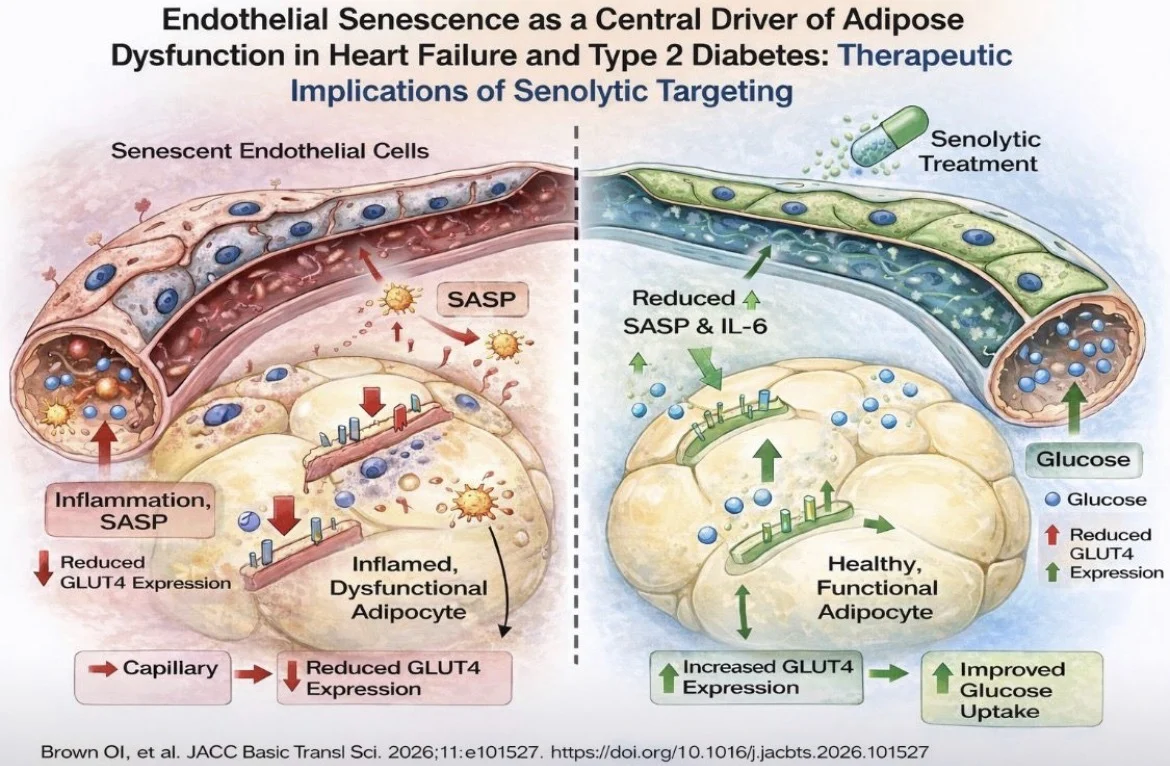
This translational study investigates the role of endothelial senescence in subcutaneous adipose tissue (SAT) dysfunction among patients with heart failure and type 2 diabetes (HFDM).
Using human SAT biopsies, the authors demonstrate that microvascular endothelial cells (MVECs) from HFDM patients exhibit a clear senescent phenotype, characterized by increased senescence-associated β-galactosidase activity, reduced proliferative and angiogenic capacity, mitochondrial dysfunction, and a proinflammatory secretory profile (SASP).
Functionally, these senescent endothelial cells drive maladaptive cross-talk with adipocytes.
In coculture experiments, they induce a proinflammatory adipocyte phenotype marked by increased interleukin-6 expression, reduced adiponectin, impaired GLUT4 expression, and decreased glucose uptake—key features of metabolic dysfunction.
This establishes endothelial senescence as a central mechanistic link between vascular dysfunction and impaired adipose metabolic regulation in HFDM.
Importantly, the study identifies digoxin, at therapeutic concentrations, as a potential senolytic agent.
Treatment with digoxin significantly reduced endothelial senescence markers, improved mitochondrial function and proliferation, and attenuated inflammatory cytokine secretion.
Consequently, adipocytes exposed to digoxin-treated endothelial cells demonstrated improved glucose uptake and a more favorable metabolic phenotype.
These findings introduce a novel paradigm in cardiometabolic disease:
Endothelial senescence is not merely a bystander but an active driver of adipose tissue dysfunction.
Therapeutically targeting senescent endothelial cells may therefore represent a promising strategy to restore metabolic homeostasis in high-risk HFDM populations.
However, clinical translation requires caution given digoxin’s narrow therapeutic window and the need for in vivo validation.
Overall, this study provides strong mechanistic insight and opens new avenues for senescence-targeted therapies in cardiometabolic disease.”
More posts featuring Ney Carter Borges on Hemostasis Today.
-
Sep 13, 2026, 17:28Jim Hoffman: New Potential Predictive Biomarker for Lupus Nephritis
-
Sep 13, 2026, 17:08W. Alberto Sifuentes Giraldo: Urticarial Vasculitis Clinical Features, Systemic Involvement, and Treatment
-
Sep 13, 2026, 16:58Let’s Debunk Some Myths about Blood in SCD – ASCO
-
Sep 13, 2026, 16:56William Wallace: A Magnesium Ion Decides Whether Your Brain Learns or Not
-
Sep 13, 2026, 16:54Meet NBDF’s 2026 Excellence Fellowship Recipients – National Bleeding Disorders Foundation
-
Sep 13, 2026, 16:52Kaloyan Takov: Native Lp(a) Carries a Distinct Triglyceride Signature Linked to Cardiovascular Disease
-
Sep 13, 2026, 16:51Axay Tomar: How Simulation-Based Education Shapes Safer Transfusion Practices
-
Sep 13, 2026, 16:51Edina Cenko: AZURE-HeFH Highlights the LDL-C Treatment Gap in HeFH
-
Sep 13, 2026, 16:49William Aird: Why Is LDH Elevated In Splenic Infarction?