


Muriel De Vos: Real-World Outcomes in Haemophilia A Without Inhibitors in the United States
Muriel De Vos, VP Head of Global Medical Affairs Rare Diseases at Novo Nordisk, shared Wolfgang Miesbach’s post on LinkedIn:
“Real world data highlighting the reality ‘good’ is not good enough!
More than 38 percent of people living with Hemophilia A have breakthrough bleeding, irrespective of the prophylactic treatment they are on.
Still a gap remaining to optimize individual treatment and understanding the trade-offs that people with Hemophilia are making in their daily life, including treatment burden.
Congratulations to the authors.”
Wolfgang Miesbach, Professor of Medicine at Frankfurt University Hospital, shared a post on LinkedIn about a recent article by Allison P. Wheeler et al, published in Hemophilia, adding:
“Even with modern prophylaxis, people with moderate‑to‑severe haemophilia A continue to live with a meaningful burden of bleeding, pain and impaired quality of life.
New real‑world data in haemophilia A: 211 people with moderate‑to‑severe haemophilia A from the US.
Prophylaxis with:
- SHL FVIII in 58 percent of participants
- EHL FVIII in 38 percent of participants
- Emicizumab in 39 percent of participants (many individuals received more than one class over time)
Longitudinal medical records plus PROMIS‑29 and pain surveys.
Some observations from this study:
- Most participants still had more than 1 bleed/year, regardless of prophylaxis class – ‘low’ ABR – no disease burden.
- On‑demand factor use remained frequent, signalling persistent breakthrough bleeding.
- Pain medication use was high across all treatment groups, reflecting substantial chronic pain and pain flares.
- PROMIS‑29 scores showed not only pain interference, but also pronounced sleep disturbance, fatigue, anxiety and restrictions in social roles and activities – impacting work, family life and participation in daily routines.
Why this matters?
These data underline that controlling bleed numbers alone is not enough.
We still need to better individualize therapy, proactively manage chronic and breakthrough pain, and systematically capture patient‑reported outcomes to understand the real physical, emotional and social burden of haemophilia A in clinical practice.
Congratulations to Allison Wheeler and co-authors for highlighting these important unmet needs in haemophilia A.”
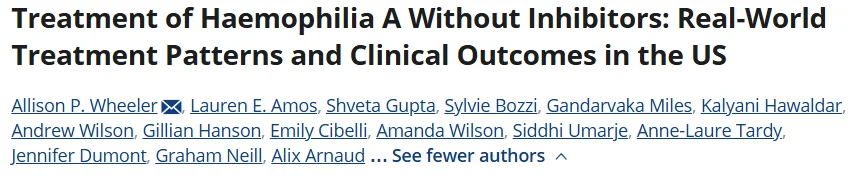
Title: Treatment of Haemophilia A Without Inhibitors: Real-World Treatment Patterns and Clinical Outcomes in the US
Authors: Allison P. Wheeler, Lauren E. Amos, Shveta Gupta, Sylvie Bozzi, Gandarvaka Miles, Kalyani Hawaldar, Andrew Wilson, Gillian Hanson, Emily Cibelli, Amanda Wilson, Siddhi Umarje, Anne-Laure Tardy, Jennifer Dumont, Graham Neill, Alix Arnaud
Stay updated on all scientific advances with Hemostasis Today.
-
Sep 29, 2026, 12:37Dan Milikovsky: Uncovering Cerebrovascular Injury in Sickle Cell Disease
-
Sep 29, 2026, 12:02Hajra Malik: Bridging Language Gaps in Hematology With AI
-
Sep 29, 2026, 11:57Joan Montaner: Can Blood Test Identify Intracerebral Hemorrhage Within Minutes?
-
Sep 29, 2026, 11:43From Years Without Answers to Life With Hemophilia Care – WFH
-
Sep 29, 2026, 11:32Sara Al Dallal: Transforming Hemophilia Care Across the Gulf
-
Sep 29, 2026, 11:21Richard Davis: Rapid Rescue in Massive Pulmonary Embolism
-
Sep 29, 2026, 11:14Nissan Brown: Every Step Counts for the Hemophilia Community
-
Sep 29, 2026, 11:03Zain Khalpey: SINGLE AF Adds New Evidence to the Anticoagulation Debate
-
Sep 29, 2026, 10:54How Does Haemophilia Affect Motor Development in Infants? – EAHAD