


Kalyan Roy: Effect of Irradiation on Red Blood Cells
Kalyan Roy, Transfusion Medicine Specialist at Square Hospitals LTD, shared a post on LinkedIn:
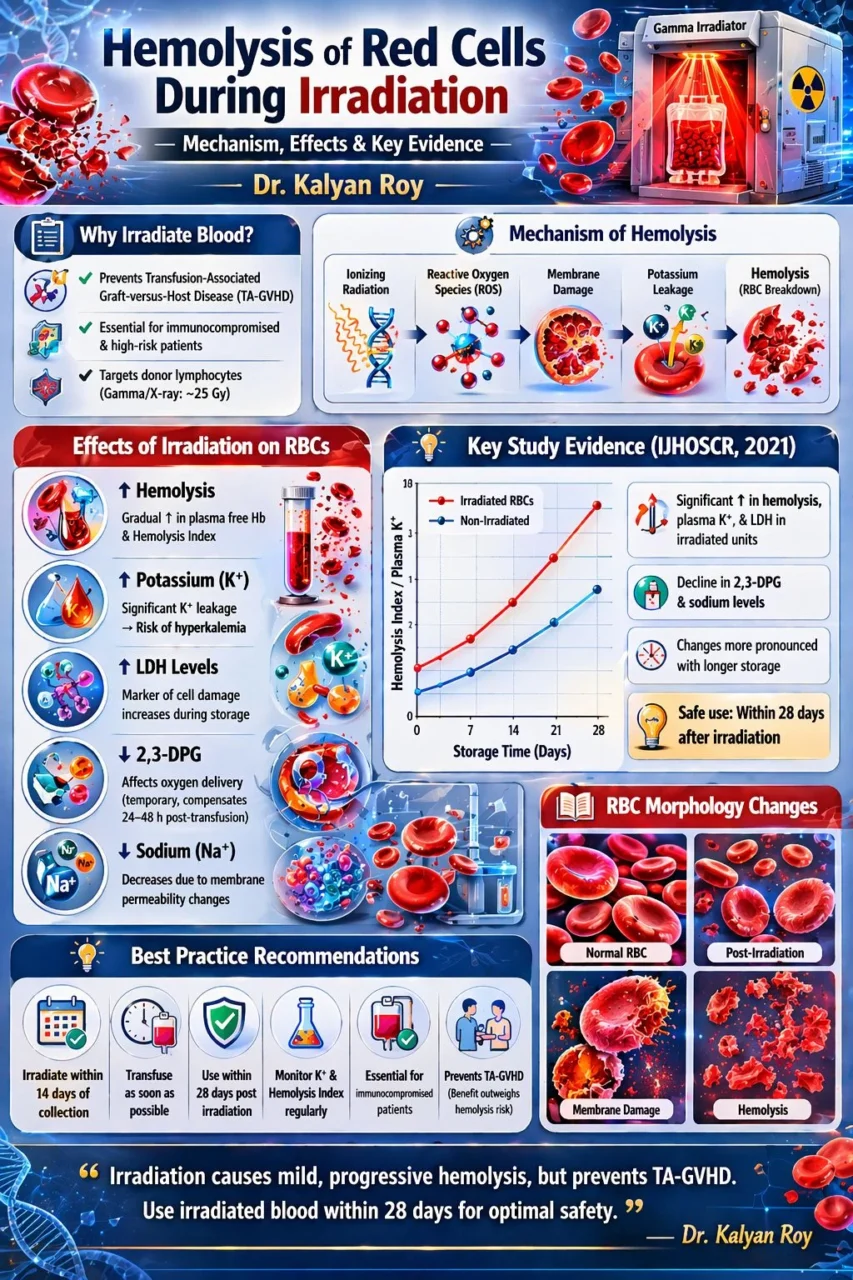
“Effect of Irradiation on Red Blood Cells (RBCs)
Why do we irradiate blood?
Blood irradiation is primarily performed to prevent transfusion-associated graft-versus-host disease – a rare but often fatal transfusion complication.
However, this life-saving step comes with measurable effects on RBC quality during storage.
Key Scientific Insights
Storage Lesions After Irradiation
Irradiation accelerates biochemical and structural changes in RBCs:
Increases
- Hemolysis (RBC breakdown)
- Plasma potassium (K⁺)
- Lactate dehydrogenase (LDH)
Decreases
- Sodium (Na⁺)
- 2,3-DPG impacts oxygen delivery
Hemolysis Pattern
- Gradual and progressive rise during storage
- Higher in irradiated units vs non-irradiated
- Most evident with prolonged storage (≈ Day 28)
Key Point: Hemolysis is not immediate – it develops over time
Potassium Leakage
- Begins within 24 hours post-irradiation
- Peaks between Day 7–28
Clinical Concern:
Risk of hyperkalemia, especially in:
- Neonates
- Massive transfusion cases
- Renal impairment
Impact of Storage Duration
Longer storage after irradiation leads to greater RBC damage
Progressive decline in quality:
- Increased hemolysis
- Increased biochemical alterations
Late storage: highest risk period
Best Practice Recommendations
- Irradiate within 14 days of collection
- Use irradiated blood as early as possible
- Maximum shelf-life: 28 days post-irradiation
Take-Home Message
Irradiation does increase hemolysis – but:
- It is mild and progressive
- Becomes significant mainly with prolonged storage
- Remains clinically acceptable within guidelines
Most importantly:
The benefit of preventing TA-GVHD far outweighs these risks.
Optimizing timing and storage is the key to balancing safety and efficacy in transfusion medicine.”
Find more posts featuring Kalyan Roy on Hemostasis Today.
-
Sep 30, 2026, 01:52Javed Anees: DADA2 – When a Young Stroke Is More Than a Stroke
-
Sep 30, 2026, 01:51How a Venous Thrombus Becomes Revascularized – ISTH
-
Sep 29, 2026, 22:45Victor Agunyego: Paracetamol – The Most Common Drug We Underestimate
-
Sep 29, 2026, 22:42Nova Sinclair: Advancing the Future of Hematology – Meet Our 2027 Organizing Committee
-
Sep 29, 2026, 22:41Lorenz Räber: Intracoronary Imaging in PCI – Why, When, How, and Which Modality?
-
Sep 29, 2026, 22:31Selma Turkovic: Pleased to Deliver the Opening Presentation at Kingston Hospital
-
Sep 29, 2026, 22:31Miguel Teran: Ultrasound and Simulation in Arterial Blood Sampling
-
Sep 29, 2026, 22:28Mohammad Refaei: Navigating Your Career in Hematology From Training to Practice
-
Sep 29, 2026, 22:27Matteo Foschi: 10 Clinical Pearls for Antithrombotic Therapy in Secondary Stroke Prevention