


Ney Carter Borges: Randomized Trial of the Vascular Effects of Low-Dose Colchicine in High-Risk Type 2 Diabetes
Ney Carter Borges, Member Cardiologist of Global Physician Association at Cleveland Clinic Florida, shared a post on LinkedIn:
“Colchicine and Arterial Stiffness in High-Risk Type 2 Diabetes: A Randomized Trial Perspective
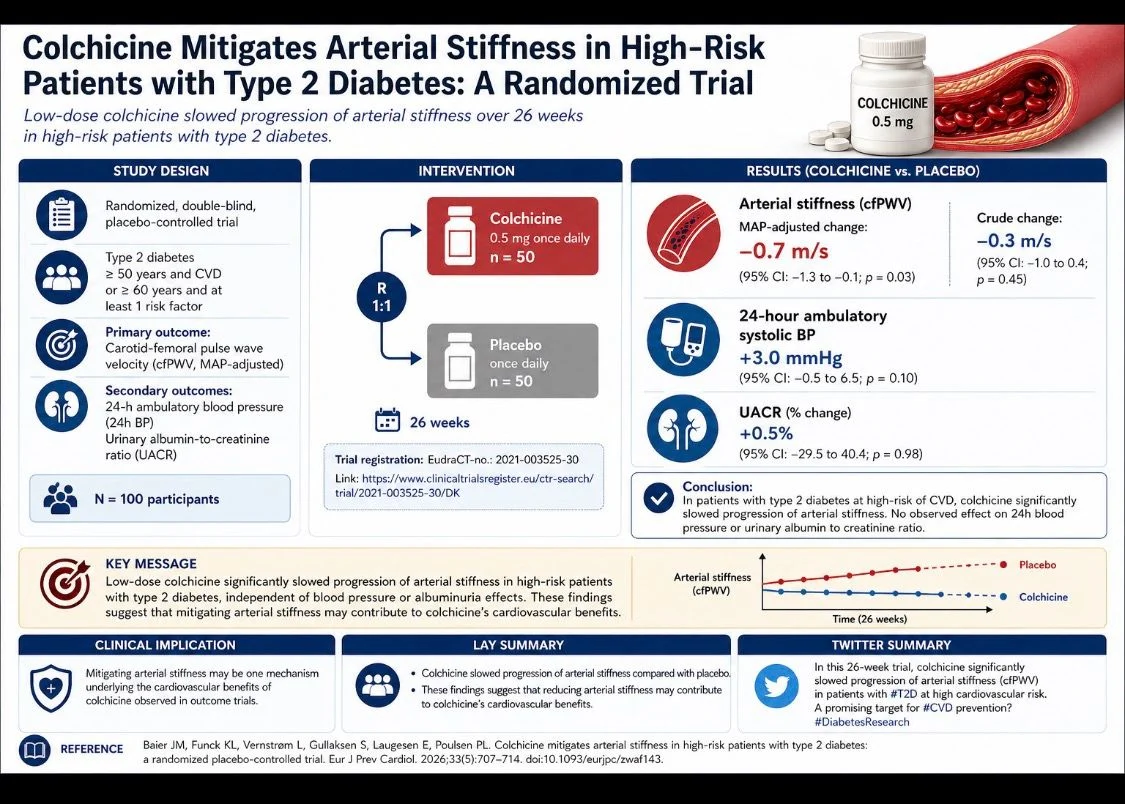
This randomized, double-blind, placebo-controlled trial evaluates the vascular effects of low-dose colchicine in patients with type 2 diabetes at elevated cardiovascular risk.
Over a 26-week period, 100 participants were assigned to colchicine 0.5 mg daily or placebo, with arterial stiffness assessed via carotid–femoral pulse wave velocity (cfPWV) as the primary endpoint.
The study demonstrates a statistically significant reduction in arterial stiffness progression with colchicine when adjusted for mean arterial pressure (ΔcfPWV minus 0.7 m/s; 95% CI minus 1.3 to minus 0.1; p equal to 0.03), suggesting a potential mechanistic link between anti-inflammatory therapy and vascular compliance improvement.
Notably, crude analyses without adjustment did not reach statistical significance, highlighting the hemodynamic interplay between blood pressure and arterial stiffness.
Secondary outcomes revealed no meaningful impact on 24-hour ambulatory blood pressure or albuminuria, indicating that colchicine’s vascular benefits may occur independently of systemic hemodynamic or renal effects.
Additionally, while a modest reduction in C-reactive protein was observed, other inflammatory biomarkers remained unchanged, suggesting a selective or limited anti-inflammatory modulation.
Clinically, these findings are relevant given that a 1.0 m/s increase in cfPWV is associated with approximately 15% higher cardiovascular risk.
Thus, the observed reduction may translate into meaningful long-term benefits, although this remains speculative.
In conclusion, colchicine appears to attenuate arterial stiffness progression in high-risk diabetic populations, reinforcing its role as a potential adjunctive strategy in residual cardiovascular risk reduction, pending confirmation from larger outcome-driven trials.”
Other posts featuring Ney Carter Borges on Hemostasis Today.
-
Sep 30, 2026, 01:52Javed Anees: DADA2 – When a Young Stroke Is More Than a Stroke
-
Sep 30, 2026, 01:51How a Venous Thrombus Becomes Revascularized – ISTH
-
Sep 29, 2026, 22:45Victor Agunyego: Paracetamol – The Most Common Drug We Underestimate
-
Sep 29, 2026, 22:42Nova Sinclair: Advancing the Future of Hematology – Meet Our 2027 Organizing Committee
-
Sep 29, 2026, 22:41Lorenz Räber: Intracoronary Imaging in PCI – Why, When, How, and Which Modality?
-
Sep 29, 2026, 22:31Selma Turkovic: Pleased to Deliver the Opening Presentation at Kingston Hospital
-
Sep 29, 2026, 22:31Miguel Teran: Ultrasound and Simulation in Arterial Blood Sampling
-
Sep 29, 2026, 22:28Mohammad Refaei: Navigating Your Career in Hematology From Training to Practice
-
Sep 29, 2026, 22:27Matteo Foschi: 10 Clinical Pearls for Antithrombotic Therapy in Secondary Stroke Prevention