


Kalyan Roy: A New Blood Group System Has Been Discovered
Kalyan Roy, Transfusion Medicine Specialist at Square Hospitals LTD, shared a post on LinkedIn:
“A New Blood Group Has Been Discovered – And Only One Person in the World Is Known to Have It.
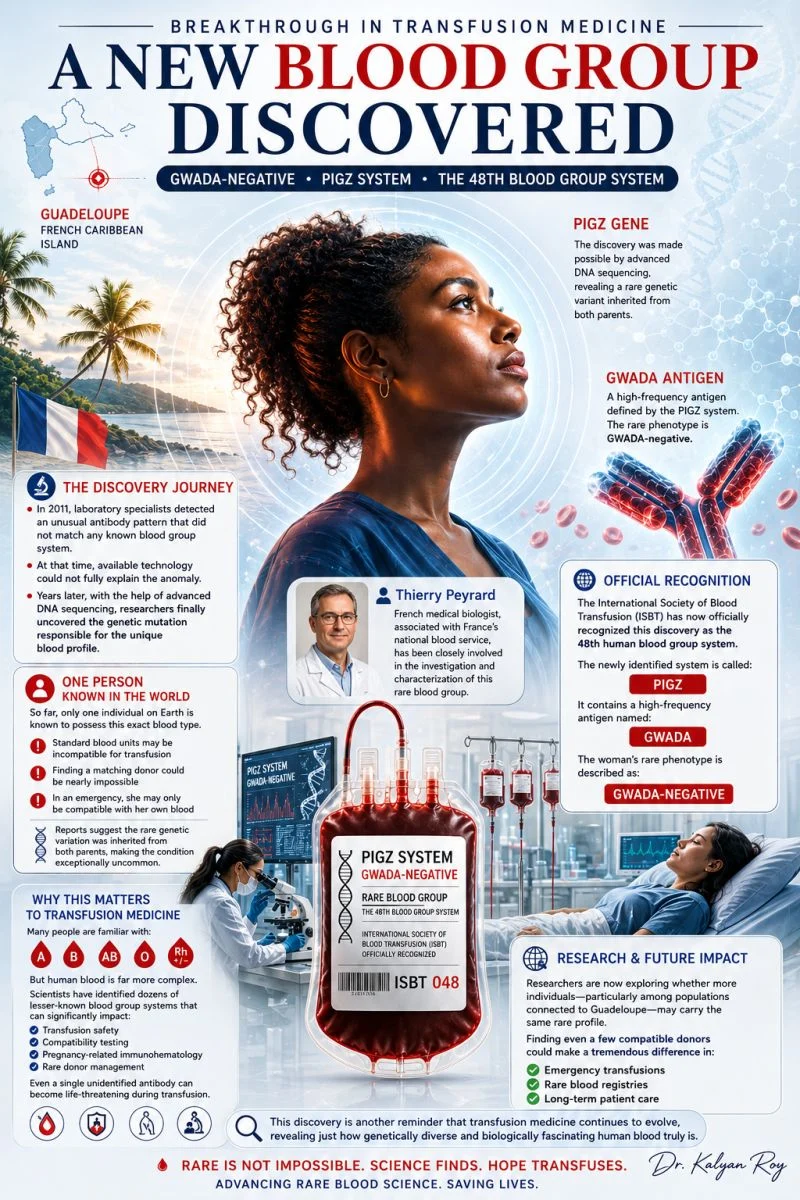
In a remarkable breakthrough in transfusion medicine, French scientists have identified an ultra-rare blood type linked to a woman from Guadeloupe, a French Caribbean island.
What began as a routine pre-surgical blood test in Paris turned into a scientific mystery that would take years to solve.
The Discovery Journey
- In 2011, laboratory specialists detected an unusual antibody pattern that did not match any known blood group system.
- At that time, available technology could not fully explain the anomaly.
- Years later, with the help of advanced DNA sequencing, researchers finally uncovered the genetic mutation responsible for the unique blood profile.
Official Recognition
The International Society of Blood Transfusion (ISBT) has now officially recognized this discovery as the 48th human blood group system.
The newly identified system is called: PIGZ
It contains a high-frequency antigen named: GWADA
The woman’s rare phenotype is described as: GWADA-negative
Why This Is Extraordinary
So far, only one individual on Earth is known to possess this exact blood type.
This means:
- Standard blood units may be incompatible for transfusion
- Finding a matching donor could be nearly impossible
- In an emergency, she may only be compatible with her own blood
Reports suggest the rare genetic variation was inherited from both parents, making the condition exceptionally uncommon.
French medical biologist Thierry Peyrard, associated with France’s national blood service, has been closely involved in the investigation and characterization of this rare blood group.
Why This Matters to Transfusion Medicine
Many people are familiar with:
- A
- B
- AB
- O
- Rh positive/negative
But human blood is far more complex.
Scientists have identified dozens of lesser-known blood group systems that can significantly impact:
- Transfusion safety
- Compatibility testing
- Pregnancy-related immunohematology
- Rare donor management
Even a single unidentified antibody can become life-threatening during transfusion.
Researchers are now exploring whether more individuals—particularly among populations connected to Guadeloupe—may carry the same rare profile.
Finding even a few compatible donors could make a tremendous difference in:
- Emergency transfusions
- Rare blood registries
- Long-term patient care
This discovery is another reminder that transfusion medicine continues to evolve, revealing just how genetically diverse and biologically fascinating human blood truly is.”
Find more posts featuring Kalyan Roy on Hemostasis Today.
-
Sep 29, 2026, 22:45Victor Agunyego: Paracetamol – The Most Common Drug We Underestimate
-
Sep 29, 2026, 22:42Nova Sinclair: Advancing the Future of Hematology – Meet Our 2027 Organizing Committee
-
Sep 29, 2026, 22:41Lorenz Räber: Intracoronary Imaging in PCI – Why, When, How, and Which Modality?
-
Sep 29, 2026, 22:31Selma Turkovic: Pleased to Deliver the Opening Presentation at Kingston Hospital
-
Sep 29, 2026, 22:31Miguel Teran: Ultrasound and Simulation in Arterial Blood Sampling
-
Sep 29, 2026, 21:47Javed Anees: DADA2 – When a Young Stroke Is More Than a Stroke
-
Sep 29, 2026, 22:28Mohammad Refaei: Navigating Your Career in Hematology From Training to Practice
-
Sep 29, 2026, 22:27Matteo Foschi: 10 Clinical Pearls for Antithrombotic Therapy in Secondary Stroke Prevention
-
Sep 29, 2026, 22:26A Global Call for Action on Cardiovascular Health on World Heart Day – ISTH