

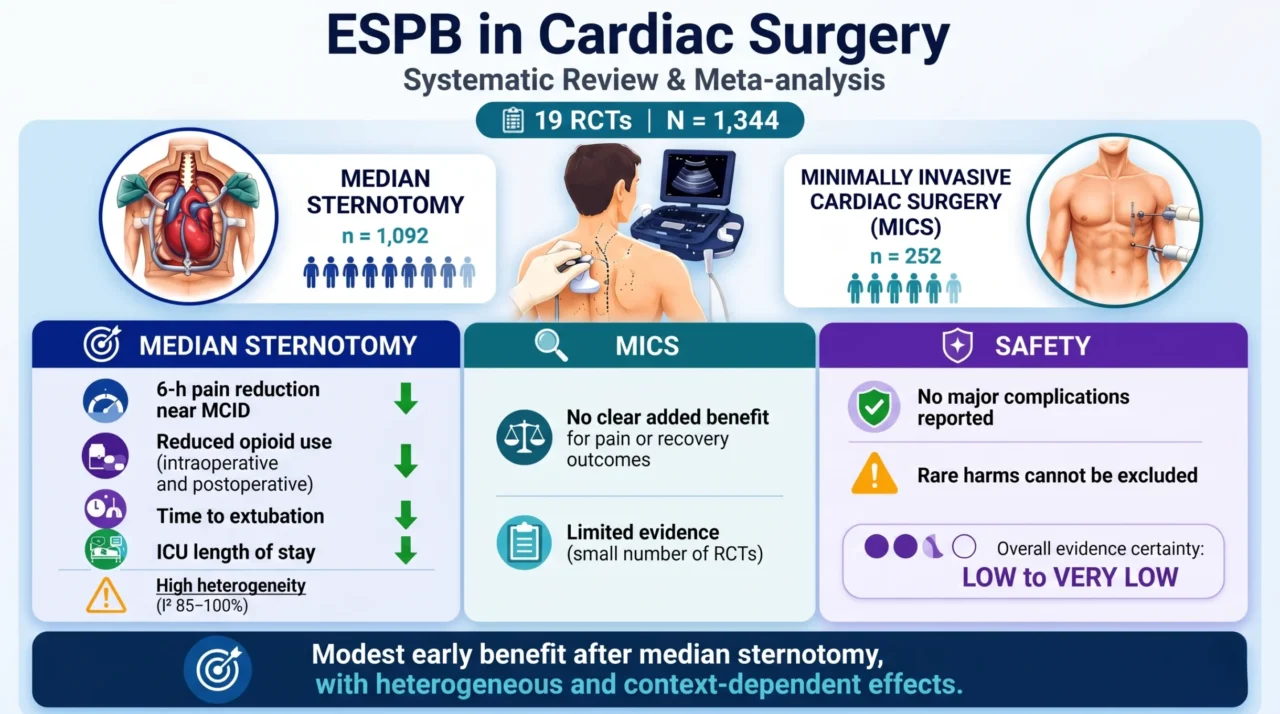
Diana Pérez Moreno: Analgesic Efficacy and Safety of Erector Spinae Plane Block After Sternotomy and MICS
Diana Pérez Moreno, Specialist in Pain Medicine, Palliative Care, and Interventional Pain Management at National Cancer Institute, shared a post on LinkedIn about a recent article she and her colleagues co-authored, published in Journal of Clinical Anesthesia, adding:
“To all our friends,
I would like to share our latest publication, which was published yesterday. It is a meta-analysis on the efficacy of the erector spinae plane (ESP) block in cardiac surgery, published in the Journal of Clinical Anesthesia.
In this article, our group has systematically evaluated and synthesized evidence supporting the use of the ESP block in cardiac surgery, drawing on multiple randomized controlled trials published over the last decade.
This October will mark the 10th anniversary of the ESP block since we first described the technique in Regional Anesthesia and Pain Medicine.
Today, that original publication has accumulated more than 3,000 citations and has generated over 2,000 publications indexed in PubMed alone.
Current medical evidence and guideline recommendations, including PROSPECT, now support the ESP block as a first-line analgesic technique for thoracic surgery (VATS) and laparoscopic cholecystectomy, and as an alternative option for thoracotomy and caesarean section.
Not to mention that it has become a first-line analgesic approach for rib fractures and spine surgery.
This publication, which took more than two years to complete, represents our team’s effort to clarify the true indications for the ESP block.
This work further supports the recommendations of several anesthesiology and cardiovascular surgery societies that now include the ESP block as an analgesic option in cardiac surgery, particularly when neuraxial techniques are contraindicated, such as in patients receiving anticoagulants.
This work was led by Diana Perez Moreno and Javier Andres Mora-Arteaga, experts in epidemiology and methodology from Bogotá, Colombia, and, of course, Maria Fernanda Contreras, a cardiovascular anesthesiologist who has performed hundreds of ESPBs in cardiac surgery in Colombia, providing outstanding clinical care to this patient population.
My deepest respect goes to Diana, the first author, whom I consider one of the leading figures in anesthesia and pain medicine research in Colombia. It has been a privilege to contribute to this important project.
Happy 10th anniversary to our ESP block.”
Title: Analgesic efficacy and safety of erector spinae plane block after sternotomy and minimally invasive cardiac surgery: A systematic review and Meta-analysis of randomized trials
Authors: Diana Perez-Moreno, Mauricio Forero, María Fernanda Contreras, Javier Andres Mora-Arteaga

Stay updated on all scientific advances with Hemostasis Today.
-
Sep 20, 2026, 13:29Factor XI Deficiency and the Challenge of Unpredictable Bleeding – EHC
-
Sep 20, 2026, 13:18Cindy Howry: FDA Approves First Treatment for Ataxia-Telangiectasia
-
Sep 20, 2026, 13:08Mohammad Salar Amoli: When Routine Coagulation Tests Miss von Willebrand Disease
-
Sep 20, 2026, 12:55Stelios Andreadis։ Human Salivary Gland Organoids Offer New Potential for Regenerative Medicine
-
Sep 20, 2026, 12:43Obi Light Ogbonnia: The Power of Lived Experience in Sickle Cell Care
-
Sep 20, 2026, 12:34Sabrine Mekni: Advancing HSCT for Children With Fanconi Anemia
-
Sep 20, 2026, 12:11Giacomo Buso: Silent Atherosclerosis Begins Earlier Than Expected
-
Sep 20, 2026, 12:0310 Posts Not to Miss This Week
-
Sep 20, 2026, 11:27Edward Lee Carter: Prasugrel Dosing Matters in P2Y12 Inhibitor Comparisons After PCI