


Ammar Alsughayir: Universal Access to Safe Blood – The 2026-2030 Action Framework
Ammar Alsughayir, Program Accreditation Surveyor at Saudi Commission for Health Specialties (SCFHS), shared a post on LinkedIn:
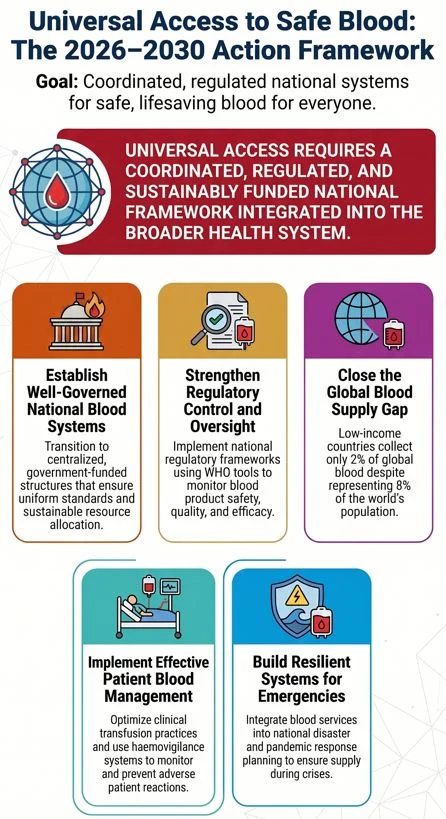
“The World Health Organization has just released its Action Framework for 2026–2030.
The goal?
Universal access to safe, effective, and quality-assured blood products as a core component of Universal Health Coverage (UHC).
To move from strategy to measurable country-level impact, the WHO has structured its new roadmap around 7 Strategic Pillars:
- Governance: Building appropriately structured, well-coordinated, and sustainably funded national blood systems integrated into broader health programs.
- Regulation: Enforcing national regulatory frameworks to oversee strict safety standards and product quality.
- Supply: Driving 100% voluntary, non-remunerated donations (VNRD) to keep blood products affordable and accessible.
- Clinical practice: Implementing Patient Blood Management (PBM) strategies to optimize transfusion use and protect patient outcomes.
- Surveillance: Establishing robust haemovigilance and pharmacovigilance systems backed by accurate, vein-to-vein data collection.
- Emergencies: Architecting preparedness and contingency plans to keep blood systems resilient during disasters and outbreaks.
- Partnership: Strengthening WHO leadership and international collaboration to tackle global health threats.
Action plan for healthcare leaders and policy makers
To turn this high-level framework into ground-level reality, healthcare systems should prioritize this 4-step execution plan:
- Audit and align: Evaluate your national blood system using the Blood System Self-Assessment (BSS) tool to identify gaps in coordination and regulation.
- Scale PBM: Fast-track the adoption of Patient Blood Management protocols in hospitals to reduce unnecessary transfusions and preserve critical supply.
- Invest in digital surveillance: Upgrade data collection infrastructure to support digital solutions and bidirectional traceability from donor to recipient.
- Mobilize community partnerships: Shift strategies toward sustainable, fully voluntary donor models to ensure a safe and stable blood supply.
I will seeon post, about how aligning Saudi Arabia national strategy with these WHO-recommended actions, in which Saudi Arabia can further enhance its blood system’s safety, efficiency, and role as a pillar and leader of global health equity and safety.
I encourage my network to reflect on the role each of us plays in shaping the future of healthcare.
Let’s foster dialogue that drives innovation and improves the quality of care for all.”
Stay updated with Hemostasis Today.
-
Sep 19, 2026, 14:17Abdul Mannan: What Exactly Is a Platelet?
-
Sep 19, 2026, 13:39Keisuke Goda: Decoding Platelet Phenotypes in COVID-19 With Optofluidic Imaging
-
Sep 19, 2026, 13:30Targeted Thrombolysis Beyond tPA
-
Sep 19, 2026, 13:21Paul Armstrong: From Summer Studentship to Young Researcher
-
Sep 19, 2026, 13:06Rabiya Masood: Breaking the Cycle of Thalassemia Through Screening
-
Sep 19, 2026, 10:52Consuela A. Albright: The Critical Role of Black Blood Donors in Sickle Cell Treatment
-
Sep 19, 2026, 10:47Amber Yates: Inside Agios’ Partnership with the Sickle Cell Community
-
Sep 19, 2026, 10:46Anton Farkas: Mechanical Thrombectomy for Acute PE in Early Pregnancy
-
Sep 19, 2026, 10:40Marjolein Smidt: ASH Raises Ferritin Thresholds for Iron Deficiency