


Abdul Mannan: Antiphospholipid Syndrome in Thrombotic Storm Mode
Abdul Mannan, Consultant Haematologist at Betsi Cadwaladr University Health Board, shared a post on LinkedIn:
“Most thrombosis cases give you time to think.
CAPS does not.
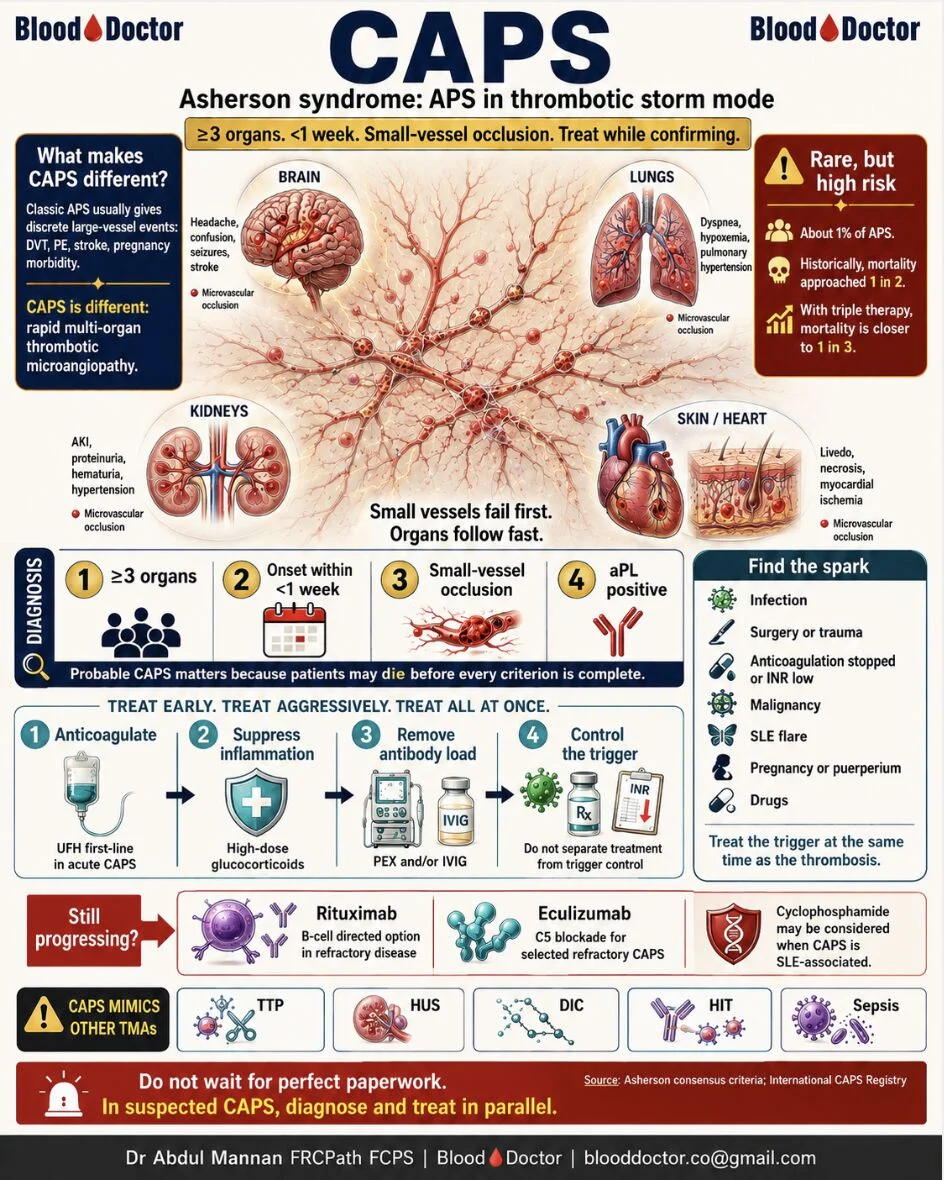
Catastrophic antiphospholipid syndrome, or Asherson syndrome, is what happens when APS stops behaving like a large-vessel event and turns into a thrombotic storm hitting three or more organs within days.
It accounts for roughly 1% of all APS cases.
Historically, nearly half of patients died. With current triple therapy, mortality has improved, but it still sits around 30%. Not a condition to misread.
Here is what makes it different from classic APS:
- Large-vessel events, DVT, PE, or stroke, are not the main feature
- Small-vessel microangiopathy drives the organ damage
- Brain, lungs, kidneys, and skin are all in the firing line simultaneously
Infection and anticoagulation interruption are the two most common triggers
Diagnosis follows the Asherson Consensus Criteria:
- Three or more organs involved
- Onset within a week
- Small-vessel occlusion on histology or imaging
- Positive aPL
But here is the clinical reality: patients can die before all four boxes are ticked. Probable CAPS is a real category.
Treat it as such.
The core treatment is triple therapy:
- Anticoagulation with unfractionated heparin.
- High-dose glucocorticoids.
- Plasma exchange and/or IVIG.
- The trigger, almost always infection or a lapse in anticoagulation, has to be treated at the same time, not after.
For refractory disease, rituximab and eculizumab have both been used.
Neither has RCT-level evidence, but the International CAPS Registry has documented their use in selected cases.
One more thing: CAPS mimics TTP, HUS, DIC, and HIT. Distinguish them early. The treatments are very different.
Do not wait for a complete diagnostic picture before starting treatment.
In CAPS, time is tissue.
Have you managed a case of CAPS, or encountered a mimic that slowed you down?”
Other posts featuring Abdul Mannan on Hemostasis Today.
-
Sep 26, 2026, 16:58Paul Whiteley: Iron Deficiency and Behavioral Problems in Children With Autism
-
Sep 26, 2026, 16:41Matthew Smeds: Management of Thoracic Endograft Thrombosis and Mesenteric Embolization
-
Sep 26, 2026, 16:04Isabelle Feldhaus: What the New ASH Iron Deficiency Guidance Means for Care
-
Sep 26, 2026, 15:55Francesca Palandri: The R-NAT Score Developed in Ruxolitinib-Treated MF Patients
-
Sep 26, 2026, 15:49Alex Ehsan: Antiphospholipid Syndrome – A Practical Guide
-
Sep 26, 2026, 15:42Michael Tadao Inouye: The Next Frontier in Genomic Population Health
-
Sep 26, 2026, 15:32Katariina Öörni: Familial Hypercholesterolaemia in Children Why Early Diagnosis Matters
-
Sep 26, 2026, 15:30P-Selectin as a Therapeutic Target in Thrombosis
-
Sep 26, 2026, 15:27Berkan Kurt: The Role of Biomarkers in Cardiovascular Prevention