


Andreas Calatzis: Can Fibrinolysis Sensitivity Be Claimed Without a Reference Standard
Andreas Calatzis, Managing Director of Eonis GmbH and Dynabyte GmbH, shared a post on LinkedIn, about a recent article by Todd W Allen et al., published in Blood Coagulation and Fibrinolysis, adding:
“100% vs. 0%? Really?
In a recent LinkedIn post by a viscoelastometry manufacturer the statements are
‘100% vs. 0%, seeing what your viscoelastometry test may be missing.’
‘A sub-analysis published in Blood Coagulation and Fibrinolysis reveals that the Quantra System identified hyperfibrinolysis in 100% of heparinized samples where other viscoelastic tests missed every case.’
‘This heightened sensitivity supports personalized coagulation strategies, ensuring surgical teams have the accurate, real-time data required to manage hyperfibrinolysis effectively during complex procedures.’
This post reminded me of ‘Beyond Belief: Fact or Fiction’, hosted by Jonathan Frakes, who would famously ask: ‘Did this really happen? Or is it pure imagination?’
Before reading on, I invite you to read the underlying paper (it’s open access) and decide for yourself.
What was actually done in the article was the following:
In a multicenter study, 125 patients undergoing liver transplantation were evaluated. The present paper is a sub-analysis focusing on 13 heparinized samples in which ROTEM delta and Quantra produced discordant results. In all 13 of these samples, Quantra indicated hyperfibrinolysis, whereas ROTEM EXTEM did not.
Based on these observations, the company concludes that Quantra detected 100% of cases, whereas ROTEM detected 0%, and therefore claims ‘heightened sensitivity.’
Without an independent reference standard, however, that conclusion cannot be supported.
The study demonstrates a difference in classification between two systems, but it does not establish which system is correct.
In the abstract the authors state:
‘Calibrated automated thrombinography revealed that Quantra reagents produce slower, reduced thrombin generation compared to ROTEM, diminishing thrombin activatable fibrinolysis inhibitor (TAFI) activity.’
Thrombin does activate TAFI, and in the absence of thrombomodulin this activation is relatively inefficient, which makes the mechanism plausible.
The second part of the statement (‘diminishing TAFI activity’) was not demonstrated in the study.
The sentence should therefore read: ‘which may diminish TAFI activity’.
The next statement similarly overstates the evidence:
‘This enhances sensitivity of Quantra to detect fibrinolysis in these samples.’
The study does not demonstrate enhanced sensitivity. It shows a mechanism that may explain the observed discordance.
A more appropriate wording would therefore be:
‘This may enhance the sensitivity of Quantra to detect fibrinolysis in these samples.’
Observing 13 discordant results, proposing a mechanism based on thrombin generation experiments, and then concluding ‘100% vs. 0% sensitivity’ goes well beyond what the data actually demonstrate.”
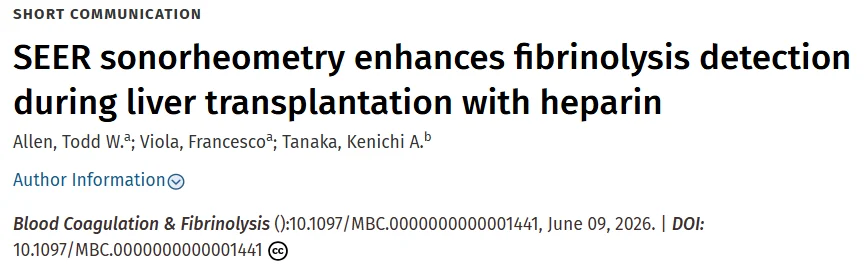
Title: SEER sonorheometry enhances fibrinolysis detection during liver transplantation with heparin
Authors: Todd W Allen, Francesco Viola, Kenichi A Tanaka
Stay updated on all scientific advances with Hemostasis Today.
-
Sep 29, 2026, 19:00Caitlin Raymond: Can Artificial Blood Solve Blood Supply Shortages?
-
Sep 29, 2026, 18:51Chaza Alaji: Dyslipidemia, Thrombosis and the DIC Diagnostic Trap
-
Sep 29, 2026, 17:31Rajnikant Patel: Bridging Ayurvedic Concepts and Modern Toxin-Mediated Disease
-
Sep 29, 2026, 17:13Nicholas Lang։ A Meaningful Case of Immune Thrombocytopenia
-
Sep 29, 2026, 16:55Ayatullah Gamal Wahab: When the CBC Lies
-
Sep 29, 2026, 16:35Jonathan Douxfils: Navigating the VTE Risk Continuum in Reproductive Medicine
-
Sep 29, 2026, 16:35Chaima Rajeh: Types of Anemia and Their Laboratory Features
-
Sep 29, 2026, 16:27Scott Isaacs: How GLP-1 RAs Target Systemic Inflammation to Drive Cardio, Autoimmune, and Gut Health
-
Sep 29, 2026, 16:21Yitshak Kreiss: From Treating Patients to Defining the Standard of Knowledge