


Abdul Mannan: Why Clotting Patients Bleed
Abdul Mannan, Consultant Haematologist at Betsi Cadwaladr University Health Board, shared a post on LinkedIn:
“A bleeding patient. An ugly clotting screen. The trolley arrives with plasma before anyone has asked one simple question.
We do this a lot. Often it does not help.
Bleeding in a patient who is also clotting comes in two forms, and they pull in opposite directions.
The empty tank. A big clot has burned through the platelets and fibrinogen. Fibrinogen is low, platelets are low, D-dimer is high. The tank is genuinely empty, so replacing fibrinogen and platelets works.
The leaky pipe. The vessel wall itself has failed. The lining cells pull apart, the protective glycocalyx layer sheds, and blood escapes through the gaps. Fibrinogen and platelets can be perfectly normal. This is not about anticoagulation, and plasma does not patch a wall.
Jecko Thachil put this plainly in JTH 2021.
Bleeding in these states is mostly an endothelial problem, not a missing-factors problem. A factor level of 15 to 20 percent is enough to stop bleeding, yet PT and APTT start to look abnormal at 50 to 60 percent. So the screen frightens us into treating the lab, not the patient.
The bedside rule fits on a sticker. Check fibrinogen and platelets. Low means top up the tank. Normal but still bleeding means a leaky pipe, so treat the cause and support the patient.
One honest line. This is strong physiology, not trial proof, and guidelines still allow plasma in active bleeding. Use it to think, case by case.
Next bleeding patient with a messy screen, what is your first move?”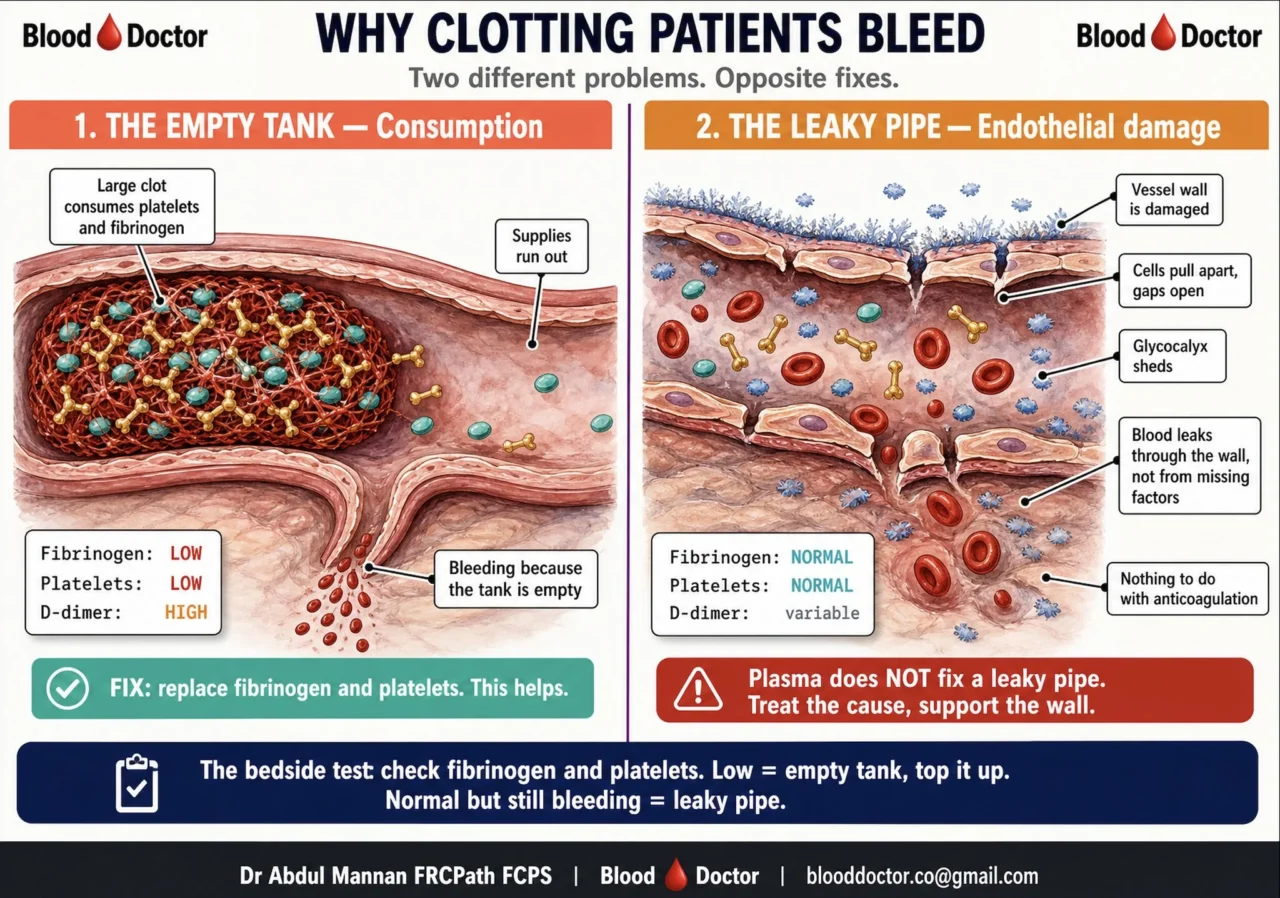
Find more posts featuring Abdul Mannan on Hemostasis Today.
-
Oct 2, 2026, 00:33Marwa Mostafa: Hemoglobinopathies – When Globin Genes Go Wrong
-
Oct 1, 2026, 23:46Behnood Bikdeli: Global Burden of Venous Thromboembolism
-
Oct 1, 2026, 23:46Sthanu Subramanian: Clinical Presentation, Risk Factors, Diagnosis, and Neuroimaging Findings in CVT
-
Oct 1, 2026, 23:45Martha Gulati: Oral MHT Is Associated With Increased Thrombotic Risk
-
Oct 1, 2026, 23:44Priya Sriskandarajah: HEMA-MED Trial Exploring Roginolisib Plus JAK Inhibitors in Myelofibrosis
-
Oct 1, 2026, 23:44Inge Vanhomwegen: Join Our Upcoming Webinar on D-dimer Testing
-
Oct 1, 2026, 23:43Bianca Rocca: Beyond API-CAT – Who Should Continue Anticoagulation, And for How Long?
-
Oct 1, 2026, 23:26Sara Gaafar Ibnauf Suliman: The Changing Role of Bariatric Surgery in the GLP-1 Era
-
Oct 1, 2026, 23:16Ahmed Reda: New Ferritin Cutoffs For Iron Deficiency – Ash 2026