


Shahzaib Akram: What Are We Actually Seeing When a Sickling Test Goes Positive?
Shahzaib Akram, Medical Laboratory Technologist at Allied Hospital, Faisalabad, shared on LinkedIn:
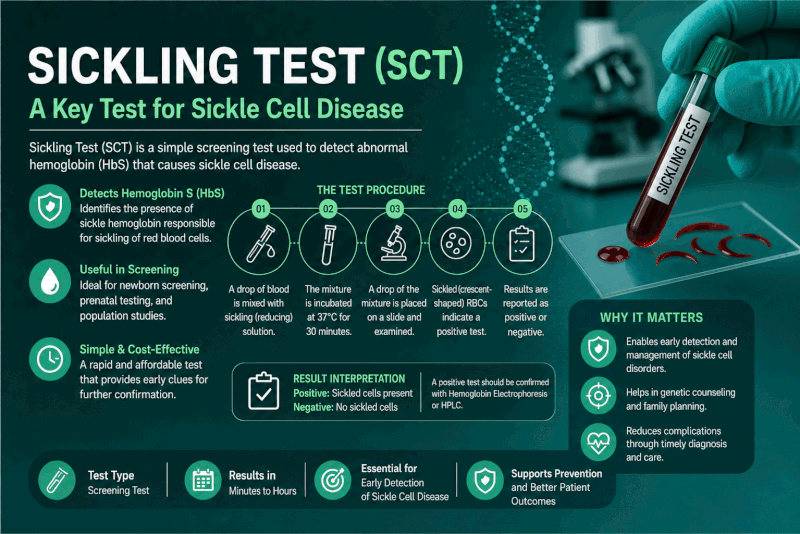
”What are we actually seeing when a Sickling Test goes positive?
As laboratory professionals, we perform qualitative tests daily.
But some of the simplest manual methods carry the most profound clinical weight.
Take the Sickling Test.
On paper, it relies on a straightforward mechanism: inducing hypoxia in a red blood cell sample to see if abnormal Hemoglobin S (HbS) polymerizes, distorting that smooth, flexible biconcave disc into a rigid crescent.
But when you look down the microscope and see those classic sickle shapes form, you aren’t just observing a chemical reaction.
You are looking at the exact microscopic pathology driving a medical emergency.
That rigid ‘logjam’ on the slide is the identical process that causes microvascular occlusion in a patient—starving tissues of oxygen, accelerating hemolysis (dropping an RBC’s lifespan from 120 days down to just 10–20 days), and triggering agonizing vaso-occlusive crises.
While advanced methods like HPLC and electrophoresis provide the final quantitative breakdown, the humble sickling test remains a vital frontline gateway for:
- Rapid Screening and Triage: Offering critical direction in acute care settings when time is of the essence.
- Kinetics Clues: Gauging sickling speed (rapid vs. prolonged) to offer immediate clinical hints distinguishing Sickle Cell Disease (HbSS) from Sickle Cell Trait (HbAS).
I’ve put together a comprehensive, deeply practical guide breaking down the exact physiology, diagnostic nuances, and clinical significance of the Sickling Test.
Whether you are a student mastering hematology or a tech looking for a solid diagnostic refresher, this resource is built for you.
Dive into the full clinical breakdown.
Let’s keep learning, practicing, and mastering lab science together.”
Stay updated with Hemostasis Today.
-
Oct 7, 2026, 16:44Amor Salah: 2026 NCS/SCCM Guidelines for Managing Antithrombotic-Associated ICH
-
Oct 7, 2026, 16:04NETs in Thrombosis: From Mechanism to Therapeutic Target
-
Oct 7, 2026, 15:28Amir Samimi: Prognostic Value of Platelet Count in Resected HNSCC
-
Oct 7, 2026, 15:21Eloïse Laouenan: Bridging Immunity and Thrombosis in MVTE
-
Oct 7, 2026, 15:10Uthra Sundaram: Honouring Donors During International Plasma Awareness Week
-
Oct 7, 2026, 15:04Daniel Victor Ortigoza: Should Frail Older Patients With AF Switch From VKA to DOACs?
-
Oct 7, 2026, 14:53Susan Noone: Donor Turned Recipient Shares Lifesaving Transfusion Story
-
Oct 7, 2026, 14:49Aimee Burtenshaw: The Impact of the Infected Blood Inquiry on Hospital Transfusion Laboratories
-
Oct 7, 2026, 14:41Vikash Jaiswal: Does Timing Matter for Calcium in Pre-Eclampsia Prevention?