


Nicolas Gendron: Should Carbon Footprint Influence Therapeutic Decisions?
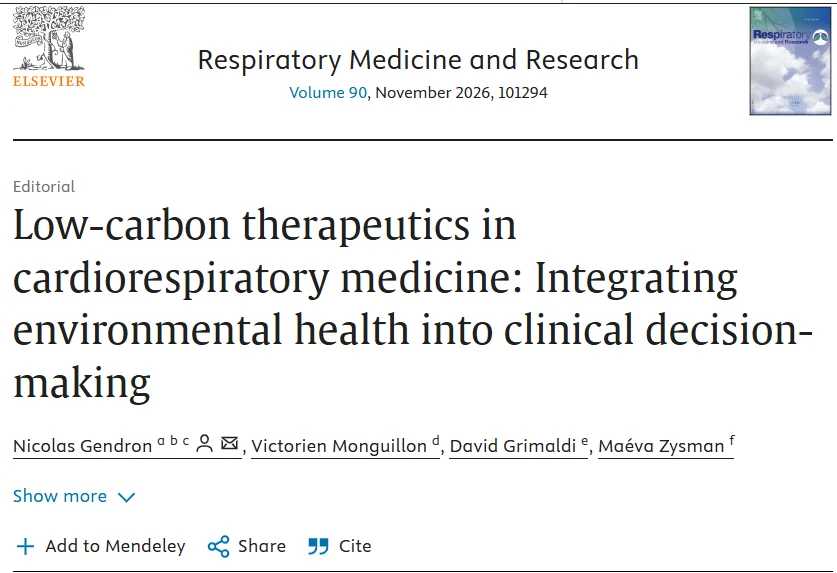
Nicolas Gendron, Research Fellow and Hematologist at Boston Children’s Hospital, shared a post on LinkedIn about a recent article he and his colleagues co-authored, published in Respiratory Medicine and Research, adding:
”Our editorial has just been published in Respiratory Medicine and Research:
The health 🇫🇷 system accounts for 8 percent of greenhouse gas emissions, of which nearly 40% are related to drugs and medical devices.
Once efficacy and safety are assured, the environmental impact of a treatment becomes a legitimate criterion for clinical decision-making, with therapeutic equivalence.
We illustrate this approach through 2 concrete examples, from recent work:
Oral anticoagulation, by comparing the carbon footprint of 3 direct oral anticoagulants (DOACs) from 2 life 🇪🇺 cycle analysis databases.
Dabigatran emerged as the most carbonaceous DOAC, with an annual footprint of about 124 kg CO2eq, compared to 34 to 37 kg for rivaroxaban and apixaban. This difference is mainly explained by its high daily dose (the active ingredient accounts for nearly 70 percent of its carbon footprint, compared to only 5 to 10 percent for the other two molecules). Another lesson is that reducing the dose of DOACs when clinically indicated reduces the carbon footprint by 5 to 36% over 10 years, depending on the molecule. Study previously published in Haematologica Journal with Laurence Chery Zahra Hassani Lise Durand Dorothee Boisseau Sebastien Taillemite Benjamin de Sainte Marie
Respiratory inhalers, with an analysis of 500 million devices dispensed 🇫🇷 over 10 years.
Pressurised metered-dose inhalers, which account for 44 percent of the total, generated 4.5 MtCO2eq, with a 38.7 percent increase in annual emissions, particularly marked since 2021.
These results argue for systematically integrating the environmental criterion into clinical recommendations when efficacy and safety are comparable.
It’s time to openly measure, document, and discuss the carbon footprint of our therapeutic practices.”
Title: Low-carbon therapeutics in cardiorespiratory medicine: Integrating environmental health into clinical decision-making
Authors: Nicolas Gendron, Victorien Monguillon, David Grimaldi, Maéva Zysman
Stay updated on all scientific advances with Hemostasis Today.
-
Oct 6, 2026, 16:43Beth Shirley: Xylitol Consumption Increases Platelet Reactivity and Cardiovascular Risk
-
Oct 6, 2026, 16:37Jared Rice: What Sets the Transfusion Threshold in Anemia of Prematurity?
-
Oct 6, 2026, 16:30Thirunavukkarasu Angappan: Immunoglobulin Decides How Much Plasma Gets Collected
-
Oct 6, 2026, 16:18Gemma Davies: New CMML Research Selected for Presentation at the 68th ASH Annual Meeting
-
Oct 6, 2026, 16:03Professor Csongor Kiss Receives the Kálmán Laki Prize – Hungarian Society of Thrombosis and Haemostasis
-
Oct 6, 2026, 15:52Mark Kheifets: A Massive Stent Thrombosis Requiring Aspiration Thrombectomy
-
Oct 6, 2026, 15:40Joseph Aslan։ Targeting Mitochondrial Permeability Transition To Reduce Platelet Thrombogenicity
-
Oct 6, 2026, 15:36Nominations Open for ISTH Outstanding Mentor Awards – ISTH
-
Oct 6, 2026, 15:17Walaa Obaid: How Warfarin Went From Poison To Medicine