


Abdul Mannan: Why Is HbS or HbD Approximately 40% in Heterozygotes Rather Than 50%?
Abdul Mannan, Consultant Haematologist at Betsi Cadwaladr University Health Board, shared a post on LinkedIn:
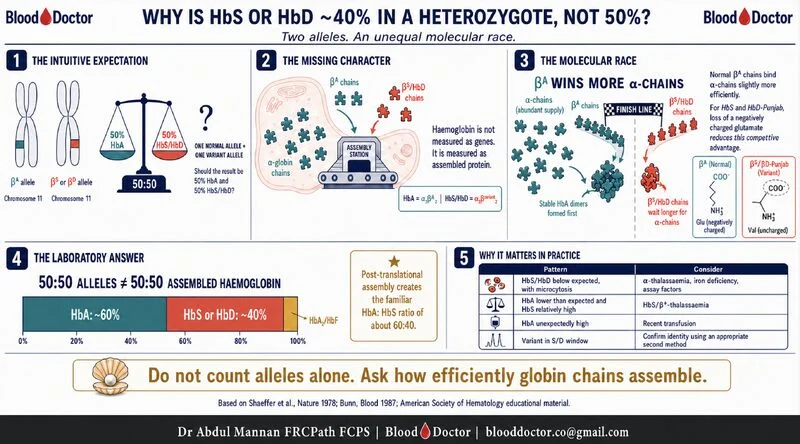
“Both β-globin alleles are switched on in sickle cell trait. So why is the result never 50:50?
Ask a trainee about HbAS and most will quote HbA around 60% and HbS around 40%. Correct.
But few can say why. If both alleles are transcribed equally, you would expect equal amounts of each haemoglobin.
You don’t.
The answer sits after translation, not before it.
Here is what is actually happening:
Both βA and βS chains are made in similar amounts.
They then compete for a limited pool of α chains during assembly.
βA wins.
HbS carries the Glu6Val change, swapping a negative charge for a neutral one, which weakens its affinity for α chains.More stable α2βA2 is assembled than α2βS2.
Hence the familiar 60:40.
This is a post-translational assembly effect, not unequal inheritance. Shaeffer showed that even with equal βA and βS supplied, more HbA formed when α chains were the bottleneck (Nature 1978).
A practical hook: co-inherited α-thalassaemia makes α chains scarcer and pushes the HbS fraction down further.
A high HbS with low HbA should make you think HbS and β+ thalassaemia instead. Recent transfusion lifts HbA.
Same logic explains HbA D-Punjab too.
What is the lowest HbS percentage you have seen reported as ‘trait’?”
Other posts featuring Abdul Mannan with Hemostasis Today.
-
Oct 20, 2026, 05:33Giulia Di Paolo: Connecting Plasma Donation to the Patients Who Depend on It
-
Oct 20, 2026, 05:20James Knowles: Exploring Plasma Manufacturing and Strengthening Industry Collaboration
-
Oct 20, 2026, 05:11Giuseppe Lippi։ Understanding Liver Test Abnormalities After AAV Gene Therapy
-
Oct 20, 2026, 05:02Sanam Loghavi: Test Your Hematology Knowledge at ASH 2026!
-
Oct 20, 2026, 04:13Ifeanyichukwu Ifechidere: DOACs Are Not the Answer to Every Anticoagulation Question
-
Oct 20, 2026, 04:04Sadia Kamal: Honored to Receive the Outstanding Abstract Award at the 20th Midwest Platelet Conference
-
Oct 20, 2026, 04:03Yu-Hsuan Chen: One Antibody, Two Diseases from FcRn Biology to Clinical Translation
-
Oct 20, 2026, 03:49Domenico Simone Castiello: Rethinking Prolonged DAPT in Multivessel PCI – Insights from the DAPT-MVD Trial
-
Oct 20, 2026, 03:37Rucha Patil: Scaling POC Diagnostics for Haemophilia A and VWD Across India