

Abdul Mannan: CHORUS Registry Reveals the Hidden Burden of Hereditary Hemorrhagic Telangiectasia
Abdul Mannan, Consultant Haematologist at Betsi Cadwaladr University Health Board, shared a post on LinkedIn about a recent article by Hanny Al-Samkari et al, published in Blood, adding:
”A 13-year-old starts getting nosebleeds.
She won’t be diagnosed with HHT for another 24 years.
By then, the damage is done.
1 in 5000 people have HHT.
Most won’t be diagnosed until their late 30s. By then, 3% will have already had a brain bleed.
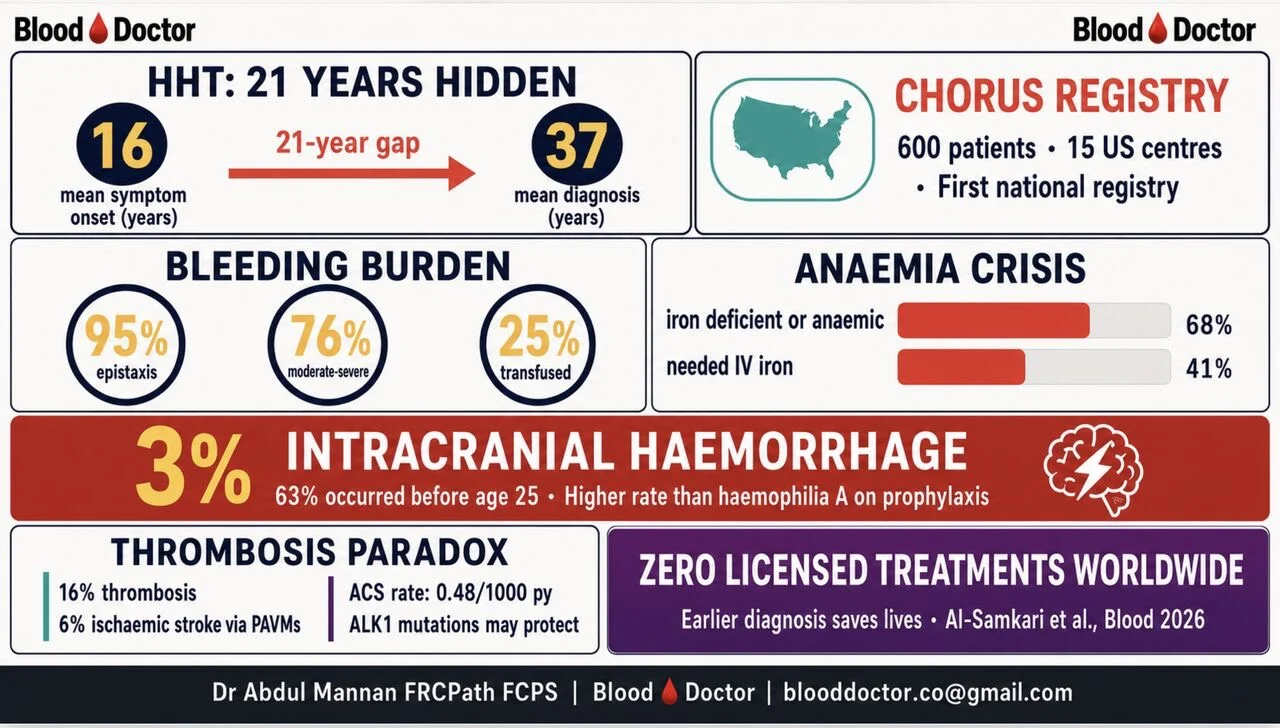
The CHORUS registry just gave us the first real numbers from 600 US patients across 15 centres.
They are sobering.
Here’s what stood out:
- 95% develop recurrent nosebleeds, usually by age 13. But the average age of diagnosis? 37. That’s over two decades of missed opportunity.
- 76% had moderate-to-severe mucosal bleeding. 25% needed red cell transfusions. 41% needed IV iron.
- Intracranial haemorrhage in 3% of patients. 63% of those bleeds happened before age 25. That rate is higher than modern haemophilia A on prophylaxis.
- Thrombosis in 16%. Ischaemic stroke in 6%, nearly all linked to paradoxical embolism through pulmonary AVMs. Yet acute coronary syndromes were strikingly rare, suggesting the ALK1/BMP pathway may protect against atherosclerosis.
- ‘HHT is the second most common inherited bleeding disorder on the planet. It still has zero licensed treatments.’
The message from CHORUS is clear:
HHT bleeds early, gets diagnosed late, and causes serious harm in between.
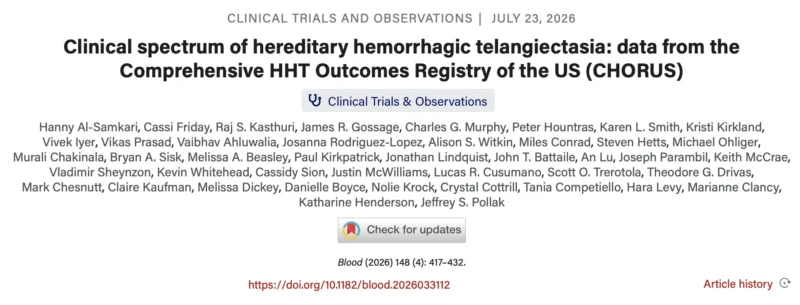
Al-Samkari H et al., ‘Clinical spectrum of hereditary hemorrhagic telangiectasia: data from the Comprehensive HHT Outcomes Registry of the US (CHORUS).’ Blood. 2026 Jul 23. PMID 41843464. DOI 10.1182/blood.2026033112.”
Title: Clinical spectrum of hereditary hemorrhagic telangiectasia: data from the Comprehensive HHT Outcomes Registry of the US (CHORUS)
Authors: Hanny Al-Samkari, Cassi Friday, Raj S. Kasthuri, James R. Gossage, Charles G. Murphy, Peter Hountras, Karen L. Smith, Kristi Kirkland, Vivek Iyer, Vikas Prasad, Vaibhav Ahluwalia, Josanna Rodriguez-Lopez, Alison S. Witkin, Miles Conrad, Steven Hetts, Michael Ohliger, Murali Chakinala, Bryan A. Sisk, Melissa A. Beasley, Paul Kirkpatrick, Jonathan Lindquist, John T. Battaile, An Lu, Joseph Parambil, Keith McCrae, Vladimir Sheynzon, Kevin Whitehead, Cassidy Sion, Justin McWilliams, Lucas R. Cusumano, Scott O. Trerotola, Theodore G. Drivas, Mark Chesnutt, Claire Kaufman, Melissa Dickey, Danielle Boyce, Nolie Krock, Crystal Cottrill, Tania Competiello, Hara Levy, Marianne Clancy, Katharine Henderson, Jeffrey S. Pollak
Stay updated on all scientific advances with Hemostasis Today.
-
Sep 20, 2026, 09:51Ceasovschih Alexandr: A Closer Look at Lipid Disorders in CKM Syndrome
-
Sep 20, 2026, 09:05World Stroke Academy: Can Adjunct IAT Improve Tissue Reperfusion?
-
Sep 20, 2026, 06:46Neeraj Songara: From Donated Blood to Engineered Therapeutics
-
Sep 20, 2026, 06:24Louise St. Germain Bannon: Improving Awareness and Care for Women Across the Lifespan
-
Sep 20, 2026, 05:17Maxime Dely: When ABO Compatibility Isn’t Enough for Safe Transfusion
-
Sep 20, 2026, 04:54William Aird: What Does a Complete History and Physical Really Mean?
-
Sep 20, 2026, 04:34Hons Saurabh Kaushik: Why Uncontrolled LDL Can Be Harmful
-
Sep 20, 2026, 03:58Salih Ehsan: The Complexities of HbF and HbA2
-
Sep 20, 2026, 03:22The Voices of People Living With Bleeding Disorders – EHC